


by Christine Condon, Maryland Matters
About $50 million worth of solar panels will appear on Maryland Department of Transportation parking lots and brownfields in coming years, paid for with money from a state renewable energy fund that has been in the news recently.
MDOT has inked a deal with the Maryland Energy Administration to tap the Strategic Energy Investment Fund for the project. It was already allocated by the General Assembly through last year’s budget process.
State officials are not ready to identify the 25 potential sites for solar just yet. That will be revealed in a request for bids from MDOT, expected before the end of this year.
While many associate MDOT with highways, the department’s holdings are vast and variable, from park-and-ride lots and transit stops to the Baltimore-Washington International Airport and the Maryland Cruise Terminal.
“They [solar installations] will be highly visible. And I think that that also is huge for changing hearts and minds,” said Evie Schwartz, assistant division director at the MEA. “I’m excited for a future when the public can see the solar panels and see what the state has done. That could also have some intangible part of convincing the world to go solar.”
The Strategic Energy Investment Fund is paid into by utility companies that can’t meet state requirements for purchasing a certain amount of renewable energy. In recent years, making the alternative payments has become cheaper in many cases than buying the renewable energy credits, causing the SEIF to balloon. That has made it a target for raiding in a time of budget deficits.
Gov. Wes Moore (D) wants to pull $292 million from the fund to help balance the state budget, a proposal that has drawn frustration from climate groups. But Moore also wants to send hundreds of millions from SEIF to climate- and energy-related programs, including a one-time electric bill refund that would average about $40 per household, and a program to finance solar energy projects to make up for the loss of federal tax credits.
In total, Moore is pulling about $725 million from the SEIF, which will still leave $164 million behind for its intended programming — lowering bills, bolstering clean power, reducing energy waste and more.
Recently appointed MEA director Kelly Speakes-Backman, a former Biden administration energy official, said the solar-fields project is “exactly what’s intended for the SEIF” — and it has added benefits. The panels will not only feed the grid, but the state will get a rebate on its electric bills for the life of the projects, Speakes-Backman said.
“Just like homeowners save on their electric bill when they have solar on their roofs, the state can save on what we need to pay for our energy bills by having it on state lands. That’s a really great thing,” she said.
There’s also hope that the panels could contribute to slowing the rapid rise of Marylanders’ energy bills, by increasing the energy supply feeding the grid. Projected demand from data centers has outpaced energy supply, wreaking havoc on power markets and raising customers’ bills in turn.
“My dream is that, as rates are coming down, people see that clean energy can be a part of the solution and is not part of the problem. I think that’s a misnomer that I’d really love to help the public understand,” Speakes-Backman said.
To acting MDOT Secretary Kathryn Thomson, the panels help show that the department, one of the largest landholders in the state, is “putting our money where our mouth is” when it comes to mitigating climate change.
“It’s an important concrete, visible commitment that we’re not just saying the words that addressing climate change is important, but we’re taking actions, visible actions, to do it ourselves,” she said.
The transportation sector is Maryland’s largest source of greenhouse gas emissions, largely because of gas-powered cars and trucks. The state is behind on its greenhouse gas commitments, in part because of a slower-than-hoped rollout of electric vehicles.
MDOT solar panels aren’t expected to come online for at least a few more years, said Anne Marie Esposito, the department’s renewable energy program manager. Installation typically takes a year to 18 months once solar companies get interconnection agreements with utilities, a process that is only just beginning, she said. And MDOT still has to put the project out for contractor bids.
Once they do start generating energy, the panels will account for about 20% of MDOT’s electricity use, Esposito said. And that’s a big number.
“Sometimes you don’t think about quite how much power a department of transportation uses, because you think: ‘Well, it’s just a road outside.’ But MDOT includes the airport and the transit authority … so things like track power and the airport terminal, that use tons and tons of power,” Esposito said.
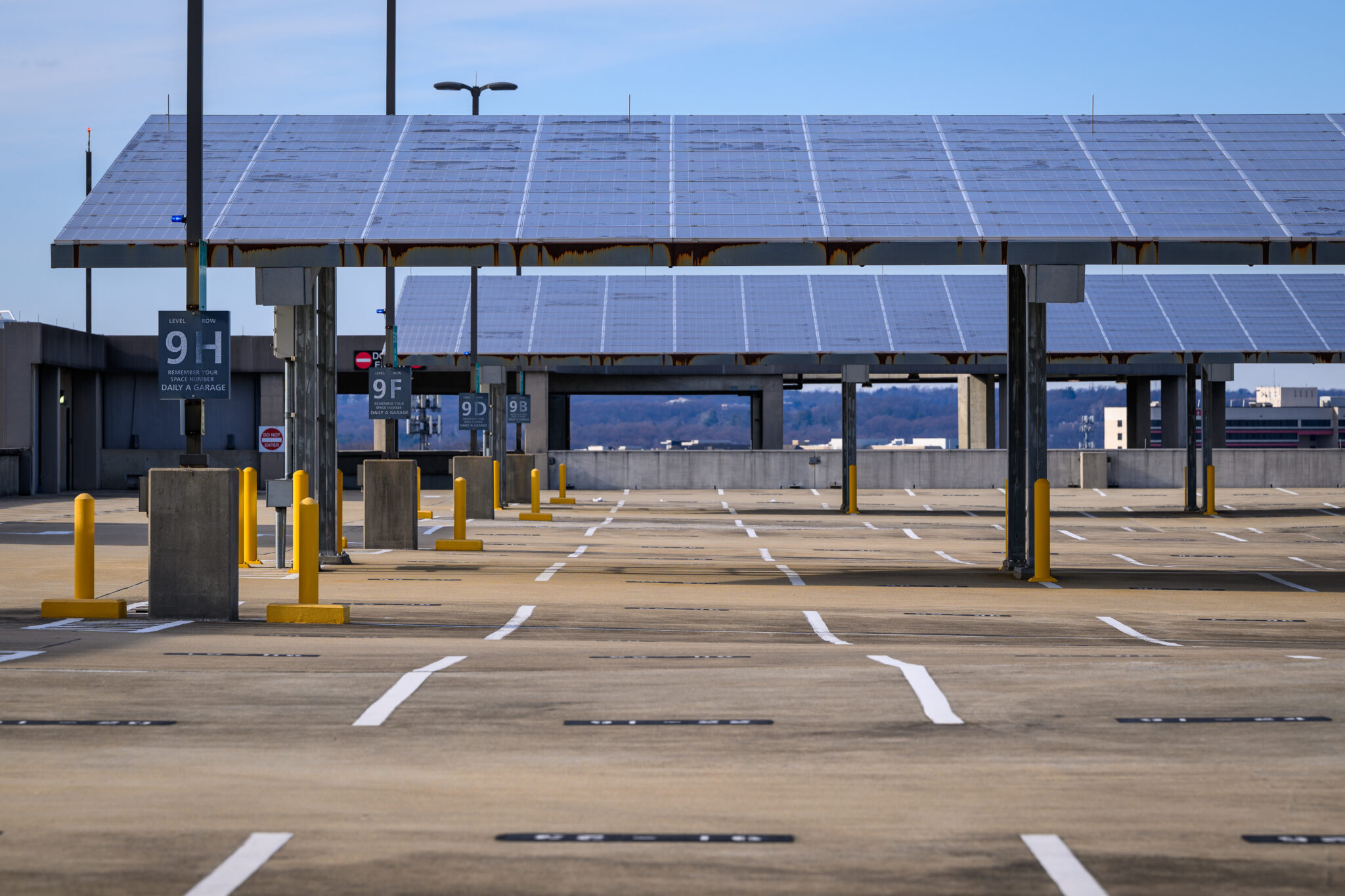
Some MDOT buildings already have panels, including the top of the short-term parking garage at BWI, where they also provide shade for parked cars, Esposito said. But this project covers much more territory — 115 acres, or more than three M&T Bank Stadiums put together, Schwartz said.
And the list of sites, which has been in the works for years, does not include any natural lands, Schwartz said, only developed areas like parking lots, and previously developed lands such as brownfields, which can include lands contaminated by a prior use.
The energy administration estimates that the panels will produce 35 megawatts of power, which MDOT estimates would power “roughly 120,000 homes across Maryland for a year,” Thomson said. In 2025, there were about 272 megawatts of solar installed in Maryland, according to data from the Solar Energy Industries Association.
It comes at a time when the state is behind on its solar goals. The state’s Renewable Energy Portfolio standard calls for 14.5% of the electricity used in Maryland to be solar by 2030.
“I wouldn’t put it in the context of, because we’re behind, we’re working on this. We’ve always been working on this. We’re just trying to be a little more vocal now,” Speakes-Backman said. “We’re acting with urgency because we know we have to work on costs, and we know part of that problem is we don’t have enough supply.”
Maryland Matters is part of States Newsroom, a nonprofit news network supported by grants and a coalition of donors as a 501c(3) public charity. Maryland Matters maintains editorial independence. Contact Editor Steve Crane for questions: [email protected].
Source link