

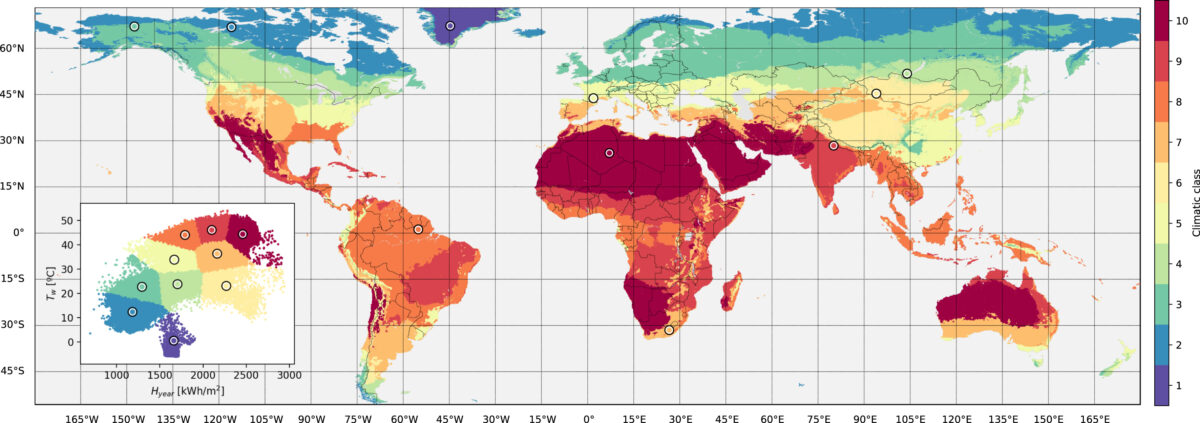
A research group from the European Commission Joint Research Centre has developed a new PV climatic classification, the first to address annual yield and performance ratio. Their work resulted in 10 globally applicable clusters. “It challenges the assumption that many more classes are needed to capture PV-relevant climate,” the researchers said.
A group from the European Commission Joint Research Centre (JRC) has proposed a new classification of climatic zones for PV systems. Unlike previous frameworks, the approach accounts for annual energy yield and performance ratio, making it directly relevant for simulations, forecasting, energy rating, and PV operations policy.
“This study presents the first PV climatic classification addressing annual yield and performance ratio, relevant for applications on PV resource allocation and energy rating. It offers a technology-agnostic solution at European and global scale,” Ana Martinez, Scientific Team Leader in the JRC’s Energy Efficiency and Renewables unit and corresponding author of the study, told pv magazine. “It also presents a novel solution based on a distribution-based classification, rather than summary statistics, encapsulating the time-dependent variability of PV energy yield, and providing insights into the potential for firm PV around the globe.”
According to Martinez, the team generated a globally applicable classification with only 10 clusters. “That is the best trade-off between granularity and interpretability. It challenges the assumption that many more classes are needed to capture PV-relevant climate diversity and strikes a good balance between the 6-class scheme of IEC 61853-4 and the 12-class scheme of the Köppen-Geiger PV classification,” Martinez added.
The classification development began with an extensive PVGIS simulation over all emerged land between latitudes of −60◦ and +75◦, with a time resolution of 1 hour and a spatial resolution of 0.1◦× 0.1◦. For Europe, they used a spatial resolution of 0.05◦× 0.05◦; the continent was subjected to a more detailed analysis in the paper. In both cases, 19 years of historical climatological data were used, spanning 2005-2023. Those simulations used equator-facing crystalline silicon PV ground-mounted modules, with tilt optimized for annual yield.
Given all those data points, the researchers wanted to identify climate variables that correlate strongly with the PV performance metrics PV array energy yield (YA) and module performance ratio (MPR), without relying on a specific module model. Based on their simulation, they found that annual irradiation (Hyear) shows strong correlations with YA. In contrast, the MPR was found to have a high correlation with a novel irradiation-weighted module temperature (TW) metric.
Moreover, the group developed a distribution-based approach to account for the growing importance of variability in PV generation. For that, they applied the theory of optimal transport to the distribution of daily irradiation, grouping locations with similar daily generation characteristics into ten clusters. “This method is better suited for applications where the variability of the generation, rather than annual averages, is the main feature of interest, such as firm power generation,” the group explained.
“We have observed that high-elevation regions and the hottest deserts share a similar, uniformly high daily-irradiation profile, leading them to be grouped,” Martinez said. “This is surprising because these two environments have very different temperature regimes and are traditionally treated as separate climatic zones.”
Concluding, Martinez added that the group decided to publish the data and models developed to allow other researchers to reproduce and also extend the analysis. “Proposed follow-up research could extend the classification framework to a wider range of PV setups (rooftop PV, vertical PV, single-axis tracking) and technologies (bifacial PV, perovskite/c-Si tandem), which will likely require the addition of new parameters such as the albedo. Likewise, it would be worthwhile including reliability considerations, such as degradation or failure rates,” she added.
The novel classification framework has appeared in “Parametric and distribution-based definition of climatic zones for photovoltaics,” published in Solar Energy. It was developed by researchers from JRC’s Ispra (VA), Italy, and the University of Göttingen, Germany.
This content is protected by copyright and may not be reused. If you want to cooperate with us and would like to reuse some of our content, please contact: editors@pv-magazine.com.
Popular content
Source link