

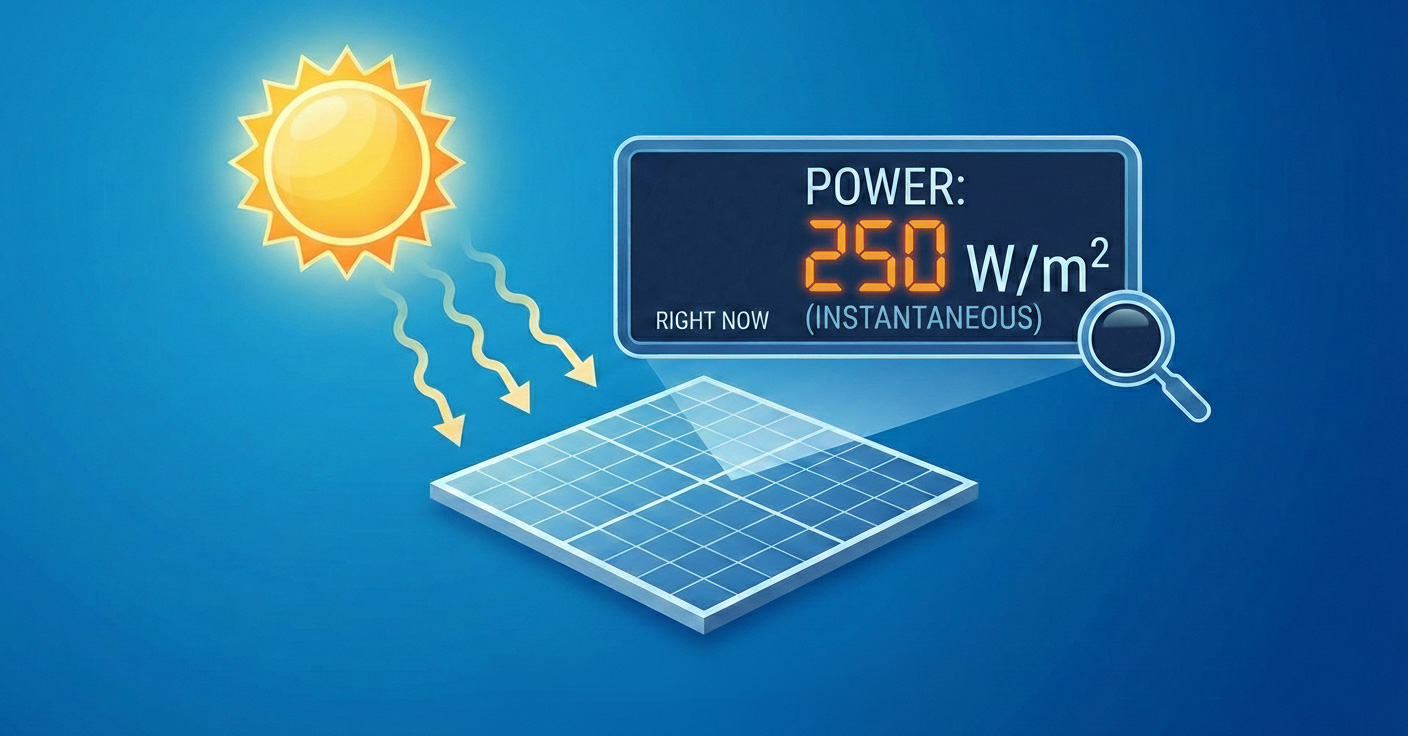
Getting the most out of solar starts with knowing your sun. With its intensity varying by location, time of day, and season, learning to measure and quantify available sunlight is the starting point for any good PV system design that aims to maximize energy production. In this article, we go over a few key concepts and measurements that will help you understand what drives PV system performance.
.fusion-body .fusion-builder-column-0{width:100% !important;margin-top : 0px;margin-bottom : 2em;}.fusion-builder-column-0 > .fusion-column-wrapper {padding-top : 0px !important;padding-right : 0px !important;margin-right : 1.92%;padding-bottom : 0px !important;padding-left : 0px !important;margin-left : 1.92%;}@media only screen and (max-width:1024px) {.fusion-body .fusion-builder-column-0{width:100% !important;order : 0;}.fusion-builder-column-0 > .fusion-column-wrapper {margin-right : 1.92%;margin-left : 1.92%;}}@media only screen and (max-width:640px) {.fusion-body .fusion-builder-column-0{width:100% !important;order : 0;}.fusion-builder-column-0 > .fusion-column-wrapper {margin-right : 1.92%;margin-left : 1.92%;}}
Solar Radiation
Solar radiation is the energy emitted by the sun, and not all of it reaches our earth’s surface. When incoming solar radiation strikes the top of the atmosphere, several things happen: it gets scattered by particulates, reflected from clouds, reflected by the Earth’s surface, and absorbed by the atmosphere, clouds, and ground. But whatever’s left is potential power that can be converted into a usable form of energy via a PV system. Enter the two fundamental concepts that are central to how the solar industry talks about solar and PV system production: power and energy.

.fusion-body .fusion-builder-nested-column-0{width:50% !important;margin-top : 0px;margin-bottom : 2em;}.fusion-builder-nested-column-0 > .fusion-column-wrapper {padding-top : 0px !important;padding-right : 0px !important;margin-right : 3.84%;padding-bottom : 0px !important;padding-left : 0px !important;margin-left : 3.84%;}@media only screen and (max-width:1024px) {.fusion-body .fusion-builder-nested-column-0{width:50% !important;order : 0;}.fusion-builder-nested-column-0 > .fusion-column-wrapper {margin-right : 3.84%;margin-left : 3.84%;}}@media only screen and (max-width:640px) {.fusion-body .fusion-builder-nested-column-0{width:100% !important;order : 0;}.fusion-builder-nested-column-0 > .fusion-column-wrapper {margin-right : 1.92%;margin-left : 1.92%;}}

.fusion-body .fusion-builder-nested-column-1{width:50% !important;margin-top : 0px;margin-bottom : 2em;}.fusion-builder-nested-column-1 > .fusion-column-wrapper {padding-top : 0px !important;padding-right : 0px !important;margin-right : 3.84%;padding-bottom : 0px !important;padding-left : 0px !important;margin-left : 3.84%;}@media only screen and (max-width:1024px) {.fusion-body .fusion-builder-nested-column-1{width:50% !important;order : 0;}.fusion-builder-nested-column-1 > .fusion-column-wrapper {margin-right : 3.84%;margin-left : 3.84%;}}@media only screen and (max-width:640px) {.fusion-body .fusion-builder-nested-column-1{width:100% !important;order : 0;}.fusion-builder-nested-column-1 > .fusion-column-wrapper {margin-right : 1.92%;margin-left : 1.92%;}}
.fusion-body .fusion-builder-column-1{width:100% !important;margin-top : 0px;margin-bottom : 1em;}.fusion-builder-column-1 > .fusion-column-wrapper {padding-top : 0px !important;padding-right : 0px !important;margin-right : 1.92%;padding-bottom : 0px !important;padding-left : 0px !important;margin-left : 1.92%;}@media only screen and (max-width:1024px) {.fusion-body .fusion-builder-column-1{width:100% !important;order : 0;}.fusion-builder-column-1 > .fusion-column-wrapper {margin-right : 1.92%;margin-left : 1.92%;}}@media only screen and (max-width:640px) {.fusion-body .fusion-builder-column-1{width:100% !important;order : 0;}.fusion-builder-column-1 > .fusion-column-wrapper {margin-right : 1.92%;margin-left : 1.92%;}}
 Peak Sun Hours
Peak sun hours provide one of the most practical ways to talk about solar energy at a specific location. The official unit of measurement here is kilowatt hours per square meter per day (kWh/m²/day).
Consider a typical unclouded day. On a chart plotting irradiance (W/m²) against time, you’d see a bell curve. The day starts dark, irradiance climbs as noon approaches, peaks, then decreases toward sunset until darkness returns. On an actual day with clouds rolling over, this smooth bell curve would have lots of peaks and valleys, dips and irregularities.
The solar industry uses 1000 W/m² as the established standard for “peak sun.” Some locations might not reach 1000 W/m² on a given day due to cloudiness, rain, or other regional factors yet other locations regularly exceed it. But 1000 W/m² still serves as the baseline measurement, providing a starting point for calculating what we’re getting from the sun as a resource.
Calculating Peak Sun Hours
Total solar insolation is the area under that daily irradiance curve, expressed in kilowatt hours per square meter or watt hours per square meter. The goal is to calculate that area and determine how many equivalent hours in a day a location receives 1000 W/m². Take that area under the curve in the image above and compress it into a rectangle at the 1000 W/m² level. The width of that rectangle represents the peak sun hours. A location might receive five and a half peak sun hours during a day, meaning that’s the equivalent number of hours that location receives 1000 W/m² of solar irradiance.
.fusion-body .fusion-builder-column-2{width:100% !important;margin-top : 0px;margin-bottom : 2em;}.fusion-builder-column-2 > .fusion-column-wrapper {padding-top : 0px !important;padding-right : 0px !important;margin-right : 1.92%;padding-bottom : 0px !important;padding-left : 0px !important;margin-left : 1.92%;}@media only screen and (max-width:1024px) {.fusion-body .fusion-builder-column-2{width:100% !important;order : 0;}.fusion-builder-column-2 > .fusion-column-wrapper {margin-right : 1.92%;margin-left : 1.92%;}}@media only screen and (max-width:640px) {.fusion-body .fusion-builder-column-2{width:100% !important;order : 0;}.fusion-builder-column-2 > .fusion-column-wrapper {margin-right : 1.92%;margin-left : 1.92%;}}
 Global Variations in Sunshine
World maps showing global horizontal irradiation reveal striking differences across the planet. Looking at daily totals, locations shown in blue receive around 2.2 peak sun hours per day. The orange zone represents approximately five peak sun hours per day. Locations in the pink range receive close to 7.4 peak sun hours per day, which is substantial.
These variations matter enormously for system design. Once you know how many peak sun hours or kilowatt hours per square meter a location receives, you can estimate how much energy a PV system in that location will produce over time. Our PVOL101 online course shows you how to apply peak sun hours from any location to real PV system sizing and design. This becomes critical when quantifying how much PV capacity you need to meet a specific requirement, such as offsetting some or all of your energy usage.
From Resource to Production
Of course, there are more steps needed before we can estimate production of a complete PV system: the size of the system, the orientation (which direction it faces), and other environmental factors influence how much electricity a system will ultimately produce from the available irradiance. But understanding the solar resource in your area is the first step in effective PV system design. Once you know how much solar energy a PV array will receive at a given location, you can calculate how much electricity it will produce. That production figure then allows you to offset actual demand and usage with solar-generated power.
The journey from understanding peak sun hours to designing an optimized system involves following the sun’s many paths across the sky, evaluating site conditions, and analyzing how different designs will perform. This foundational knowledge of the solar resource makes all of that possible.
.fusion-body .fusion-builder-column-3{width:100% !important;margin-top : 0px;margin-bottom : 2em;}.fusion-builder-column-3 > .fusion-column-wrapper {padding-top : 0px !important;padding-right : 0px !important;margin-right : 1.92%;padding-bottom : 0px !important;padding-left : 0px !important;margin-left : 1.92%;}@media only screen and (max-width:1024px) {.fusion-body .fusion-builder-column-3{width:100% !important;order : 0;}.fusion-builder-column-3 > .fusion-column-wrapper {margin-right : 1.92%;margin-left : 1.92%;}}@media only screen and (max-width:640px) {.fusion-body .fusion-builder-column-3{width:100% !important;order : 0;}.fusion-builder-column-3 > .fusion-column-wrapper {margin-right : 1.92%;margin-left : 1.92%;}}
.fusion-body .fusion-flex-container.fusion-builder-row-1{ padding-top : 0px;margin-top : 0px;padding-right : 30px;padding-bottom : 0px;margin-bottom : 0px;padding-left : 30px;}
.fusion-body .fusion-builder-column-4{width:80% !important;margin-top : 0px;margin-bottom : 2em;}.fusion-builder-column-4 > .fusion-column-wrapper {padding-top : 3em !important;padding-right : 5em !important;margin-right : 2.4%;padding-bottom : 3em !important;padding-left : 5em !important;margin-left : 2.4%;}@media only screen and (max-width:1024px) {.fusion-body .fusion-builder-column-4{width:80% !important;order : 0;}.fusion-builder-column-4 > .fusion-column-wrapper {margin-right : 2.4%;margin-left : 2.4%;}}@media only screen and (max-width:640px) {.fusion-body .fusion-builder-column-4{width:100% !important;order : 0;}.fusion-builder-column-4 > .fusion-column-wrapper {margin-right : 1.92%;margin-left : 1.92%;}}
.fusion-body .fusion-flex-container.fusion-builder-row-2{ padding-top : 0px;margin-top : 2em;padding-right : 30px;padding-bottom : 0px;margin-bottom : 0px;padding-left : 30px;}
Source link