

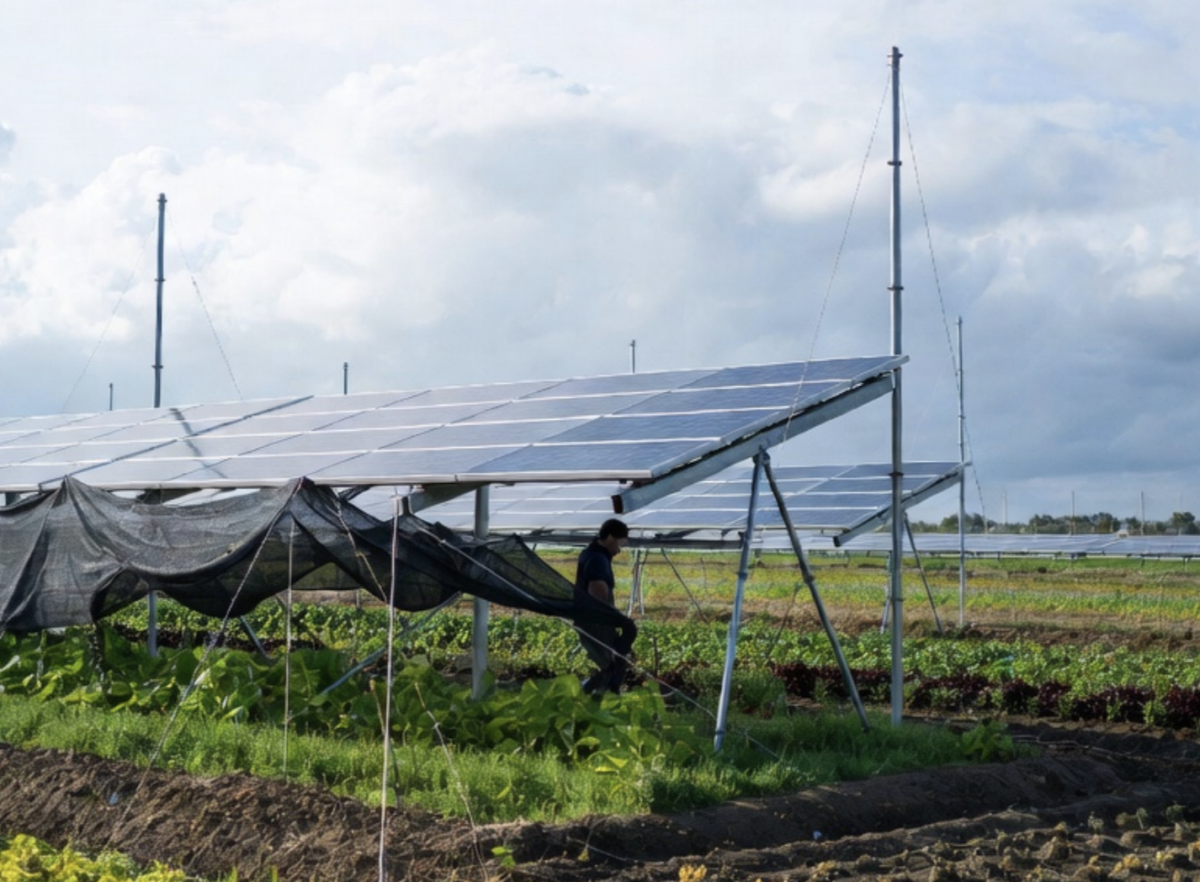
The Japanese government has defined new standards for agrivoltaics as regulators begin tightening oversight in response to nearly one-quarter of projects reporting reduced crop yields or sub-standard cultivation beneath solar panels.
Japan has started developing national benchmarks for agrivoltaics amid rising deployment and tighter regulatory scrutiny. By the end of fiscal 2023, the country had approved 6,137 agrivoltaic sites covering 1,361.6 hectares of farmland, according to the Ministry of Agriculture, Forestry and Fisheries (MAFF).
Agrivoltaics allows solar panels to be installed above farmland under temporary land conversion permits, generating electricity while maintaining agricultural production. To ensure these systems support both farming and rural development, MAFF convened a meeting of policymakers and industry experts in May 2025 to define “desirable” installations.
The government started to tighten rules in response to reports that 24% of projects had experienced farming problems in fiscal 2023, up from 22% the previous year. In most cases, issues were linked to poor management or cultivation practices rather than external factors.
Under the newly revised regulations, developers must submit cultivation plans, financial projections, equipment designs, and evidence that crops can grow beneath panels. Annual production and financial reports are also now required.
The authorities will be able to deny approval if crop yields drop by 20% or more, if agricultural activity is neglected, or if panel height and spacing prevent machinery use. Violations may be publicly disclosed, and site inspections will be conducted, according to MAFF.
The government has also suspended renewable energy subsidies for non-compliant projects. Following amendments to the renewable energy support law in April 2024, feed-in tariff (FIT) and feed-in premium (FIP) payments could potentially be halted.
Official MAFF figures show that FIT/FIP payments were suspended for 15 installations across six operators in August 2024 and 14 installations across seven operators in November 2024. The violations included failing to maintain farming under panels or operating after land conversion permits expired.
MAFF’s expert committee is now considering technical benchmarks for project evaluation. Draft proposals include shading ratios below 30%, panel heights of roughly 3 meters, and support pillar spacing of 4 meters to 5 meters to accommodate farm machinery.
Statistics from MAFF indicate that ornamental plants are the most common crops beneath agrivoltaics, accounting for 36% of sites, followed by vegetables at 28% and fruit at 13%. However, the authorities tend to emphasize producing food crops where feasible in order to support food security.
Japan’s Food, Agriculture and Rural Areas Basic Plan encourages agrivoltaics that enhance farm income and strengthen rural energy systems, noting that solar feed-in tariffs have declined to roughly JPY 10 ($0.06)/kWh, reducing reliance on subsidies.
Previous research in Japan has shown that agrivoltaic systems on rice paddies involve trade‑offs between crop yields and energy output. A recently concluded agrivoltaics field trial, for example, showed that rice yields tend to fall under solar panels, while combined returns remain far higher when electricity generation is included.
Separately, researchers at the University of Tokyo have identified technical pathways to improve solar-agricultural outcomes, noting that advanced designs such as dual‑axis tracking can adjust panel angles seasonally to better balance sunlight for crops and power production.
A growing number of Japanese companies, such as Idemitsu Kosan, are also now advancing commercial agrivoltaic projects, integrating such systems into broader renewable energy and farm income strategies.
This content is protected by copyright and may not be reused. If you want to cooperate with us and would like to reuse some of our content, please contact: editors@pv-magazine.com.
Popular content

Source link