

Spain and Portugal are 53% less exposed to gas price volatility than they were three years ago, according to a new report from Positive Money.
From pv magazine Spain
The report Towards Cheaper Electricity, produced by Positive Money, examines how the energy transition is reshaping electricity prices across Europe, with a particular focus on the role of renewable energy in reducing dependence on gas and limiting exposure to volatile energy markets.
According to the study, the European Union remains heavily reliant on imported fossil fuels, leaving it vulnerable to price shocks and geopolitical instability. Recent crises, including the fallout from the war in Ukraine and tensions in the Middle East, have exposed this weakness, driving sharp increases in gas and electricity prices while also fueling inflation and undermining industrial competitiveness.
The report notes that European electricity prices have climbed well above those in other major economies, including the United States, particularly for energy-intensive industries.
While natural gas prices still exert significant influence over electricity markets, their role in price formation has weakened in several countries in recent years. Spain is highlighted as a key example. In 2018, wholesale electricity prices closely tracked gas prices, but by 2025 that correlation had weakened considerably, with wholesale prices frequently falling below levels implied by gas costs. The report attributes this shift to the rapid expansion of renewable generation. By contrast, Italy continues to rely heavily on gas, which remains the dominant benchmark for wholesale electricity pricing.
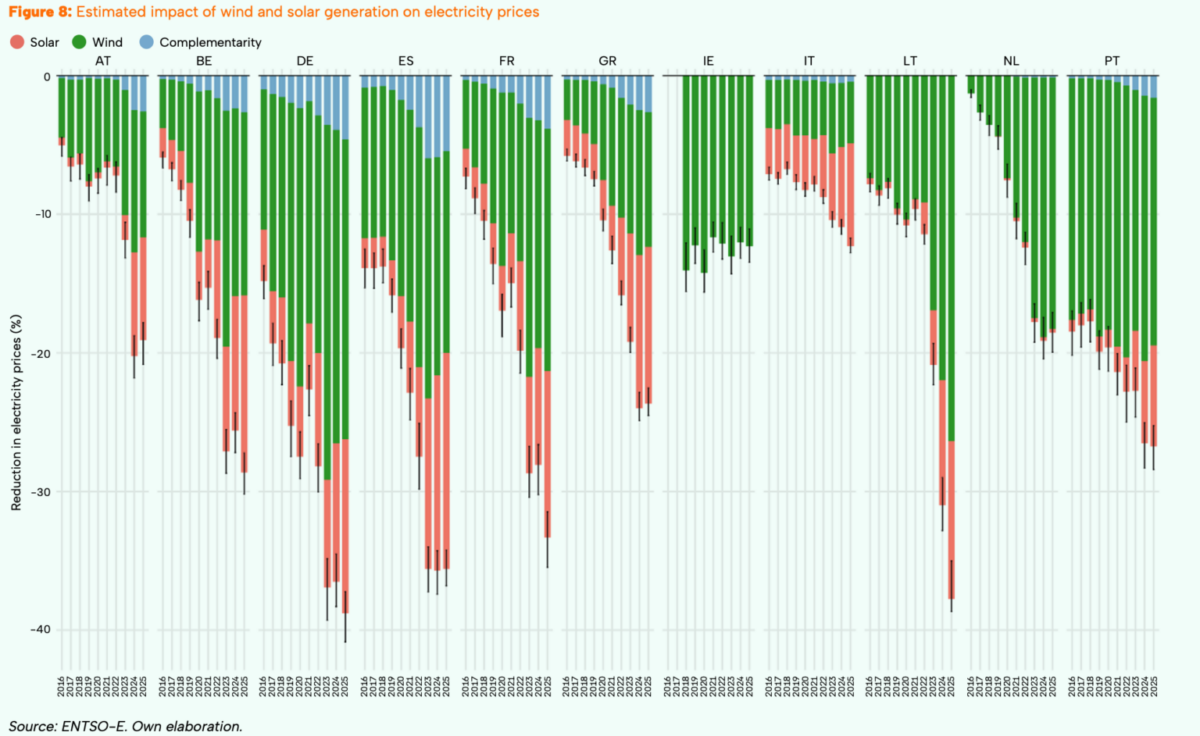
Overall, the study estimates that between 2023 and 2025, the expansion of renewable energy capacity reduced wholesale electricity prices by an average of 24.2% across the countries analyzed, although the impact varied significantly between markets. Spain and Portugal, for example, are now 53% less exposed to gas price fluctuations than they were three years ago.
The report identifies two main mechanisms through which renewables lower electricity prices. First, renewable generation displaces more expensive fossil fuel plants within Europe’s marginal pricing system, reducing the cost of the marginal unit that sets the market price. Second, when renewable output covers a sufficiently large share of demand, renewables themselves can set the market price because of their near-zero variable costs. According to the study, this effect becomes stronger as renewable penetration increases, particularly in systems with lower dependence on gas or with large shares of low-cost technologies such as nuclear and hydropower.
However, the report stresses that gas still plays a central role in Europe’s electricity pricing mechanism, even in countries where gas accounts for a relatively small share of power generation. The decoupling of electricity and gas prices therefore remains incomplete across many European markets, partly because of the high level of interconnection between national power systems.
The authors also argue that large-scale renewable deployment must be accompanied by greater system flexibility. Spain is identified as one of the markets experiencing the widest intraday price swings as renewable penetration rises, creating favorable conditions for battery storage and other flexibility technologies. Extremely low midday prices combined with higher evening peak prices are generating increasingly strong economic incentives for investment in energy storage, the report concludes.
This content is protected by copyright and may not be reused. If you want to cooperate with us and would like to reuse some of our content, please contact: editors@pv-magazine.com.
Popular content

Source link