

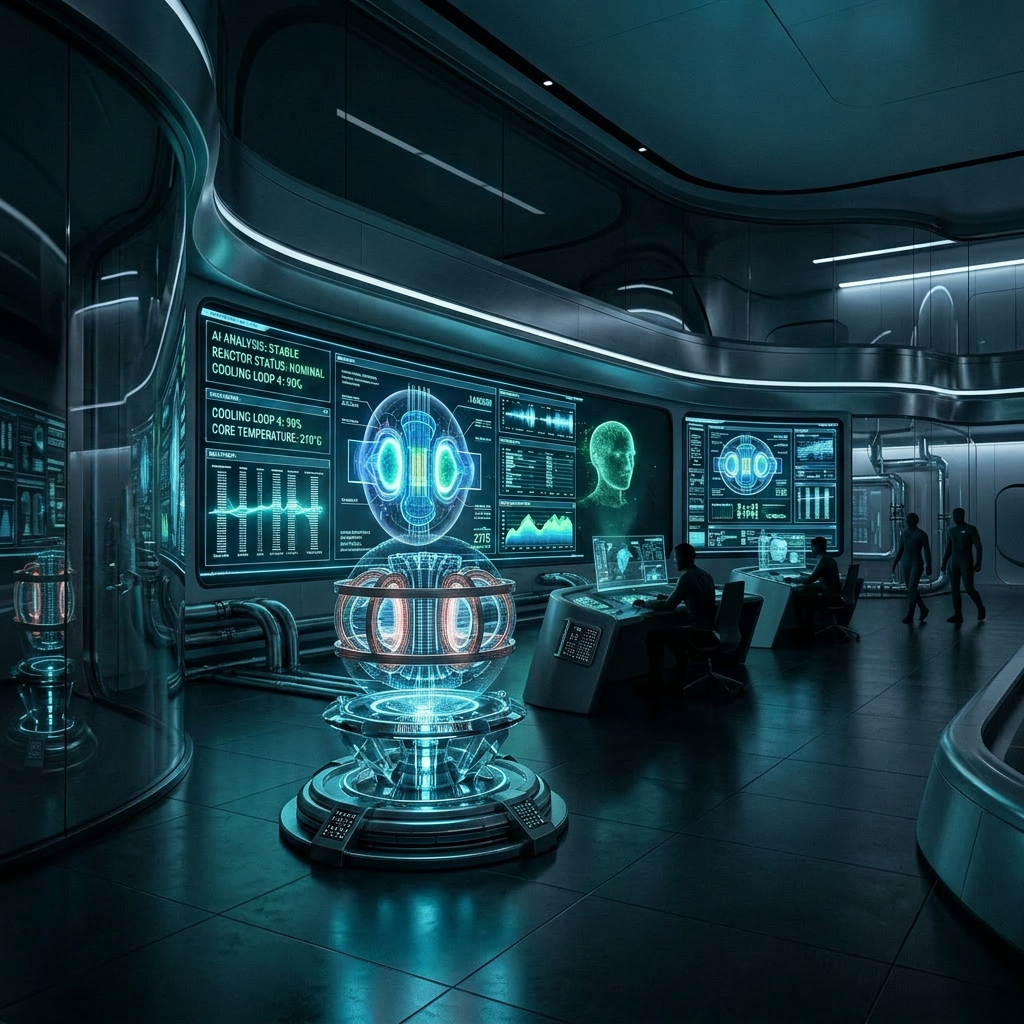

Researchers at Texas A&M University have developed an AI-enabled monitoring framework, AROMA-GPT (Advanced Reactor Operation and Monitoring Assistant), that combines generative pre-trained transformers with physics-informed digital twins to enhance situational awareness in advanced nuclear reactors.
The system is architected around a human-in-the-loop paradigm, where large language models are integrated with domain-specific knowledge bases, reactor physics models, and real-time simulation environments. The digital twin serves as a high-fidelity, continuously updated virtual representation of reactor states, enabling dynamic analysis of system behavior under varying operational conditions.
AROMA-GPT functions as a supervisory decision-support layer, capable of contextualizing sensor data, retrieving relevant engineering knowledge, and generating actionable insights for operators. Its outputs are constrained by physics-based models and validated reactor behavior, addressing key challenges associated with deploying AI in safety-critical environments—namely reliability, interpretability, and operational trust.
A key technical contribution lies in the modular architecture: the framework decouples the AI layer from reactor-specific implementations, allowing adaptability across different reactor designs and computational models. This model-agnostic approach facilitates integration with existing simulation codes, control systems, and training platforms.
Beyond nuclear applications, the convergence of generative AI and digital twin technology represents a scalable paradigm for complex energy systems. Similar architectures are being explored for grid management, predictive diagnostics, and performance optimization across low-carbon infrastructure.
As clean energy systems become increasingly data-intensive and distributed, hybrid AI-physics frameworks like AROMA-GPT could redefine real-time monitoring and control strategies across the energy sector.
Related
Discover more from SolarQuarter
Subscribe to get the latest posts sent to your email.
Source link