

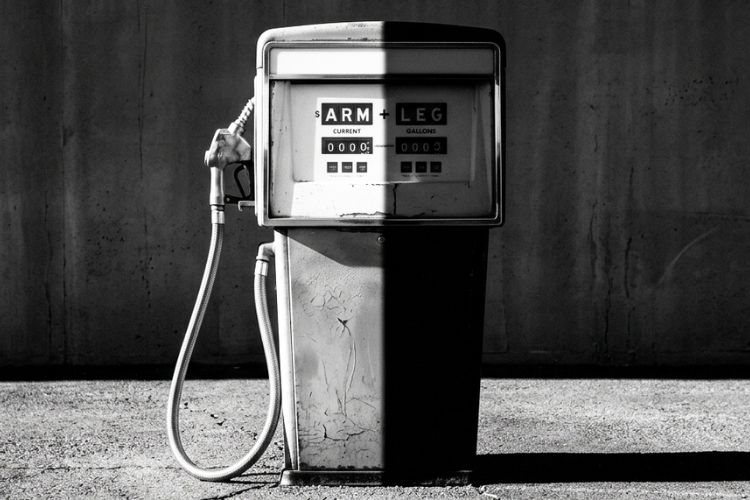

The Gas Buddy is beside himself right now.
“Who the hell is the Gas Buddy?” pipes my wife from the other side of the garage as we scramble to get our daughter to daycare.
“Patrick De Haan is the Gas Buddy. He’s on Twitter,” I reply in sweet and affectionate tone, as always. “He tracks gas prices everywhere and talks about them on TV- the locals up to the networks. It’s, like, his business.”
Wholesale gasoline prices in the Midwest skyrocketed last week, rattling the cage of the typically unflappable digester of diesel data, De Haan. Retailers were forced to respond in a hurry, adding quarters to their prices faster than an ’80s kid could pump them into a Pac-Man machine. Week-over-week averages went up by a staggering $1.09 per gallon in Indiana, 94¢/gal in Ohio, and 88¢/gal in Michigan. With the national average price of gasoline sitting at a robust $4.42/gal, Friday was the most expensive day to fill up since the summer of 2022.
If you aren’t longing for the halcyon days of Harry Styles topping the charts, you’re far from alone. Refinery issues exacerbated by the ongoing war in Iran indicate we’ll likely be paying more at the pump before we return to the, say, Drake vibes of 2018 and $2.75/gallon. And the Gas Buddy is beside himself.
Speaking of gas and pipelines, have you noticed how different PJM’s new Cycle 1 queue looks compared to when it shut the interconnection process down in 2022? Natural gas is the predominant generation technology currently waiting to connect to the grid, whereas four years ago, nearly two-thirds of the PJM queue was renewables. There are still nearly as many solar projects (142) in Cycle 1 as gas (157), but the natural gas projects account for four-and-a-half times as much capacity (105,797 MW) as solar and solar/storage combined (23,671 MW). There are some obvious scientific reasons for that, but it also shows plenty of clean energy projects withdrew from the queue, and PJM admits as much.
Despite persistent permitting problems, federal futzing with financial incentives, and cost challenges, solar and storage remain the fastest-to-deploy and most cost-effective generation solutions available. We’re starting to see more large load customers catch on. Seems like no matter how you slice it, and no matter what sort of gas you’re talking about, clean energy is our ticket out of this worsening affordability crisis.
Welcome to the Factor This Brief, a weekly collection of power project finance and development updates, delivered straight to your inbox on Monday mornings and hosted in a not-so-brief fashion here on Factor This, featuring the people, projects, and technology driving our electric future.
Thanks for checking it out. If you like what you see or want to recommend a story for next week, drop me a line. In case you missed them, you can scope our last couple of editions here and here. Until next time, may your milk stay cold and your cereal extra crunchy. Be good, people.
Twice as Much Squeeze?
The Orange County Convention Center (OCCC) is more than doubling its homemade solar energy production while maintaining the same rooftop footprint. Talk about getting more for the squeeze!
SolarEdge Technologies and Advanced Green Technologies have completed one of Florida’s largest rooftop solar installations at the OCCC, celebrated at the Great Solar Celebration event on-site on April 24.
The 2.2 megawatt (MW) DC system is powered by SolarEdge inverters with power optimizers and was installed across multiple roof zones using Hanwha Q CELLS modules. It utilizes an innovative combiner box configuration engineered with SolarEdge to efficiently transmit energy across a 700 to 800-foot rooftop. The commercial roofing work, completed by Advanced Roofing, was a critical part of the coordination effort required to execute a project of this scale within an occupied, fully operational building.
The installation supports the Convention Center’s LEED Gold certification and long-term sustainability strategy while helping power daily operations for one of the largest convention facilities in North America, which attracts 2.4 million attendees annually.


“When we started in the solar business nearly 20 years ago, the original installation was something of a holy grail at that time — a project we all looked up to. To come in all these years later, tear it out, and reinstall something over double its original capacity was a full-circle moment for us,” shared Clinton Sockman, executive vice president at Advanced Green Technologies. “To now deliver one of the largest rooftop solar projects in Florida, while working around a packed event calendar, is a true milestone for commercial solar in our state.”
Rather than sending thousands of still-functional modules to a landfill, the OCC chose to give them a second life. In February of last year, it partnered with the Orlando-based environmental nonprofit IDEAS For Us to launch The Great Solar Giveaway, redistributing 5,800 decommissioned solar panels to more than 120 Florida residents, businesses, and nonprofit organizations.
“Upgrading our rooftop solar array was never just about improving the facility. It was about giving back to the community, reducing our environmental footprint, and continuing to lead by example,” said Mark Tester, OCCC executive director. “We’re proud to demonstrate how large-scale public venues can operate responsibly while delivering meaningful impact to the people they serve.”
SunPower Sunsets Debt
Residential solar stalwart SunPower, long since back from the dead, announced this week that it had closed a private placement of $41 million in senior, convertible debenture notes with a 10% coupon. The proceeds will provide liquidity and debt reduction by paying off $28.75 million of existing debt.
In addition, certain investors in SunPower’s prior 7.0% convertible notes have agreed to exchange $21.25 million of the principal in those notes for equity in the company, bringing the company’s total debt reduction to $40 million.
Finally, Sunder, SunPower’s recently acquired solar sales company, has swapped $10 million in acquisition debt for notes in the new offering.
SunPower’s sole Financial Advisor and Placement Agent was Santander, and Arnold & Porter served as legal counsel on this convertible note transaction.
SunPower CEO T.J. Rodgers says the cash plan for this offering will carry his company through 2026 into a positive cash flow period in 2027 and beyond.
“It was key in convincing investors to support our new offering in the very week that Freedom Forever, the fast-growing No. 2 U.S. residential solar company, declared Chapter 11 bankruptcy, adding to solar market uncertainty,” Rodgers added. “Based on prior acquisitions, SunPower has moved to the No. 5 spot in residential solar in the U.S., with No. 3 in sight. As a second benefit of troubled times, we have also signed about 600 sales representatives coming from Freedom Forever and two other recently distressed companies. We thank our investors for supporting our opportunity to grow.”
SunPower will release its Q1 2026 results on Tuesday, May 12, prior to market opening. A conference call to discuss the results and provide an update on the company will be held on the same day at 1:00 pm ET. Interested parties may access the webcast here.
Slinging Iron in Texas
Global renewable energy developer and operator Energea has started construction on Iron Spur Solar, a 140 MW DC solar power project in Snyder, Texas, for which Energea has provided financing.
Strategically located in West Texas, an established and liquid utility-scale solar market, the ground-mounted, single-axis tracked facility is expected to generate approximately 317 gigawatt-hours (GWh) of electricity annually once fully operational in early 2029. The project is supported by a 35-year land lease and a de-risked interconnection strategy that avoids costly substation upgrades. Iron Spur has secured an exclusivity agreement with an “investment-grade corporate energy user” for a long-term Power Purchase Agreement (PPA).

Energea will provide up to $5 million of secured convertible financing for the Iron Spur project. An initial $762,000 initial investment was made through its Solar in the USA Portfolio. The financing is Energea’s first for an industrial-scale solar project in the U.S., utilizing an innovative convertible loan structure that generates immediate income while maintaining a clear path to majority project ownership.
“Iron Spur is a strategic evolution for our Solar in the USA portfolio, adding utility-scale exposure and immediate cash generation during the traditionally non-income-producing construction phase,” explained Mike Silvestrini, co-founder and managing partner at Energea. “We see excellent investment opportunities in industrial-scale solar and anticipate expanding further beyond distributed generation projects… The Iron Spur Project speaks to our focus on risk-adjusted returns, providing secured debt protection today while preserving the optionality to convert to majority equity ownership as the project reaches key milestones.”
Rather than acquiring the project outright, Energea is providing development capital through a secured, convertible loan to the project’s special purpose entity, CT Solar One, LLC. The structure features monthly cash interest payments (providing immediate income), a five-year maturity on each loan advance, and a first-priority security interest in 100% of the project’s equity.
Iron Spur is eligible for the 30% federal Investment Tax Credit (ITC) with potential domestic content upside, and benefits from a structured engineering, procurement, and construction (EPC) procurement process aligned with ERCOT utility-scale benchmarks. It is being developed by Levona Renewables, a U.S.-based utility-scale solar developer, and is set to be part of a broader platform, with Levona and Energea exploring additional opportunities to collaborate on future utility-scale solar projects in the region.
Solar That Inspires
With support from Georgia Power, Kia Georgia’s West Point manufacturing facility now boasts one of the largest behind‑the‑meter solar canopy systems in the American Southeast.
The project, developed by Vehicle Protection Structures (VPS) in partnership with Kia Georgia, features 3.2 million square feet of hail protection canopies topped with solar panels capable of generating up to 10 MW of electricity. The solar canopy panels were manufactured by Georgia‑based Qcells. Georgia Power’s Power Services team served as the EPC provider for the solar portion of the project, overseeing system design, construction, and safe integration into Kia’s existing electrical infrastructure.

Georgia Power had been in discussions with Kia Georgia for several years about potential on‑site renewable energy solutions. When Kia moved forward following a significant hailstorm in 2023 that damaged more than 13,000 vehicles, Georgia Power was brought in at Kia’s request to implement the solar component alongside VPS’s protective canopy system.
In addition to constructing the system, Georgia Power managed the interconnection of the solar array, coordinating closely between its Power Services and Distributed Generation teams to ensure the system operates safely, reliably, and independently of the broader grid. No grid infrastructure upgrades were required, according to the utility, and all solar energy generated by the system will be consumed on‑site by Kia, offsetting approximately 10% of the facility’s annual electricity use.
“Collaborative projects like this show what’s possible when customers think strategically about energy and bring the right partners together,” assessed Cheryl Davis, VP of customer service at Georgia Power. “Our teams work closely with customers to help them meet sustainability goals while also addressing unique operational needs.”
At peak output, the system will generate roughly 15 million kilowatt‑hours of electricity annually, enough to power approximately 1,500 average U.S. homes.
Source link