


A Chinese research team has developed a novel panel surface temperature (PST) retrieval model designed specifically for utility-scale photovoltaic power plants.
The proposed approach leverages moderate-resolution thermal infrared (TIR) satellite imagery and is engineered to address several long-standing challenges that have limited accurate temperature estimation in large PV installations.
“The novelty of this research is that it enables satellites to estimate the surface temperature of photovoltaic panels – something that has been very difficult because solar farms are not uniform surfaces, but complex mixed scenes made up of panels, gap ground, and surrounding ground,” corresponding author Kun Yang told pv magazine.
“Our method goes beyond conventional land surface temperature retrievals by accounting for the three-dimensional structure of PV arrays, changes in the apparent panel area with viewing angle, and the unusually low, directional emissivity of PV panels,” the academic said. “In doing so, it provides a new scene-aware way to retrieve panel-scale thermal information from satellite observations over utility-scale solar farms.”
The novel method is based on measurements collected by the Moderate Resolution Imaging Spectroradiometer (MODIS), a scientific instrument aboard NASA’s Terra and Aqua satellites. With a spatial resolution of 1 km, each MODIS pixel covers a large surface area that typically includes not only PV modules, but also inter-row gaps, surrounding vegetation, access roads, and bare soil. As a result, the thermal signal recorded by the sensor represents a mixed radiance from multiple land-cover types rather than the temperature of the PV modules alone, which is the target variable of the study.
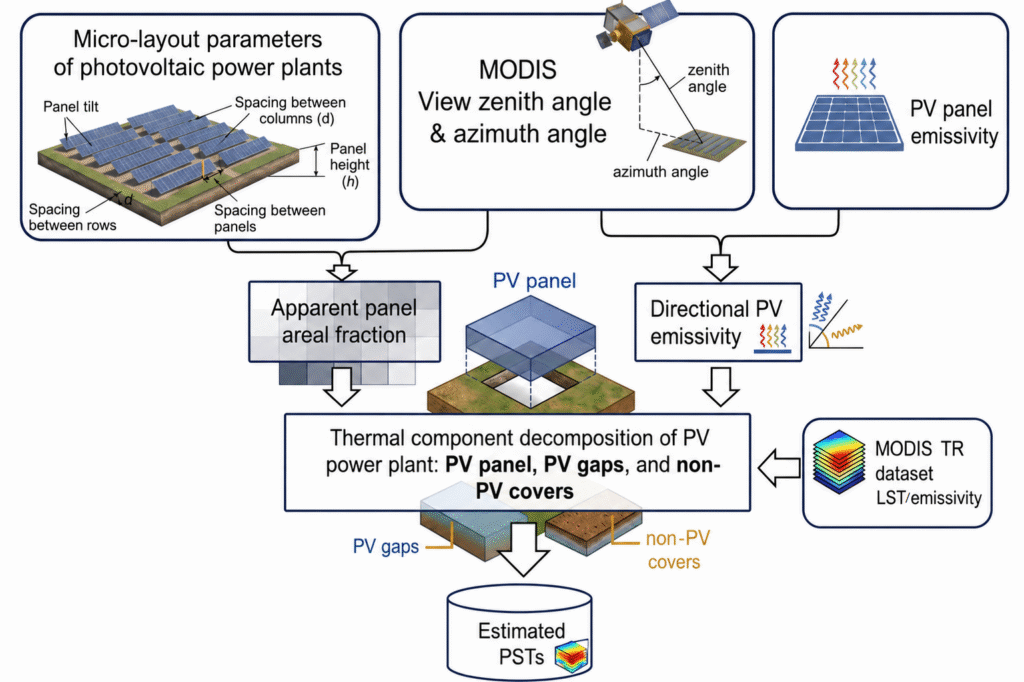
To address this limitation, the research team developed a pixel decomposition approach to separate PV modules from inter-row gaps within each MODIS footprint. High-resolution Sentinel-2 imagery was first used to estimate the fractional PV coverage within each MODIS pixel. This information was then combined with a three-dimensional geometric model of the PV array layout, incorporating module tilt, azimuth, row spacing, and satellite viewing geometry, to determine the proportion of panel surface that is actually visible to the sensor.
Finally, by explicitly modelling the thermal contribution of non-panel components such as exposed ground and inter-row spaces, the researchers were able to isolate the radiative signal attributable to the PV modules. This correction enables a more accurate retrieval of panel surface temperature at utility scale using moderate-resolution thermal infrared satellite data.
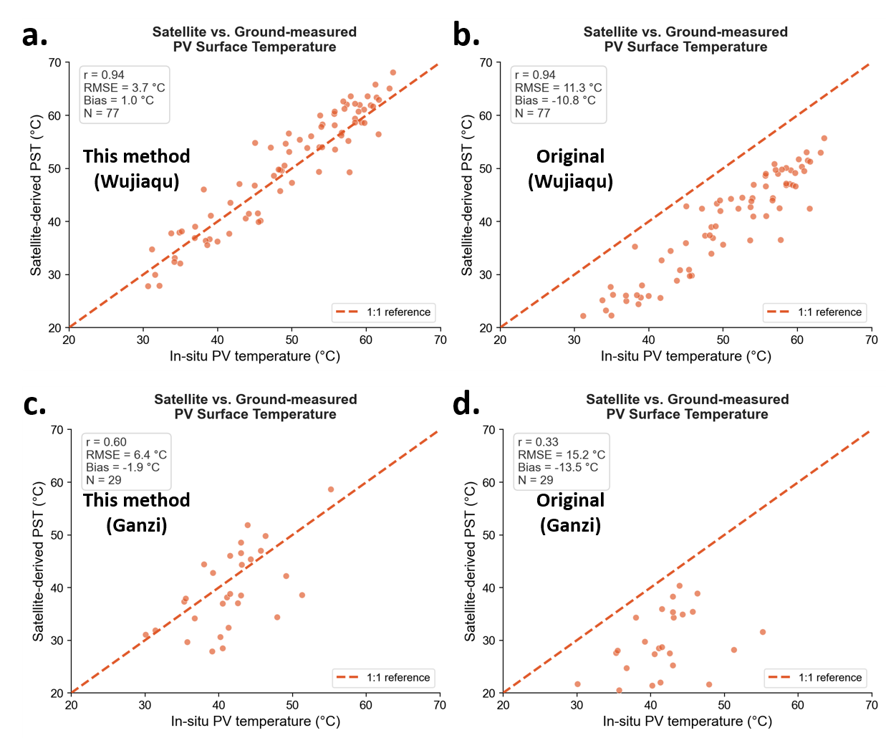
To validate the method, the research team compared modelled results against ground-based measurements from two utility-scale PV power plants: an arid-site installation in Wujiaqu, Xinjiang (northwestern China), and a more humid site in Ganzi on the eastern Tibetan Plateau, Sichuan Province (southwestern China). Ground-truth panel temperatures were recorded using calibrated thermocouples mounted on the rear surface of PV modules at four representative locations across each array.
The results show a substantial improvement in retrieval accuracy. During the warm season, the proposed algorithm reduced the root mean square error (RMSE) from 10.8–18.9 C under a conventional land-surface emissivity baseline approach to 3.7–8.6 C. At the same time, it significantly mitigated the systematic cold bias, improving it from approximately −10 to −17 C down to −2 to −3 C.
Overall, these improvements – on the order of roughly 10 C in absolute error reduction – translate into a 3–5% decrease in PV power simulation bias. This level of accuracy enhancement supports more reliable estimation of photovoltaic performance and generation potential from satellite-derived thermal data.
“One of the most striking findings is that the low emissivity of PV panels matters even more than directional effects,” Yang said. “If PV panels are treated as if they had the emissivity of a typical natural surface, the retrieved panel temperature shows a systematic cold bias of around 10 C. In other words, getting the emissivity right is essential for accurate satellite retrieval of PV panel temperature.”
However, the scientist highlighted that while the method performs well in the warm season, winter remains far more challenging, primarily due to long shadows and potential snow cover. “These factors make the ground between panel rows colder than nearby open land, which can lead to significant underestimation of panel temperatures. To address this, we plan to develop a new approach to estimate the temperature of these shaded gaps and then incorporate that into our retrieval algorithm,” Yang said.
“Our long-term goal is to produce a global data set of utility-scale PV panel temperature for both research and industrial applications. Our next key step is to understand better the non-panel parts of solar farms, especially the shaded gaps between rows of panels. These gaps can strongly affect satellite measurements in winter,” he concluded. “We will also test this method on more solar farms under different climate conditions and array setups, including both fixed-tilt and sun-tracking systems, to see how widely it can be applied.”
The new approach was presented in “Photovoltaic panel surface temperature retrieval from MODIS through accounting for directional effects,” published in the International Journal of Applied Earth Observation and Geoinformation. Scientists from China’s Tsinghua University, Renewables Research Center of Huairou Laboratory, SPIC Southwest Energy Research Institute, SPIC Innovation Center of Photovoltaic Industry, Qinghai Huanghe Hydropower Development, the Aerospace Information Research Institute under the Chinese Academy of Sciences (AIRCAS), University of Chinese Academy of Sciences, and Huadian Xizang Energy have contributed to the study.
Source link