


A developing El Niño is expected to strengthen through 2026 and reshape solar resource globally, according to analysis using the Solcast API. Analysis of past strong El Niño events from July to September shows clear regional differences in irradiance, with higher than normal solar resource in most of India, and parts of Australia, equatorial Africa and Central America, and reductions across southern South America and East Asia. These historical patterns are broadly consistent with the regional direction of current seasonal forecasts, indicating likely trends for solar performance in the coming months as the current event develops.
Sea surface temperatures and atmospheric conditions show that El Niño is already underway, as has been declared by meteorological organisations around the world. The Niño 3.4 index has exceeded 0.8 C , showing warmer-than-normal sea surface temperatures in the central Pacific.
Seasonal forecast models indicate continued warming, with the event expected to intensify and peak later in the year. As El Niño develops, large-scale circulation changes shift cloud cover and rainfall patterns. In past strong events, the largest regional irradiance changes during July to September were around 10%. El Niño typically peaks toward year-end, so impacts are likely to grow as the current event strengthens through the Northern Hemisphere winter.
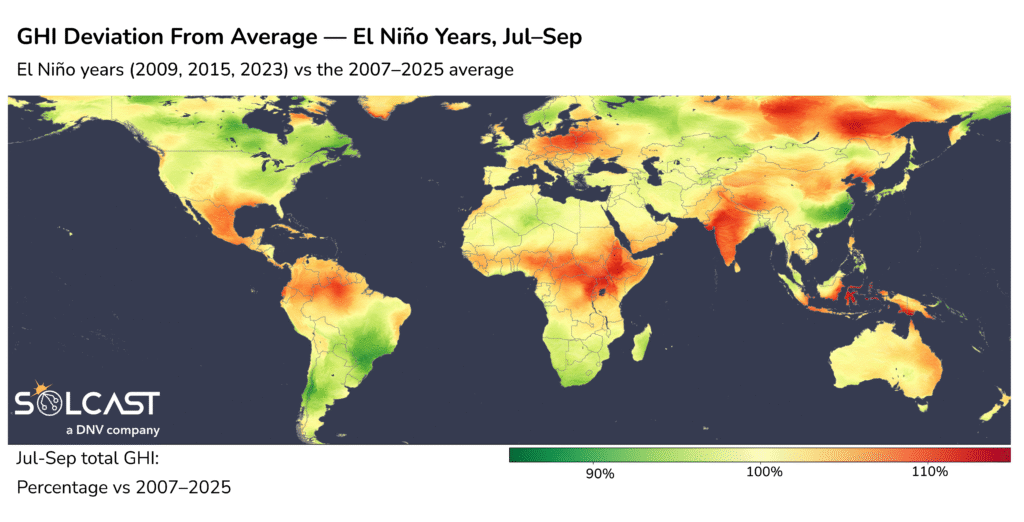
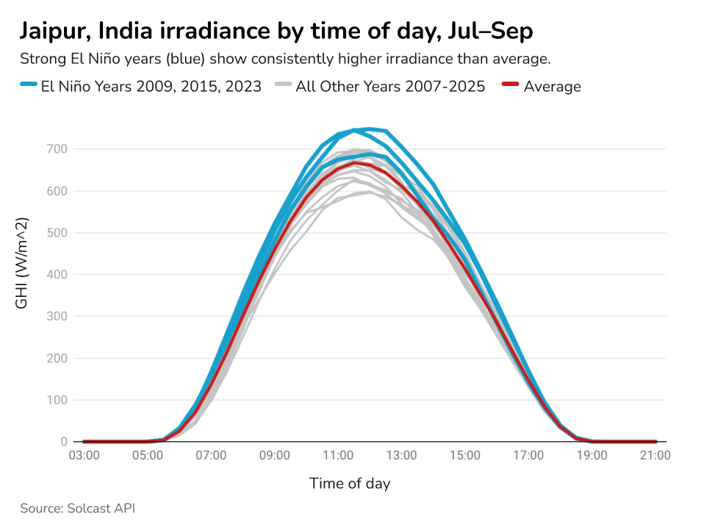
India shows one of the clearest increases in irradiance in El Niño years. Across past strong El Niño events, much of India recorded irradiance up to +10% above other years, rising to about 15% above normal in Rajasthan, a major solar development region and home to some of the world’s largest solar plants.
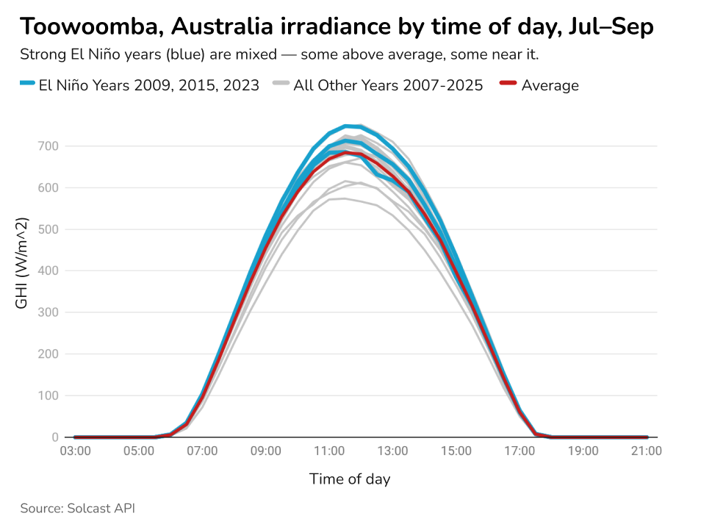
Eastern Australia also tends to see clearer conditions, with irradiance around 5% above average, although the increase is less consistent. At Toowoomba, some strong El Niño years sit above the historical range, while others remain closer to average, reflecting the influence of other climate drivers such as Indian Ocean conditions.
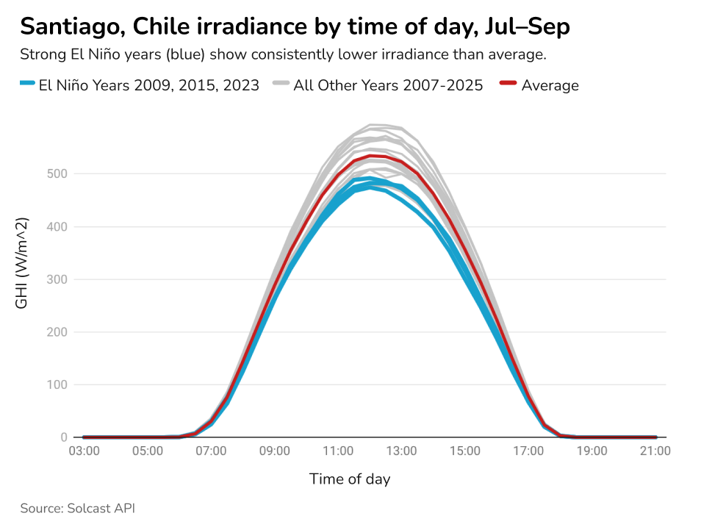
Other regions, by contrast, show reduced solar resource during strong El Niño events. Western and southern South America show the clearest reductions, with irradiance around 10% below other years.
Parts of East Asia show a weaker but still notable reduction, with eastern China experiencing increased rainfall and lower irradiance in locations such as Shanghai.
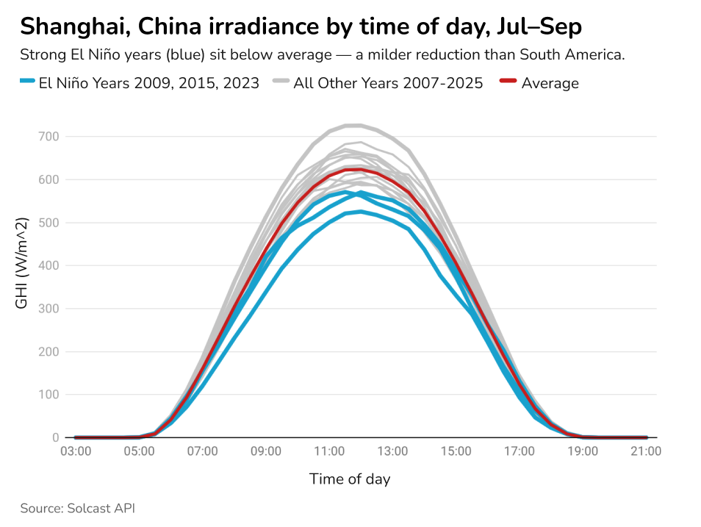
These patterns show that El Niño shifts solar resource between regions rather than uniformly increasing or decreasing it. For the coming event, this points to better conditions for solar generation across parts of India, eastern Australia, equatorial Africa and Central America, while assets in western and southern South America and eastern China are more likely to see reduced yield. Local impacts will depend on how circulation changes affect cloud formation and rainfall, so the strength of these effects will vary site to site.
Solcast produces these figures by tracking clouds and aerosols at 1-2km resolution globally, using satellite data and proprietary AI/ML algorithms. This data is used to drive irradiance models, enabling Solcast to calculate irradiance at high resolution, with typical bias of less than 2%, and also cloud-tracking forecasts. This data is used by more than 350 companies managing over 300 GW of solar assets globally.
Source link