

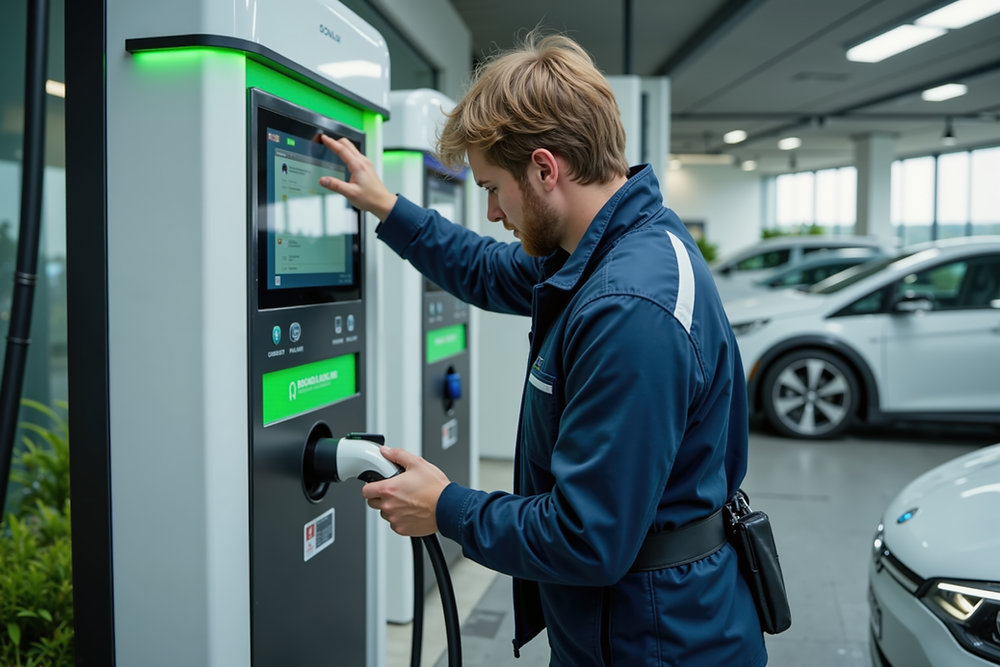
Adding EV charging to your service line is not as big a leap as it might feel. If your crew already runs solar interconnection applications, sizes conductors under NEC Article 690, and puts together permit-ready plan sets, you already have most of the skills a commercial EV charger project needs.
The two pieces that trip up new installers are commercial EV charger load calculation and the EV charger interconnection application itself. Both determine whether a site can support the chargers a customer wants. Both show up early, before any equipment gets ordered, which means getting them wrong is expensive to fix later.
This guide covers NEC 625 requirements, commercial EV charger permit design, and the electrical design decisions that separate a smooth installation from a stalled one. It is written for solar installers who already understand interconnection work and want a technical reference for expanding into EV charging.
If you would rather hand the load calc and interconnection paperwork to someone else, GreenLancer’s EV charging engineering services connect you with licensed engineers who handle it project by project.
EV Charging Load Calculation for Commercial Sites
Commercial EV charger load calculation blends two parts of the NEC that do not always line up cleanly. Article 625 governs the EVSE itself. Article 220 governs how that load gets added into the building’s overall service and feeder calculation. NEC 220.57, added in the 2023 NEC, states that EVSE load must be calculated at either 7,200 VA or the equipment’s nameplate rating, whichever is larger.
For commercial sites, the EVSE load gets incorporated into the applicable Article 220 service or feeder calculation. The exact method depends on the building type, existing service data, the adopted NEC edition, and whether a listed energy management system limits maximum demand. Confirm the calculation method with the AHJ before the load calc goes into a permit set, since this affects whether a panel upgrade is required.
Commercial Level 2 EVSE also shows up on more than one voltage system. Common configurations include 208Y/120V three-phase, 240V single-phase, and 480Y/277V three-phase equipment. A charger’s amperage rating on one voltage system is not interchangeable with another, so confirm the actual input voltage before comparing nameplate values across a project.
A commercial EV charging load study should account for:
-
Existing building demand, established using the calculation method accepted by the AHJ and utility, which may draw on interval data or a documented load study rather than nameplate totals alone
-
Continuous load classification for every EVSE circuit under NEC 625.42
-
Diversity and coincident demand across multiple ports, which is not the same as adding nameplate ratings together
-
Whether an energy management system will cap aggregate demand instead of relying on the sum of individual chargers
-
Future expansion, since retrofitting for more ports later usually costs more than sizing for growth up front
Commercial EV Charging Load Calculation Process
The workflow behind a commercial EV charging load study generally follows four steps:
-
Establish existing demand, expressed in kVA or kW for the service
-
Calculate the proposed EVSE load, applying continuous load treatment at the feeder or service level
-
Apply any permitted managed-load limit from a listed energy management system
-
Compare the resulting total demand against service, feeder, and utility capacity
Load Management Systems and Dynamic Power Sharing
NEC 625.42(A) allows the maximum equipment load on a service or feeder to equal the maximum load permitted by an automatic load management system, rather than the sum of every charger’s nameplate rating. This is one of the most effective ways to fit additional EV charging capacity onto an existing service without a full upgrade.
A dynamic load management system monitors real-time demand and throttles output to individual chargers so the total never exceeds a set limit. Power sharing works well on sites where vehicles rarely all charge at maximum output at once, which describes most commercial parking lots. The tradeoff is charging speed during peak periods, so the design still needs to match actual dwell time and turnover at the site.
Here is a simplified version of how the math works, expressed in kVA so current values at the same voltage and phase basis are not added directly:
-
Existing service: 400A, 480Y/277V three-phase, which equals a service capacity of roughly 332 kVA (kVA = 1.732 × volts × amps ÷ 1,000)
-
Existing calculated demand: 240 kVA, based on the AHJ-accepted calculation method
-
Proposed EVSE: four Level 2 charging cabinets, each with a combined nameplate input rating of 19.2 kW, for a total nameplate load of 76.8 kW, which this example treats as approximately 76.8 kVA assuming near-unity power factor
-
Unmanaged load at the feeder level: the 76.8 kVA nameplate load gets the continuous load treatment applied once, at 125 percent, for 96 kVA. Adding that to the existing 240 kVA demand puts the total at roughly 336 kVA, which is already at or slightly above the service’s 332 kVA capacity
-
Managed load with a listed EMS: if the EMS is listed for a managed maximum of 50 kVA rather than the full 96 kVA, the total becomes 240 plus 50, or 290 kVA, which fits within the 332 kVA service with headroom to spare
This example is simplified to illustrate the math, not to replace a stamped calculation. It also keeps branch circuit sizing under NEC 625.41 separate from the feeder and service calculation under NEC 625.42, since those are two different steps that should not both apply an independent continuous load multiplier to the same number. Every jurisdiction and utility applies its own review requirements, and GreenLancer’s engineers prepare project-specific load calculations and interconnection documentation for commercial EV charging installations.
NEC 625 Requirements for Commercial EV Charging Installations
NEC 625 governs the electrical conductors and equipment that connect an EV to a building’s wiring, from the branch circuit overcurrent device through the coupler. The 2023 NEC restructured parts of the article, but the core installation requirements that affect commercial projects have stayed consistent across recent cycles.
Key requirements to build into every commercial EV charger electrical design:
-
NEC 625.40 requires EVSE to be supplied by a dedicated branch circuit, unless a listed multi-EVSE or load-management arrangement documents an alternative configuration
-
NEC 625.41 requires branch-circuit conductors and overcurrent protection sized for continuous duty at 125 percent of the charger’s maximum output current
-
NEC 625.42 classifies EV charging as a continuous load and ties service and feeder sizing to the product rating, unless an automatic load management system is in use
-
NEC 625.54 requires GFCI protection for receptacles installed for EV charging. Hardwired EVSE must meet the applicable personnel-protection and listing requirements for the equipment and adopted NEC edition
How Commercial EV Charger Interconnection Applications Work
An EV charger interconnection application asks a different question than a solar interconnection application does. Solar interconnection review focuses on how much power a system can export back to the grid. EV charger interconnection is a load addition, so the utility checks whether the site’s existing service and the surrounding distribution system can handle new demand, not new generation.
Utilities may call this an EV charger interconnection application, new-load request, service application, load data sheet, or service-upgrade request, depending on the territory. The paperwork and technical review are largely the same regardless of the name on the form.
That distinction changes which review triggers apply. A small addition can clear utility review quickly if there is spare transformer capacity nearby. A larger commercial installation, especially one with DC fast chargers, often triggers a full engineering study before the utility issues approval.
If your team already handles solar interconnection agreements, the application process will feel familiar. You are usually working with the same utility contacts and sometimes the same portal, but the technical review criteria are built around demand instead of export.
Commercial EV charger interconnection applications typically require:
-
A completed load calculation showing existing demand plus the new EVSE load
-
A one-line diagram showing the point of connection, panel or switchgear details, and conductor sizing
-
Equipment specifications for each charger, including continuous output rating
-
Confirmation of whether an energy management system will be used, and its managed maximum output
-
A site plan showing charger locations relative to the existing service equipment
Timelines vary widely by utility. Straightforward applications with adequate existing service and transformer capacity may clear relatively quickly. Projects requiring utility engineering, a new service, or transformer work can take several months or longer.
GreenLancer can prepare the load calculation and utility documentation while your team handles installation.
Utility Service Upgrades for Commercial EV Charging
Not every site has enough spare capacity for new EV charging demand, and finding that out early saves a lot of redesign later. A quick capacity check against a recent utility bill or interval data can flag whether a utility service upgrade for EV charging is likely before the design goes too far.
Common upgrade triggers include:
-
Transformer capacity: the existing transformer may not support the added charging demand
-
Secondary service: conductors between the transformer and service equipment may need replacement
-
Switchgear: existing gear may lack breaker capacity or an adequate interrupting rating
-
Utility timeline: engineering, procurement, and scheduling may become the project’s critical path
-
Cost responsibility: the site host’s contribution varies by utility territory and rate class
Ask the utility about lead times early. A transformer upgrade that takes four to six months to schedule can become the critical path for the entire installation, even if the electrical design itself is straightforward. State utility regulators track these grid impacts and utility coordination challenges on EV charging projects closely, and that coordination is often what determines a project’s real timeline more than the electrical design does.
Make-Ready Infrastructure for Commercial EV Charging
Make-ready EV charging infrastructure means designing the electrical backbone before a customer commits to specific chargers. This approach pays off on any site where charger count is likely to grow, since retrofitting conduit and panel capacity later is almost always more expensive than building it in from the start.
A make-ready design commonly includes:
-
Spare conduit runs sized for future charger additions, not just the initial install
-
Oversized raceways that allow additional conductors without new trenching
-
Stub-outs at planned future charger locations, capped and ready for connection
-
Panel space planning that reserves breaker positions for the next phase of chargers
-
Coordination with the make-ready scope discussed during interconnection review, so the utility application already reflects the full build-out plan
Sites with phased rollouts, like a retail chain adding EV charging across multiple locations, benefit the most from this approach. It is also worth planning for ongoing operation and maintenance costs for EV charging infrastructure at the design stage, since networked chargers and load management hardware both carry service and software costs that a site host should budget for early.
DC Fast Charger Utility Interconnection
DC fast charger utility interconnection introduces requirements that rarely show up on Level 2 projects. Higher power levels mean three-phase 480V service is standard, and some high-power sites need medium voltage service directly from the utility. For a breakdown of charging levels and connector standards, DOE’s Alternative Fuels Data Center is a reliable reference to keep handy.
Points worth confirming early on any DC fast charging project:
-
Whether the site needs three-phase 480V service or steps up to medium voltage
-
Whether any portion of the equipment, such as a transformer or switchgear, will be utility-owned rather than customer-owned
-
Protective relaying requirements, which some utilities require on larger commercial services regardless of load type
-
Demand charges, since DC fast charging can create very high, short-duration demand spikes that affect the customer’s utility bill structure
These requirements do not need deep mastery for a typical Level 2 commercial project. They matter enough on DC fast charging and fleet work that it is worth flagging early, before a customer commits to a charger count the site cannot practically support. NREL’s research on medium- and heavy-duty charging infrastructure is a useful reference if a project moves in the direction of fleet or depot charging.
Commercial EV Charger Permit Drawings and Engineering Documents
Commercial EV charger permit design follows many of the same conventions as solar permit sets, with a few differences specific to EVSE. A complete package typically includes a one-line diagram, panel schedule, load calculation, site plan, and equipment cut sheets for every charger and any load management system.
Common AHJ rejection points on EVSE permit drawings include:
-
Missing or inconsistent load calculation showing the 125 percent continuous load factor
-
EVSE equipment shown on the drawings that does not match the submitted cut sheets
-
EVSE branch circuits shown incorrectly, including circuits shared with unrelated loads or multi-EVSE configurations that do not document the permitted load-management method
-
GFCI protection not called out for cord-and-plug connected equipment
-
Missing energy management system documentation when the load calc relies on a managed maximum
Depending on the project, the plan set may also need accessible-space details, equipment mounting heights, bollards, trenching and restoration notes, parking-striping, signage, and accessible-route information. Requirements vary by federal, state, and local rules, so confirm what applies before finalizing the site plan.
A PE stamp for EV charging is not automatic. Many jurisdictions require one for commercial installations above a certain service size or charger count, while some accept designs from a licensed electrician without a stamp on smaller projects. Confirm the local threshold before quoting, since a missed PE stamp requirement is one of the more common causes of permit delays. Consulting-Specifying Engineer has a solid technical overview of how electrical engineers coordinate NEC Articles 400, 625, and 750 for EV charging station design, which is worth reviewing if your team is building an internal QA checklist for commercial EVSE plan sets.
EVITP Certification and NEVI-Funded Projects
The Electric Vehicle Infrastructure Training Program, or EVITP, trains licensed electricians on EVSE installation, load calculations, and NEC compliance specific to EV charging. It is not required on every commercial project, but it shows up as a hard requirement often enough that it is worth understanding before bidding competitively funded work.
Where EVITP certification typically matters:
-
California requires EVITP certification on CEC and CARB funded charging equipment, with crew percentage requirements tied to charger power level
-
Many NEVI Formula Program-funded projects require electricians to hold EVITP certification or satisfy the federal alternative through an approved registered apprenticeship program with charger-specific training, with additional crew-composition rules on projects with more than one electrician
-
Some private commercial customers request EVITP certification as a qualification standard even when it is not legally required
EVITP eligibility requires a state-licensed or certified electrician, or documented proof of at least 8,000 hours of hands-on electrical construction experience in states without licensing. The course runs about 20 hours online, followed by a proctored exam, and certification stays valid for three years. Verify these details against EVITP’s current pages before quoting a project, since training length and renewal policies can change. EVITP’s FAQ page explains how to verify a contractor’s or electrician’s certification status, and its training and certification program page covers current eligibility requirements in detail.
Adding EV Charging Engineering to Your Service Line
Solar installers already have licensing, interconnection experience, and permitting relationships that most electrical contractors spend years building. Adding commercial EV charging services is less about learning a new trade and more about layering NEC 625 and interconnection specifics onto skills your team already has.
GreenLancer supports contractors adding EV charging to their service lines with:
-
Commercial EV charger load calculations and load studies
-
EV charger interconnection applications
-
EVSE permit drawings and PE-stamped engineering documents
-
Commercial EV infrastructure design, including make-ready planning
Create a free GreenLancer account to submit your first commercial EV charging project and get a quote on load calculations, interconnection applications, or permit drawings.
Frequently Asked Questions
What NEC article governs commercial EV charger installations?
Article 625 covers the electrical conductors and equipment connecting an EV to the building’s wiring. Articles 220, 400, and 750 may also apply, covering load calculations, flexible cords and cables, and energy management systems. If battery storage or bidirectional charging is part of the project, other NEC articles come into play depending on the equipment and configuration.
What’s required for a commercial EV charger interconnection application?
Requirements vary by utility, but most applications need a site plan, one-line diagram, equipment specifications, existing and proposed service information, a load calculation, and documentation for any energy management system. Larger projects may also require interval load data, transformer review, or a full utility engineering study.
How is EV charging load calculated differently from solar?
Solar load calculations account for generation being added to a system, with interconnection limits like the 120 percent rule governing how much can be added at the service panel. EV charging load calculations account for new demand instead, classified as a continuous load under NEC 625.42 and added at 125 percent of the charger’s rated output unless a load management system caps the aggregate demand.
Can an existing commercial electrical service support EV charging?
It depends on existing demand and available capacity. A load calculation using recent utility interval data, not just nameplate totals, is the only reliable way to confirm whether a service can absorb new EV charging demand without a utility upgrade.
When does an EV charging project require a utility transformer upgrade?
A transformer upgrade becomes necessary when the calculated EV charging load, combined with existing building demand, exceeds the transformer’s rated capacity. This is more common on DC fast charging projects and multi-port commercial installations than single-charger Level 2 projects.
Do I need a PE stamp for a commercial EV charging installation?
Requirements vary by jurisdiction and project size. Many AHJs require a PE stamp above a certain service size or charger count, so confirming the local threshold before quoting a project avoids permit delays later.
Is EVITP certification required to install EV chargers?
Not universally, but it is required on many publicly funded projects. California mandates it for CEC and CARB funded charging equipment, and many NEVI-funded projects require EVITP certification or an approved registered apprenticeship program with charger-specific training as the federal alternative.
Source link