

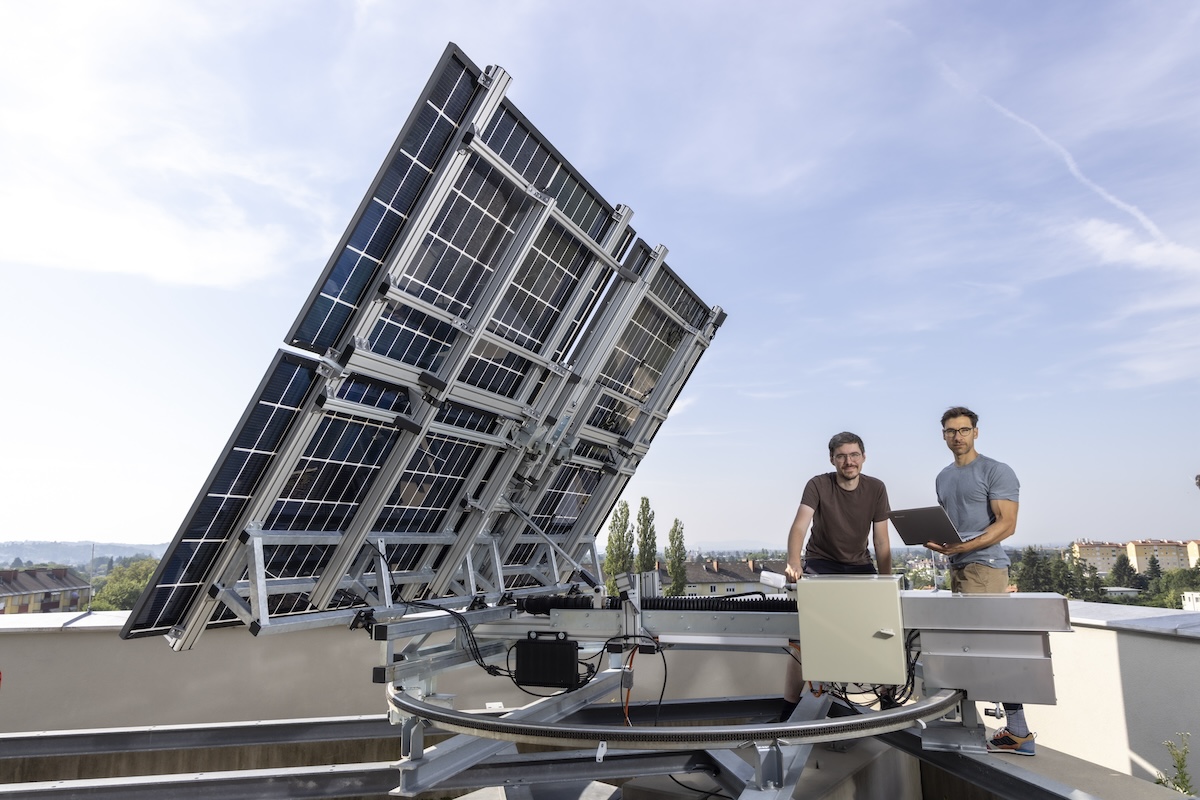
A research group at TU Graz’s Institute of Electrical Measurement and Sensor Systems in Austria is seeking to revive a photovoltaic concept long considered obsolete: dual-axis solar tracking.
Due to significantly higher specific yields, dual-axis tracking was once a proven approach, including for large-scale ground-mounted PV arrays until the early 2000s, when module prices were considerably higher. However, as costs declined, the additional expense of wind-resistant mechanical structures became increasingly difficult to justify against the incremental energy gains. Today, single-axis trackers, which offer simpler and more robust designs, dominate the tracking market, while fixed-tilt mounting systems are used almost exclusively for smaller installations.
The system developed at TU Graz, called FLAPTrack, aims to challenge this trend. The acronym stands for “Face-to-Face Lay-Down Anti-Degradation Protection,” reflecting the system’s main features: higher energy yields combined with enhanced module protection.
At night, and particularly during severe weather events, the modules automatically fold together and lie flat on the ground. Connected to a local weather station and regional forecasting models, the system is designed to protect the modules from wind loads, snow accumulation, dust, and hail damage.
Hail is an often-overlooked risk, according to Buchroithner. “Compression of the silicon wafers caused by hail impacts can create hotspots; the resulting increase in internal resistance reduces the efficiency of the entire module,” he explained.
Pilot project
The system is currently undergoing field testing with a 1.8 kW PV array installed on the roof of a university office building. Even this rooftop application would be challenging for a conventional dual-axis tracker without a protective mechanism, such as the ability to move modules into a wind-sheltered position, due to the substantially higher wind loads compared with ground-mounted installations.
Buchroithner identified the mechanical design as the system’s core innovation. FLAPTrack uses a patented linear actuator that performs two functions: adjusting the modules’ orientation toward the sun and folding them into a protective position. “This dual function reduces installation and operating costs, thereby improving economic viability,” he said.
Horizontal rotation is achieved through a belt drive with a circular guide positioned close to the ground, further simplifying the mechanical design.
According to the research team, FLAPTrack can deliver an average yield increase of around 40% compared with fixed-tilt PV systems. However, Buchroithner says the system’s economic potential lies primarily in its ability to increase electricity generation during periods of high demand.
“The additional power output during the early and late hours of the day is the key factor for economic viability: in the morning and evening—when overall electricity consumption is particularly high—FLAPTrack’s optimized solar tracking allows it to generate more than twice as much power as conventional PV systems, while also helping to reduce grid stress,” he said.
The effect is expected to be particularly significant during winter months and at higher latitudes, where the sun remains lower on the horizon for longer periods.
Source link