

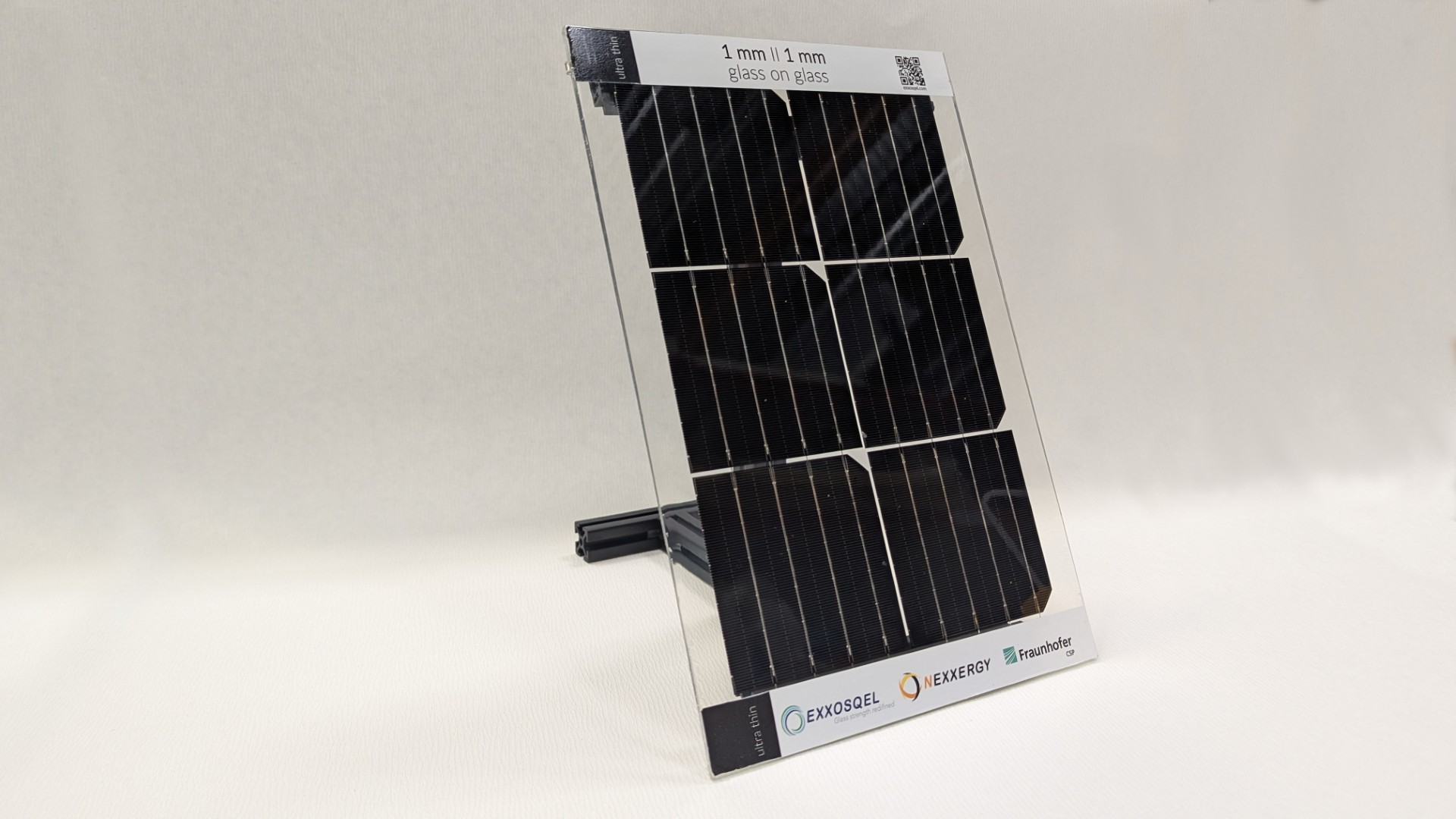
Germany’s Fraunhofer Center for Silicon Photovoltaics (Fraunhofer CSP) and startup Exxosqel GmbH, a subsidiary of German consultancy firm Exxergy GmbH, are developing a thin-glass solar module that uses a special glass coating to compensate for the reduced mechanical strength associated with thinner glass covers.
“The developed thin-glass module is currently only a showcase demonstrator,” Fraunhofer CSP scientist Ringo Köpge told pv magazine.
The module uses 1 mm-thick front and rear glass panes, resulting in a total glass area of 300 mm × 200 mm. It incorporates standard solar module encapsulation materials and quarter-cells from bifacial M6 9-busbar PERC cells. The quarter-cells are connected in series, with each cell delivering approximately 1.58 W.
“The module was manufactured using a standard PV laminator, with modifications to process parameters including temperature, pressure, and system setup,” Köpge said.
The coating is described as a multi-component reactive surface treatment applied directly to the glass surface. It is designed to chemically react with hydroxyl (Si–OH) groups generated by surface damage, creating covalent bonds with the glass structure.
According to Exxosqel, this reaction partially heals microcracks, reduces surface brittleness, and improves the mechanical strength of the glass. The resulting crosslinked composite layer is designed to remain transparent and chemically durable while maintaining a refractive index matched to glass to minimize optical losses.
“Inspired by the structure of abalone shells, where small amounts of organic material dramatically increase toughness, the coating creates a stronger composite surface while maintaining transparency and durability,” Exxosqel CEO Thomas C. Sauer told pv magazine. “The technology can be integrated into existing glass production or finishing processes and may enable thinner, lighter glass products without compromising mechanical performance.”
The company has not disclosed further details about the coating’s chemical composition.
Laboratory tests conducted by Exxosqel reportedly show significant improvements in glass strength, with 2 mm glass samples increasing from 79 MPa to 364 MPa and 1 mm glass samples improving from 184 MPa to more than 1,300 MPa. The company estimates that thinner glass substrates could reduce material use, energy consumption, and carbon emissions by enabling weight reductions of up to 40%.
“The special coating process is not limited to the demonstrator module and can also be applied to standard solar modules,” Köpge said.
According to Fraunhofer CSP, coating ultra-thin glass could provides a solution for applications such as building-integrated photovoltaics (BIPV), including modules with printed front covers and lightweight designs.
The coating technology could also potentially help reduce PV module manufacturing costs by enabling the use of thinner glass, lowering material consumption, module weight, and associated transport and handling costs. However, thinner glass also raises concerns about mechanical durability in the field, particularly under extreme weather conditions such as hail events.
According to a recent study from India, solar modules with 3.2 mm-thick front glass may not be strong enough to withstand storms producing big hailstones. The scientists found that a front glass of at least 4 mm should be used to avoid significant damage.
Source link