

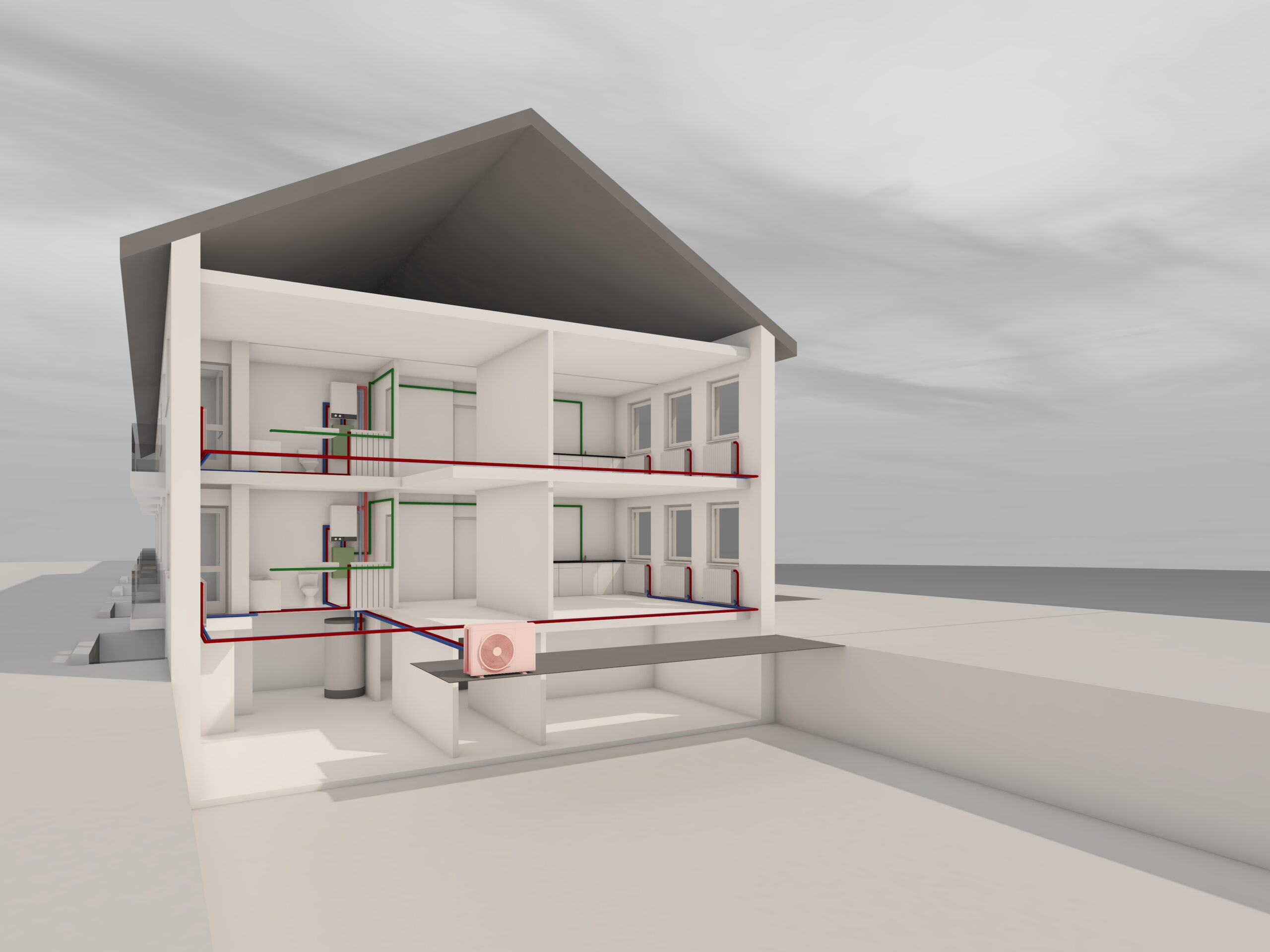
Researchers from Germany’s Fraunhofer Institute for Solar Energy Systems (ISE) have developed a set of typical solution concepts for replacing gas and oil heating systems with propane (R290) heat pumps in multi-family houses.
The set of concepts form part of the LC R290 research project, in which Fraunhofer ISE worked with a consortium of 20 companies from the heating industry and housing sector to develop heating system replacements.
The research team examined example buildings from a portfolio of participating housing companies with heating loads ranging from 23 kW to 93 kW. Some buildings had individual gas apartment heating, while others had central heating systems.
They concluded that no universal solution exists and that system design must account for building size, available heat sources, space constraints, hot water demand acoustics, and safety.
“Due to the various challenges, such as the question of a suitable heat source or limited space, there is no single technological solution; rather, we have developed several solutions that can be applied,” explained Björn Nienborg, Project Coordinator at Fraunhofer ISE. “What’s important is a building-tailored system design including heat pump, storage, hydraulics, control, and heat distribution.”
As a result, the researcher developed several R290 heat pump demonstrators for different retrofit scenarios. For central systems, they designed an outdoor unit with 20% less propane refrigerant than comparable systems, increasing efficiency by 15%. Their indoor solution features a 28 kW brine-to-water heat pump optimized for a low refrigerant charge. For decentralized retrofits with a hydraulically connected heat source, they built a 4.9 kW apartment-level heat pump using a charge of 150 g of propane.
“The low charge of 150 g is an important value for minimizing the hazard potential when using the flammable refrigerant propane, thus enabling the use of heat pumps in kitchens or utility rooms – the typical installation locations,” explains Timo Methler, Team Leader for Building Heat Pumps at Fraunhofer ISE.
The solutions will now be integrated into a software tool for decision-making and design of heat pump systems in multi-family houses as part of a new project.
Source link