

China’s photovoltaic industry entered a broad contraction during the first half of 2026, with production falling across every major manufacturing segment and domestic installations dropping sharply from last year’s exceptional level.
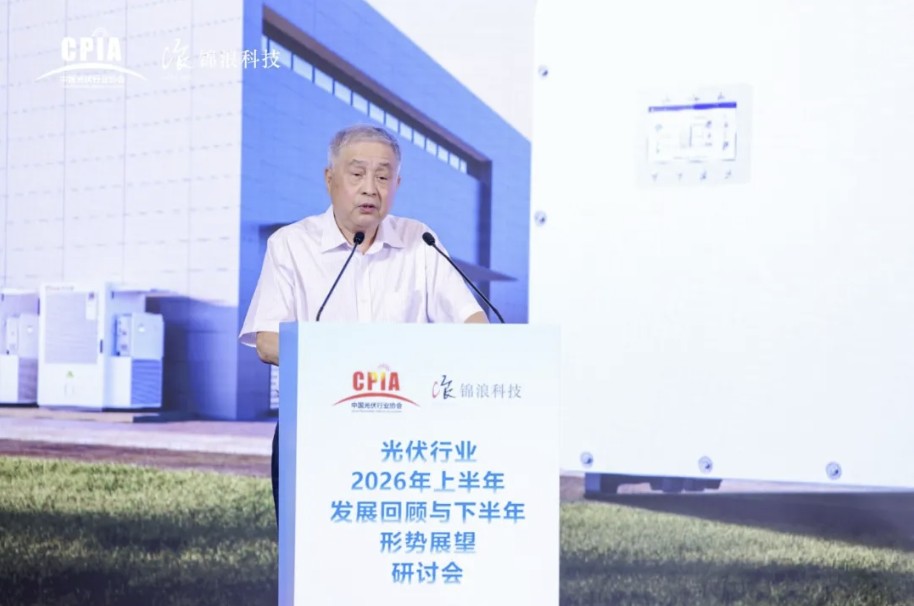
Speaking at the China Photovoltaic Industry Association’s (CPIA) mid-year review and outlook conference, former secretary-general, Wang Bohua, said the industry was undergoing a “deep adjustment,” but argued that the decline in installations represented a return to a more sustainable growth pattern rather than a reversal of the long-term trend.
China produced 538,000 tonnes of polysilicon in the first six months of the year, down 9.8% year on year. Wafer output fell 7.3% to 293 GW, cell production declined 21.9% to 260.7 GW and module output dropped 35.1% to 201.3 GW.
Prices also remained under pressure. By early July, polysilicon prices were 42.3% below January levels, while wafer and cell prices had fallen 28.7% and 27.7%, respectively. Module prices were around 3% higher, partly reflecting changes to China’s export tax rebate arrangements.
New solar installations reached 72.07 GW in the first half, down about 66% from 212.21 GW in the same period of 2025. The comparison was distorted by a rush to connect projects before China introduced market-based pricing for new renewable energy projects in June 2025.
Wang said the 2026 figure remained above the average recorded during the first halves of 2021 to 2024. Monthly installations were also more evenly distributed than in the previous five years, suggesting a shift away from policy-driven deployment surges.
The association maintained its forecast of 180 GW to 240 GW of new solar capacity in China for the full year, compared with around 315 GW in 2025. Even at the upper end, 2026 would mark China’s first annual installation decline since 2019.
Exports provided a partial counterweight to the domestic slowdown. China exported $17.18 billion of wafers, cells and modules in the first half, up 24.3% year on year. Cell exports rose 36.8%, while module export volumes declined 2.5%. Africa increased its share of Chinese module exports, reflecting a gradual diversification beyond established European markets.
CPIA expects global PV additions to decline 8% to 612 GW in 2026. China’s policy transition will account for much of the contraction, while grid congestion, curtailment and negative electricity prices are slowing project development in several international markets.
The association expects global growth to resume from 2027, with annual additions reaching 864 GW by 2030, equivalent to a compound annual growth rate of around 7% from 2026.
The transition remains difficult. Most manufacturers continue to face losses, grid constraints are limiting deployment, and new demand from emerging applications may not immediately absorb existing capacity. The industry’s recovery will therefore depend on both supply-side consolidation and the development of more flexible electricity markets.
Source link