

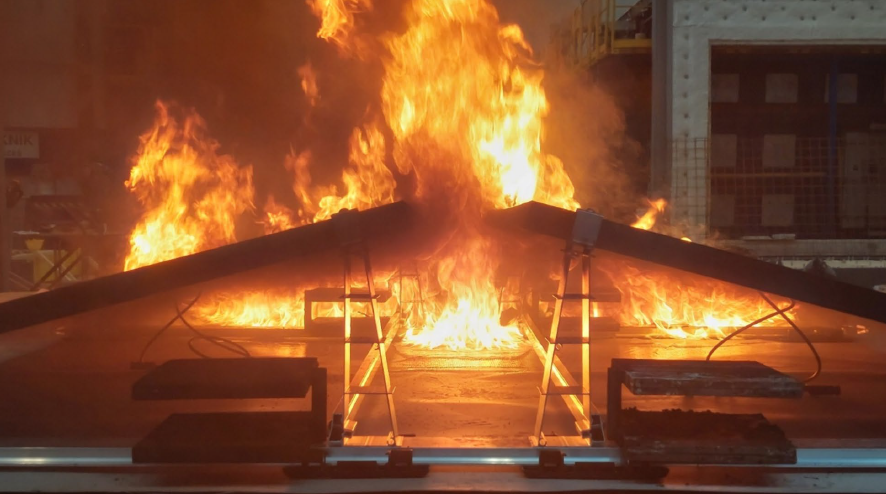
An international research team led by the Slovenian National Building and Civil Engineering Institute (ZAG) has conducted an extensive review of all PV-related fires requiring firefighter intervention across the UK, Italy, Slovenia and Sweden and have found the diversity in results depends mostly on the respective reporting methodology.
“The harmonization of parameters and their terminology required in the reports that are filled by the firefighters after incidents would be extremely beneficial when thinking about cross-country comparisons,” corresponding author Nik Rus told pv magazine. “This would enable a much better comparison and also point out where the lacking safety levels might require prompter interventions.”
“Any regulations, building codes or fire safety requirements should definitely be data-based, especially given recent conflicting reports in the PV field,” he went on to say. “For instance, some safety components shut-off switches, which are theoretically designed and installed to improve the safety of PV systems, have, over the years, become one of the more common causes of failures that then evolve into ignition sources capable of leading to a fire. Such solutions not only harm the systems in which they are installed, but also distort the perception of broader efforts to improve the safety of PV systems.”
The study presents fire occurrence data across the four countries, with a detailed analysis of the Swedish dataset to identify ignition sources, fire development, and resulting consequences. “These data can serve as a foundation for risk analysis and risk management concerning rooftop PV systems, as well as provide general guidance for the fire safety of PV systems in general,” the scientists said.
They also explained they worked on national datasets that differ considerably in their definitions of PV-related fires. Italy and the UK primarily include incidents involving PV modules, whereas Slovenia and Sweden apply a broader definition that covers all PV system components, including cables and inverters. In order to bring clarity, the research team defined a PV-related fire as any incident involving a PV system component, regardless of whether the system initiated the fire or was affected after ignition elsewhere.
The Italian dataset, covering 2015–2024, shows an increasing number of reported incidents but cannot definitively determine fire origin. Most cases are classified as electrical or of undetermined cause, demonstrating the limitations of operational fire statistics for forensic analysis. Slovenian data became available after the introduction of a dedicated PV fire category in 2023, while Swedish data were further analysed through expert review to identify ignition sources and classify fire consequences.
The Swedish dataset provides detailed insight into damage severity, ranging from PV equipment damage to complete building fire involvement. UK statistics are based on keyword searches and may underestimate the true number of PV-related incidents due to narrower reporting criteria, the scientists said.
The analysis shows an overall increase in reported fires across all countries. When normalized by installed capacity or number of installations, the countries show comparable orders of magnitude, with Sweden and Italy displaying similar trends, the UK slightly lower values, and Slovenia higher values due to its broader reporting criteria.
Furthermore, the research team found that the Swedish dataset enabled a more detailed analysis of fire occurrence according to system size, ignition sources, and fire consequences. Fire frequency was found to vary considerably with system capacity, indicating that smaller systems generally have lower fire occurrence rates per installation but represent a substantial share of total incidents due to their large number. Larger systems showed higher variability because fewer installations result in greater statistical uncertainty.
Analysis of ignition sources in Sweden showed that DC cables and connectors were the most common origin of PV-related fires, accounting for approximately one-quarter of incidents. Other frequent ignition sources included DC switches and AC-side electrical central units. In contrast, PV modules and converters were less frequently identified as ignition sources, although annual variations remain significant due to the limited number of incidents.
The analysis also demonstrated that the consequences of PV-related fires were generally limited in severity. In Sweden, approximately two-thirds of incidents resulted only in damage to PV equipment, either indoors or outdoors. More severe events involving fire spread to adjacent surfaces accounted for around one-quarter of cases, while only a small proportion resulted in extensive building damage or total building loss. Most severe cases involved agricultural buildings or unoccupied structures rather than residential buildings.
“It should not be a surprise that some fires remain confined to the ignition source, others spread to nearby areas, and only some grow large enough to cause extensive damage,” Rus explained. “Our ongoing research examines the parameters that influence the early stages of fire development, assessing how the system limits or enables flame spread beyond the area of the ignition source.”
Overall, the findings demonstrate that PV-related fires remain relatively infrequent, but improved harmonised data collection and detailed analysis of ignition mechanisms are essential for effective risk management and future fire safety strategies.
“The reported numbers of fires per GW of installed capacity of PV systems range from about 5 to 13 annual fires for Italy, 7 to 19 annual fires per GW in Sweden, 2 to 4 fires per GW in the UK, and about 35 to 40 fires per GW in Slovenia,” the academics emphasized. “The numbers for annual fires per 100,000 systems are below 5 for the UK, between 14 and 24 in Italy, between 11 and 31 in Sweden, and about 80 in Slovenia.”
Their findings were presented in the study “Fire Incidents Involving Photovoltaic Systems – An Analysis of Different National Statistics,” published in the Fire Safety Journal. The research team included scientists from Sweden’s Bengt Dahlgren Fire Research, the Italian National Fire Brigade, and the University of Primorska in Slovenia.
Source link