

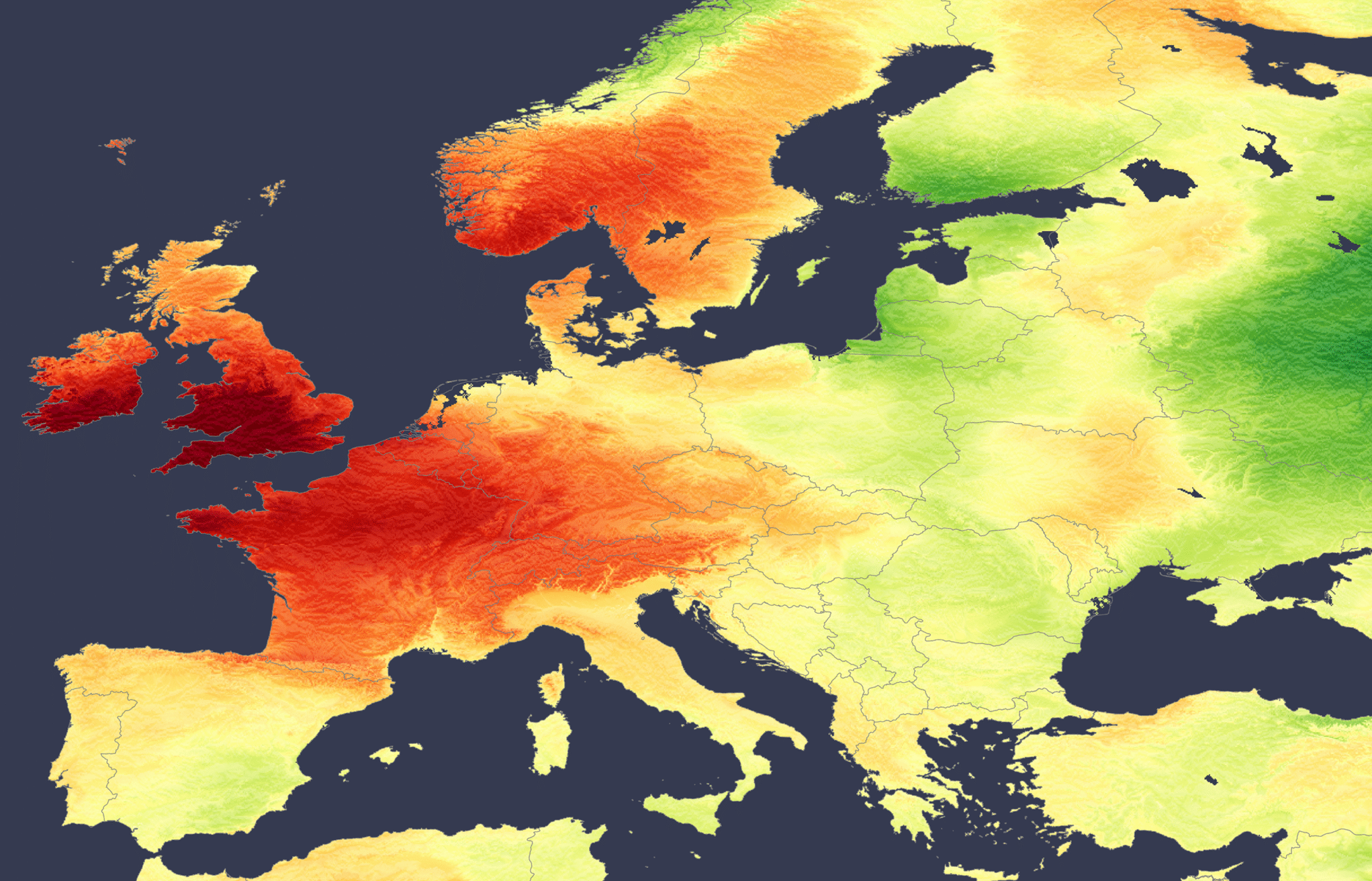
Europe’s July heatwave accompanied unusually high solar irradiance across much of western Europe, according to analysis using the Solcast API. Persistent high pressure limited cloud formation across the west and north of the continent, lifting irradiance well above typical July levels. At the same time, wildfires in France and Spain, together with Saharan dust outbreaks across the Mediterranean, added aerosols to the atmosphere and increased the risk of panel soiling.
The strongest positive irradiance anomalies were recorded across western and northern Europe, where cloud cover was suppressed for much of the month. Southern England, Wales and Ireland saw irradiance up to 35% above usual July levels, while northern France, the Low Countries and western Germany were up by around 25%. Southern Norway and Sweden were around 15% above usual. These conditions were linked to the same slow moving high-pressure systems that drove the month’s extreme heat. High pressure tends to stabilise the lower atmosphere and reduce cloud development. However, the continued high temperatures from June into July will have reduced PV module efficiency, partly offsetting the benefit of higher irradiance.
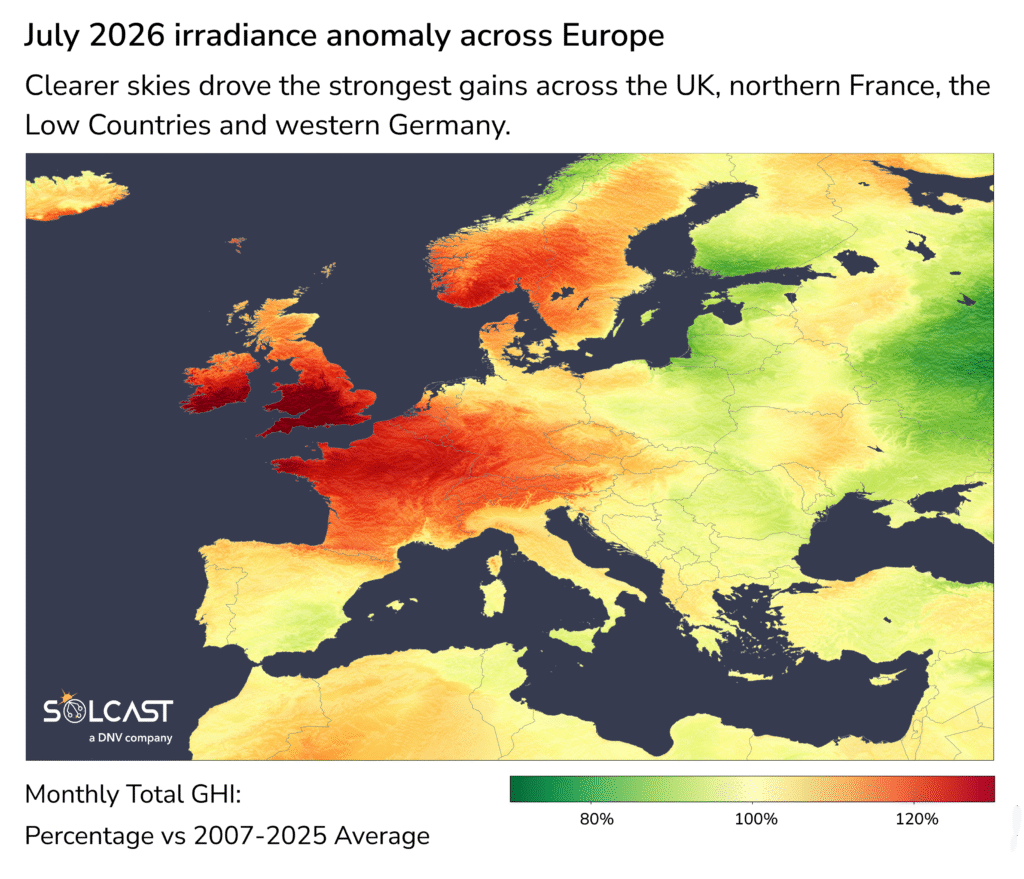
Across southern Europe, wildfire smoke and Saharan dust reduced the benefit of otherwise clear, high-irradiance summer conditions. Smoke from these fires reduced clear-sky irradiance across parts of southern France and Spain, with some smoke also spreading into neighbouring areas. Saharan dust outbreaks also crossed the Mediterranean at times, adding haze across parts of Spain, Italy and Greece. In southern Spain, where July irradiance is normally high at around 8.1 kWh/m² per day, monthly irradiance fell by as much as 4% to around 7.7 kWh/m², with larger reductions during individual smoke or dust events.
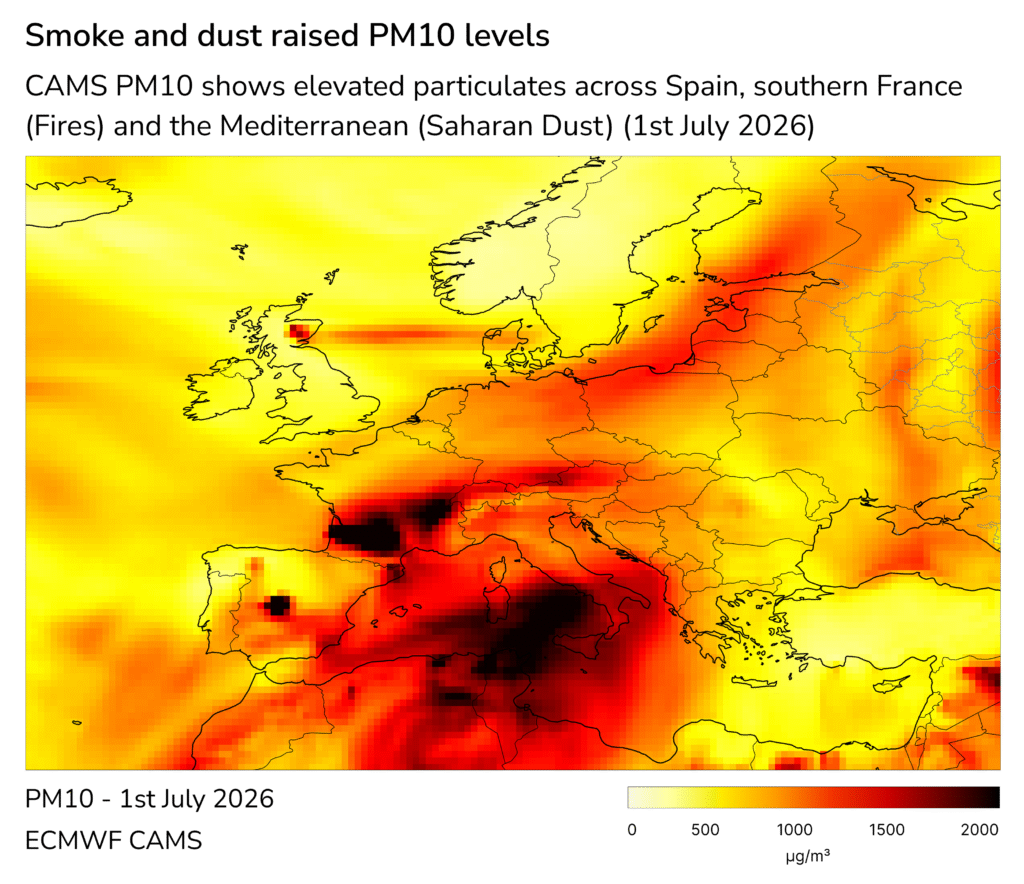
Aerosols also created a soiling risk where particles settled on PV modules and were not removed by rain or cleaning. Using PM2.5 and PM10 concentrations in the HSU soiling loss model, the end-of-month soiling impact for uncleaned panels was estimated at 5.6% in Valencia. This reflected both smoke from the nearby Vall d’Uixo wildfire and repeated Saharan dust episodes, with no appreciable rainfall events to clean panels during the month. Madrid saw a lower estimated impact of 2.2%, where nearby fire impacts were less prolonged and Saharan dust was less significant. In Bordeaux, nearby wildfires brought intense smoke pollution late in July, but rainfall events limited the estimated soiling impact to a peak of 0.6%.
The site-level soiling estimates show how similar regional aerosol conditions translated into different operational risks depending on local particulate exposure and whether enough rainfall occurred to clean module surfaces.
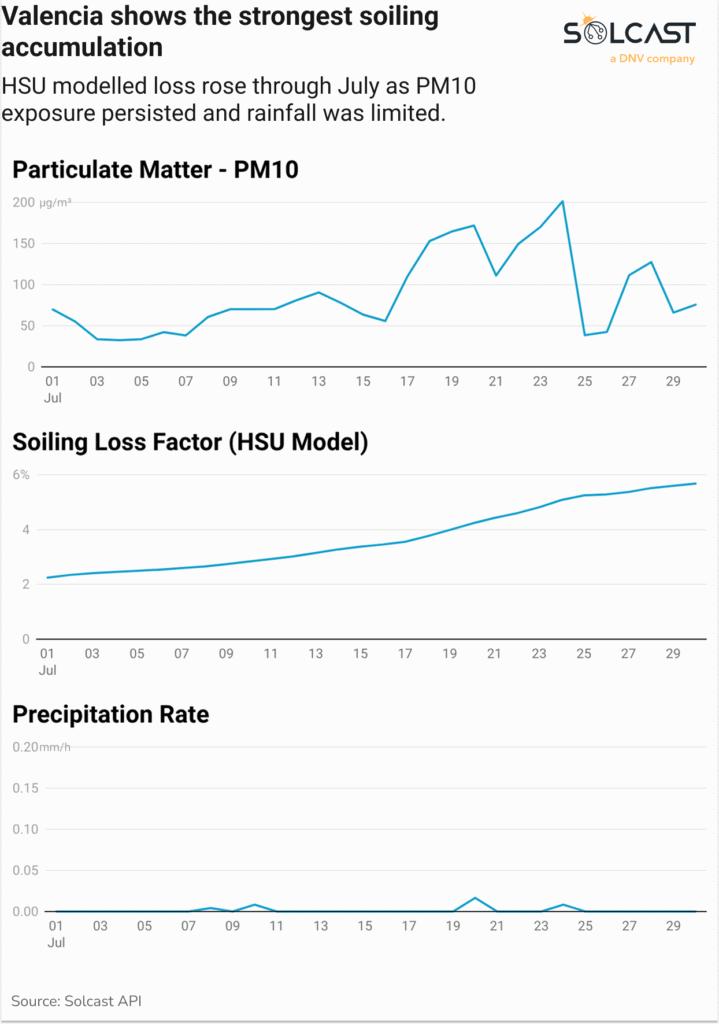
Valencia was the high-accumulation case. PM10 exposure persisted through several parts of the month, while limited rainfall meant the modelled soiling loss continued to rise.
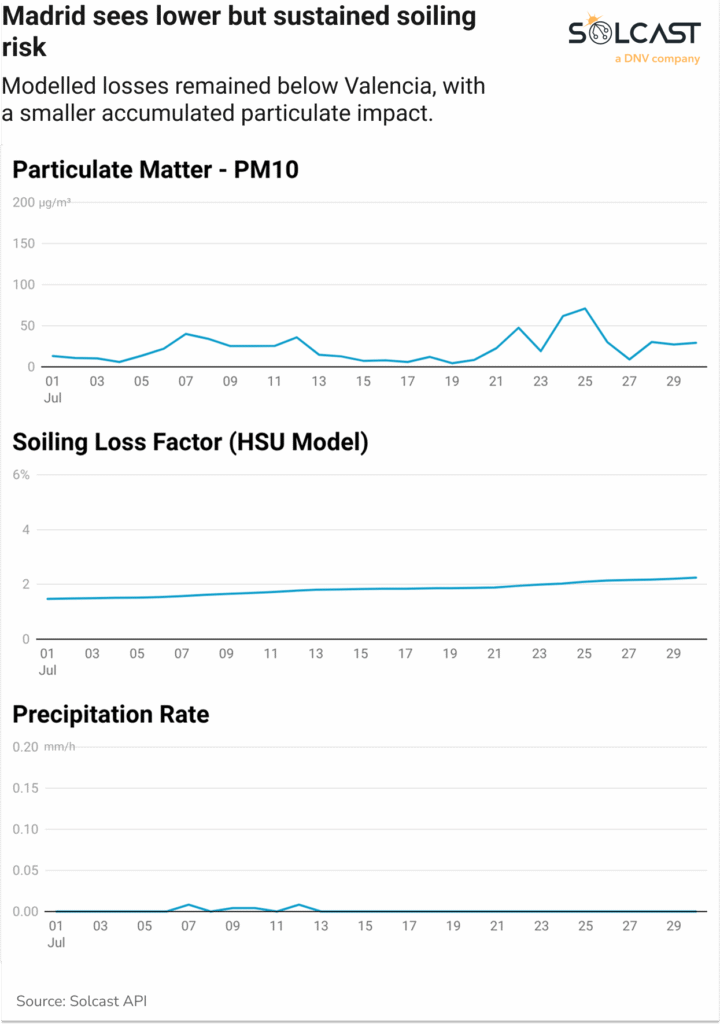
Madrid shows a more moderate example. PM10 levels were lower than Valencia, and the modelled soiling loss increased more slowly, limiting the end-of-month impact.
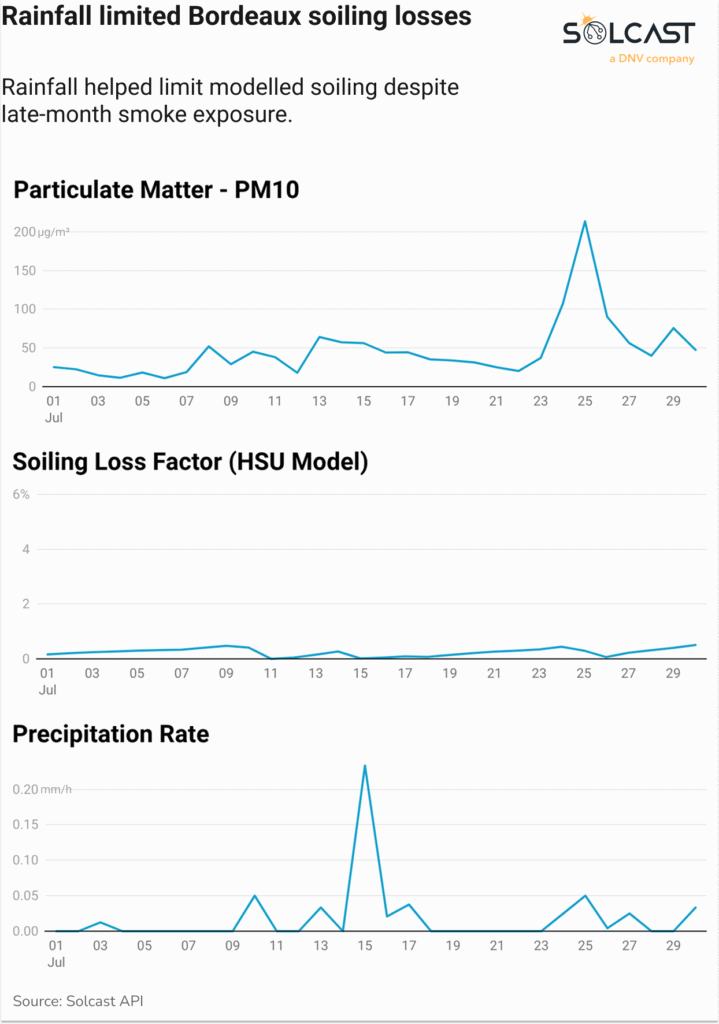
Bordeaux provides the contrast. Particulate levels increased late in the month, but rainfall limited accumulation on uncleaned panels and kept the modelled soiling impact low.
Solcast produces these figures by tracking clouds and aerosols at 1-2km resolution globally, using satellite data and proprietary AI/ML algorithms. This data is used to drive irradiance models, enabling Solcast to calculate irradiance at high resolution, with typical bias of less than 2%, and also cloud-tracking forecasts. This data is used by more than 350 companies managing over 350 GW of solar assets globally.
Source link