

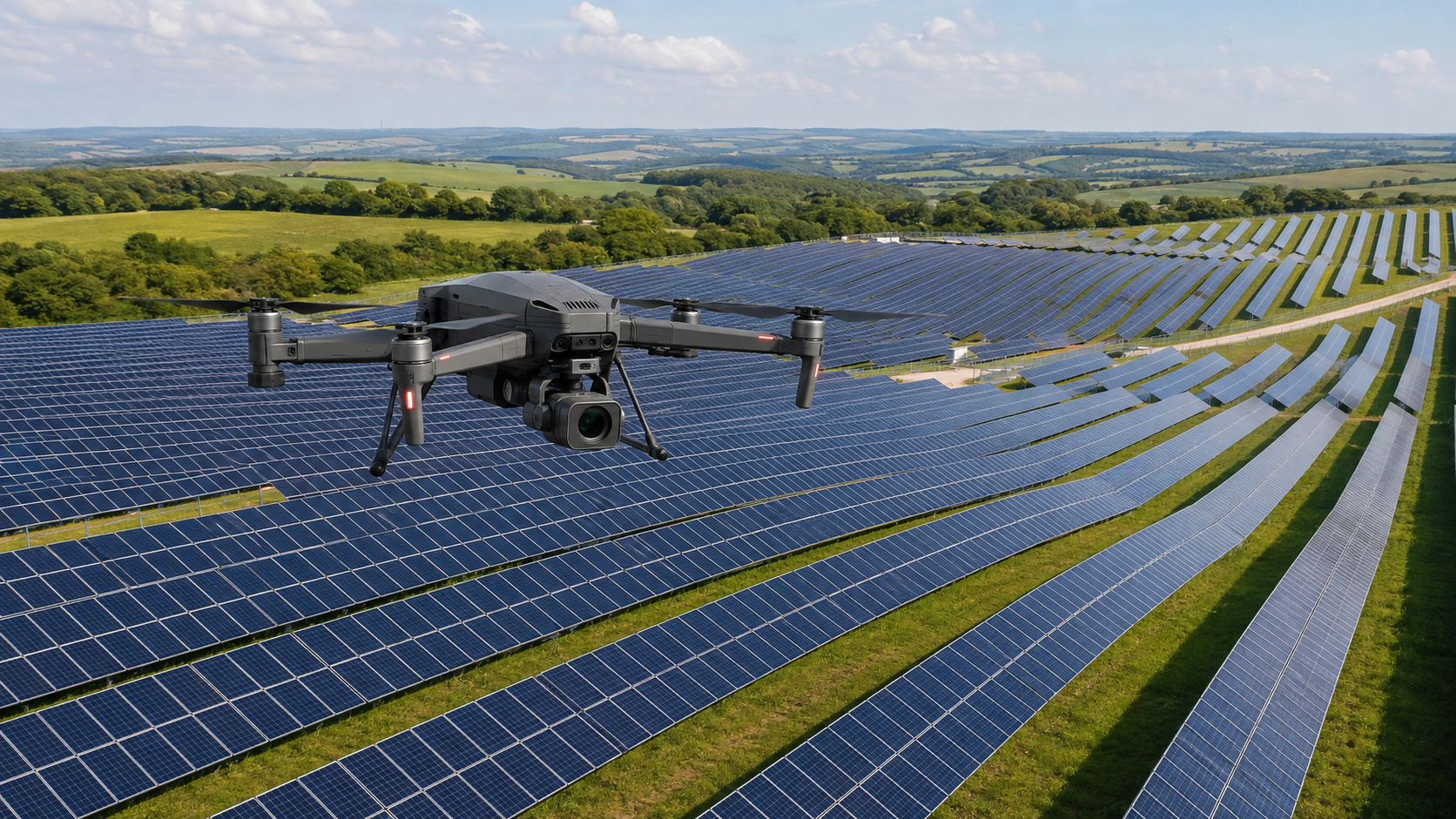
A team of researchers from Spain has developed a novel method for locating faults in individual PV modules and quantifying their severity in large-scale solar plants.
Their proposed technique, which utilizes unmanned aerial vehicles (UAVs), consists of three phases: modeling the UAV’s flight geometry, detecting and quantifying thermal defects, and mapping faults to individual PV modules. Their framework is presented in the research paper A novel approach for fault location and defect quantification in large-scale photovoltaic plants, published in Applied Energy.
Corresponding author Isaac Segovia Ramírez told pv magazine the main novelty of the research is the location and quantification of faults in photovoltaic plants, as traditional machine-learning algorithms generally focus only on identifying the type of fault.
“We are planning to continue this line of research,” he added. “The next steps will focus on validating the proposed methodology in several large-scale photovoltaic plants, improving the automatic classification of faults. For industrial applications, we plan to implement this methodology in Internet of Things (IoT) platforms where customers can upload the images to obtain a report.”
The first phase of the approach models the UAV inspection geometry using flight parameters, camera characteristics, GPS position and PV module dimensions. These parameters are used to calculate the ground sampling distance and convert a defect’s image coordinates into its approximate real-world position.
The second phase then applies a transformer-based deep-learning model to thermal images, detecting defective regions and extracting pixel-level temperature values. Fault severity is assessed using indicators including maximum and average temperature difference, the 95th temperature percentile, thermal variance, affected physical area and integrated thermal contrast.
In the third phase, overlapping UAV images are combined using OpenDroneMap to create a georeferenced orthomosaic. YOLOv8 is then used to identify PV strings, while Segment Anything Model 2 and histogram analysis are applied to segment and count individual modules.
The completed plant map allows each detected thermal anomaly to be assigned to a specific module, even when an existing plant layout is unavailable.
To test the methodology, the team applied it to two operational PV plants in England: an 8 MW facility with more than 38,000 modules and a 3 MW facility with more than 17,000 modules. Data were collected over two consecutive days under estimated irradiance levels of approximately 600–780 W/m². The researchers used different UAVs and thermal cameras, including a DJI Mavic 2 Enterprise equipped with a thermal camera, to evaluate the method under varying acquisition conditions.
The flights captured overlapping infrared and RGB images, which were processed into orthomosaics with a resolution of 5 cm per pixel. The tests targeted common PV faults such as hotspots, broken or defective cells, open circuits and bypass-diode failures. For validation, selected hotspots and thermally affected rows were measured 15 times using both the UAV thermal camera and an independent SI-131 radiometric infrared sensor.
“The most surprising results were the reliability of both algorithms in generating an orthomosaic of the plant from individual images and in classifying faults as either severe or moderate based on several criteria,” Ramírez said.
The framework achieved module-detection accuracies between 95% and 98.55%, with only 20 modules missed in the highest-performing test case. The reconstructed layouts showed row-alignment errors of approximately 6-8 cm, mean angular deviations below 2°, and inter-row spacing variations generally below 5%.
The RoboFlow-DETR model achieved 88.58% precision during validation, while the overall framework reached 96.6% fault-detection accuracy in the case studies, correctly identifying 85 faults. Of these, 34.1% were classified as severe, 27.1% as moderate, and 38.8% as low severity.
Comparison with an independent infrared sensor produced a mean absolute temperature error below 2 C, within the thermal camera’s stated accuracy of ±2 C or ±2% of the measured value. The inspection system had an estimated capital cost of €8,500 ($9,795) and a direct cost of €202 per inspection, comprising €142 in hardware amortization and €60 in cloud-processing expenses.
Researchers from Spain’s Autonomous University of Madrid and the University of Castilla–La Mancha have contributed to the research.
Source link