
In 2000, the National Academy of Engineering named mass electrification and automobility as the first and second greatest engineering achievements of the 20th century.1 Now, a quarter century later, the two are converging through electric vehicles (EVs). However, many developments have been met with resistance.
EVs are giant batteries on wheels. They could smooth out the daily and seasonal variations of energy flows on the electric grid, making the grid more reliable and everyone’s electricity cheaper. But a self-serving alliance of disparate interests is working hard to discourage EV adoption. One front of their many attacks involves apocalyptic tales of grid collapse.
Reduced photovoltaic (PV) system prices have made storage costs the main hurdle to going off-grid. But if your car provides storage, the marginal cost of cutting the cord (“grid defection”) drops drastically. Grid defection is less than ideal for society, no matter how much sense it makes to an individual. But utilities, seeking to maintain their monopolies and to usurp all the benefits of solar for themselves, are creating an environment in which defection has become a logical option for many customers.
None of this opposition is based on truth. Ultimately, it will fail. But even short-term success would be problematic. If we’re to end up with the environmentally, economically, and democratically optimal energy system we deserve, we have a lot of work (education, lobbying, etc.) to do.
The Value of the Grid
The electric grid is a shining example of community in action. Shared use of the equipment necessary to produce and deliver electricity results in massive cost, efficiency, and environmental benefits, compared to users acting independently. Unfortunately, these advantages introduce a huge sociopolitical challenge.
Because the benefits of cooperation are so strong, the grid is a “natural monopoly.” Unlike the “free” and “fair” markets which are the focus of undergraduate economics curricula, natural monopolies are “winner-take-all” markets. Even if competition were allowed, economies of scale would mean that one participant would eventually dominate, putting all others out of business.
At the dawn of the electric age, governments recognized this reality and chose to optimize capital efficiency by granting utilities territorial monopolies. These utilities were vertically integrated, with all necessary components vested in the same company: generation, transmission and distribution (T&D), and control. The granting governments, recognizing the dangers of relying on monopolies for a critical service, chose to retain citizen control by establishing public utilities commissions (PUCs). PUCs are state-level entities, but are now complemented by a wide assortment of federal agencies.
What a Tangled Web
Regulated utility monopolies are among the most successful and visible examples of public-private partnerships in the United States today. The language and concepts of free market purity, competitive advantage earned through customer satisfaction, and other tropes of laissez-faire capitalism simply don’t apply. But that doesn’t stop dishonest actors from using such language as they try to co-opt the regulatory process.
Very soon, the grid will undergo a major shift. Climate and other sustainability goals demand much greater flexibility, far better T&D connectivity, and less reliance on inflexible base load generation. Existing storage, put in place mainly to accommodate high fractions of base generation (especially nuclear), will become increasingly useful (and hence see improved capital efficiency) in the presence of higher fractions of intermittent generating assets like wind and solar.
From Outer Space to a Wire Near You
Before the 1990s, PV only made financial sense off-grid (starting with the ultimate off-grid application: spacecraft). As technology improved and markets expanded, prices dropped. Though still high, they fell enough that committed individuals could justify installing PV on the grid. By the early 2000s, ASES and other advocacy groups were winning fairer compensation and interconnection protocols, most notably net metering. The resulting market growth lowered system prices enough to make both utility-scale PV and grid-tied distributed generation (DG) financially attractive. For those interested in history, Home Power Magazine, now available through an online archive, chronicled this evolution in real time from 1987 until 2018.2
Customer-owned DG represents a major disruption of the investor-owned utility (IOU) business model. IOUs are fighting tooth and claw to retain their obsolete monopolies. Using a script provided by the American Legislative Exchange Council (ALEC), a segment of conservative politicians disingenuously attacks DG by reducing or eliminating net metering compensation, adding bogus fees, and erecting other hurdles. Their arguments accuse net-metered customers of freeloading, claiming that DG systems add costs that their (presumably wealthy) owners don’t pay, creating a cross-subsidy from less affluent ratepayers.
Contrary to ALEC’s main line of attack, numerous independent studies have concluded that net metering introduces no significant cross-subsidy.3 In fact, many studies show the opposite: a significant cross-subsidy from net metered customers to other ratepayers.4,5
Because batteries are usually the most expensive part of an off-grid system, most grid-tied PV systems don’t include storage, and anti-islanding safety features prevent them from generating power during grid outages. Accordingly, much of ALEC’s model legislation “encourages” net metered ratepayers to add storage. The real purpose is to raise system costs, lengthening payback times, and discouraging investment.
Driving to Resilience (The Opportunity)
EVs disrupt an even broader group of industries than PV. Automotive OEMs (original equipment manufacturers, the people who build complete vehicles) have generally accepted their fate: they can either develop competitive EVs or they can surrender to China and go bankrupt. But other industries (oil and gas, biofuels, ocean shipping, and automotive suppliers, to name just a few) are still resisting. Their primary weapons are euphemistically called “disinformation” and “spin”; in plain language, lies.
One pervasive claim is that EVs will crash the grid. But the opposite is true. Cars are typically parked 22 hours a day, so EVs represent an almost totally dispatchable load. Drivers can be encouraged to charge during off-peak hours by offering modest incentives, such as lower prices. With significant added revenue and almost no added expense, utilities get a much smoother load profile, making the grid more reliable. Ratepayers get lower rates.
The extent to which EVs can be used to power non-automotive loads varies, and is described using a host of associated terms.6
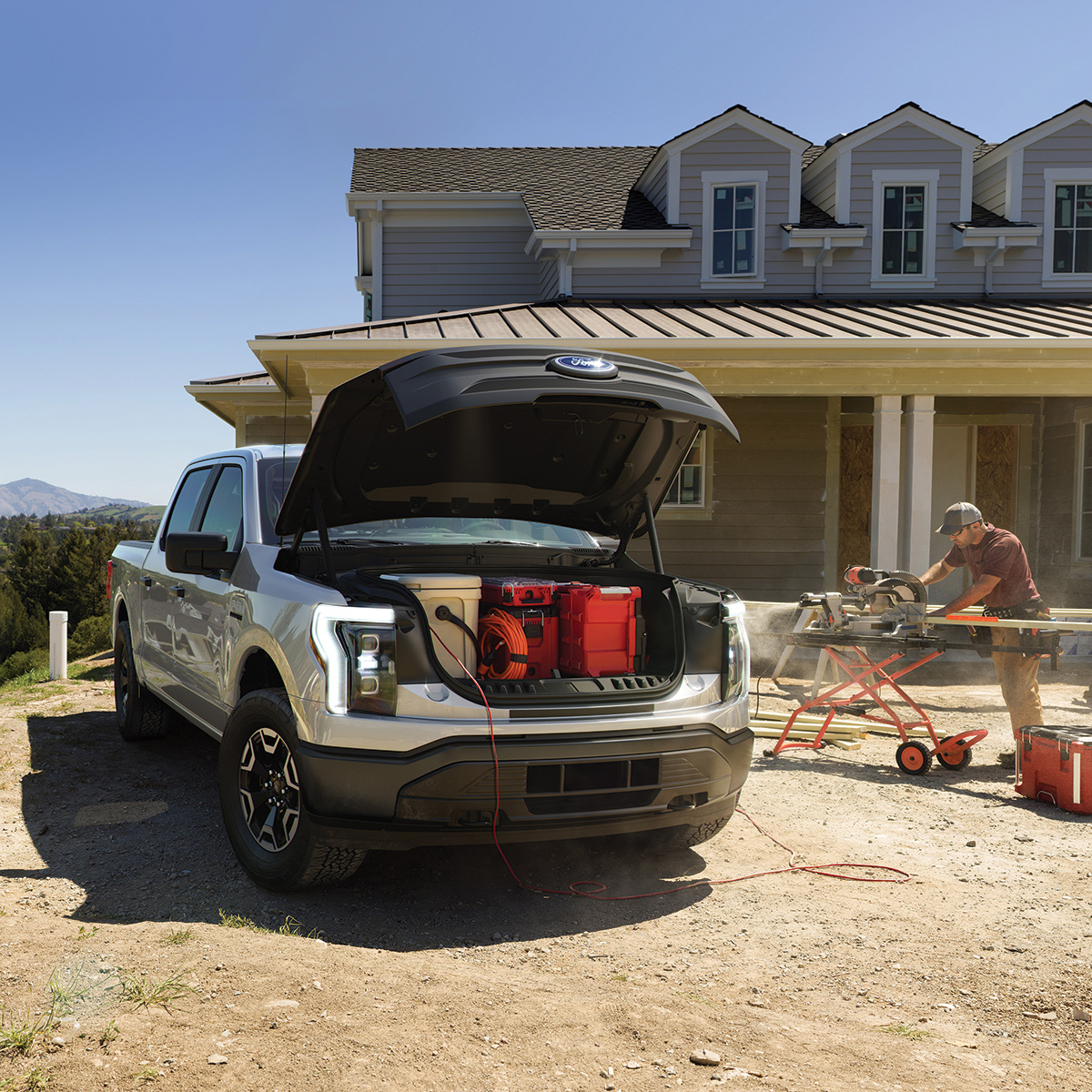
Quite a few existing and proposed vehicles can export power.7 It is not the purpose here to definitively establish nomenclature, nor to catalog product offerings in such a rapidly evolving market. So let’s just call all bidirectional power capability V2L (vehicle-to-load), and emphasize that it already exists and is growing fast. As IEEE (formerly the Institute of Electrical and Electronics Engineers), SAE (the Society of Automotive Engineers), ISO (the International Organization for Standardization), and other bodies standardize hardware and related protocols, we can expect V2L to spread even faster.
Ford F-150 Lightning electric pickup truck powering a construction site. © Ford Motor Company
With V2L, EVs’ potential as storage and dispatchable supply becomes at least as attractive as their dispatchable demand. Numerous companies are already enlisting EV owners to participate in virtual power plants, which will use the EVs’ batteries to completely replace gas-fired peaker plants, the most expensive power on the grid.8
Playing Well with the Other Children
As stated earlier, the grid is a community that facilitates resource sharing. But communities only work when everyone practices the kindergarten lessons of sharing and fairness.
For example, in the western North Carolina mountains (my home), electric demand peaks in the winter, and my net-zero PV system produces a summer surplus. But that overproduction isn’t wasted; the grid carries it to the piedmont of North and South Carolina, helping power the air conditioners that define summer peaks there. Conversely, a net-zero system in the piedmont might overproduce in winter, helping run my heat pump. Grid connectivity also allows ratepayers who can’t invest in PV to share in the benefits available to those who can, such as lower rates and greater reliability.
Storage tells a similar story. Duke Energy’s Lake Keowee / Jocassee / Bad Creek pumped storage hydroelectric facility in upstate South Carolina was built to absorb the excess off-peak output of the Oconee nuclear station. But it also buffers the intermittency of all other generators
on the grid, notably solar and wind.
Utility-owned batteries, located at the substation level in the distribution network and shared by all customers in that zone, could provide buffering with far fewer batteries than an equally capable array of independent, customer-owned systems. But the ALEC playbook pushed by most IOUs “encourages” individual, civic-minded customers to install (and fund) the batteries. Through punitive fees, inadequate reimbursement rates, and other sleight of hand, the same playbook seeks to create a system which lets utilities hoard all the benefits, just as it does with customer-owned generation.
A related dynamic is playing out with massive proposed expansions to support hyperscaled data centers for artificial intelligence (AI) and cryptocurrency operations. These investments are only necessary because of the projected new loads, but well-connected lobbyists for these uber-wealthy industries are seeking to push the expense into the rate base funded by all customers.
Overlanding (Leaving the Main Road)
Until recently, most ratepayers would have been forced to accept such unfairness, leaving only the IOUs to make the investments (the real goal of the subterfuge). But EVs with V2L are game changers. And there’s nothing like a disaster to put change in the spotlight.
When Hurricane Helene hit western North Carolina in September 2024, EVs did yeoman service. Some EVs have built-in AC plugs, both 120 and 240 volts.9 Over-the-counter adapters can turn the J1772 AC charging port on other EVs into a 120V AC outlet. Both approaches proved useful in running medical equipment, chainsaws, and other tools as people recovered from the storm. A friend and fellow EV advocate used a simple homebrewed inverter setup to run five refrigerator/freezers and a variety of other household appliances for a week, using only half the battery capacity of his Chevy Bolt (about 32 kWh, out of 64 total).
Post-Helene, generator sales in the area have increased markedly. But a typical generator costs $12,000, installed, and requires quite a bit of ongoing maintenance. Usually fueled from a methane line or a propane tank, and always loud, you only run it when you absolutely must. On the other hand, a PV system with modest battery backup is useful 365 days a year, with very low fuel costs, no noise, and almost no maintenance.
Most grid-tied PV systems lack batteries, mainly due to cost. Batteries also carry an environmental penalty, since they consume, rather than generate, electricity. The most productive way to build a flexible, reliable, environmentally optimal system is to have more customer-owned generation directly feeding the grid, with utilities building the bulk of the storage.
However, with memories of the hurricane (and wildfires or other disasters in other locations) still strong, many home PV owners are adding battery backup. Battery prices have fallen, and continue to fall, precipitously – 99% since the 1990s. Concurrently, punitive changes to net metering tariffs are leading many to consider a minimal battery pack to enable greater self-consumption and lower bills. But it’s a slippery slope.
If a microgrid can island itself for a few hours or days, the main impediment to staying off-grid permanently is the cost of the battery pack required for the most extreme sunless stretch, which only occurs every few years. But an EV with an average-sized battery can power an entire house for several sunless days, then drive to a power source and bring home a fresh load of electricity when its charge gets low. Even the most extreme case is covered, with no need for the hawk-eyed attention to consumption required in those off-grid homes described in early issues of Home Power.
People Get Ready (Just Get On Board)
Affordable energy is a luxury by world standards, but has become essential for life in developed countries. As with most necessities, freedom and democracy matter a lot in the energy arena. However financially viable it may become, defection from the grid by DG owners would be highly undesirable for society at large. But it’s a serious risk, given the way IOUs are resisting this evolution.10,11
ALEC’s propaganda claims that penalizing DG owners protects less affluent ratepayers. But, as more PV owners defect, the grid’s fixed costs would be spread among fewer customers, leading to even more defections. Ultimately, only lower-wealth ratepayers would remain on-grid, and large amounts of extra capital would have been expended creating a socially undesirable electricity system (no longer a fully interconnected grid) that is neither economically nor environmentally optimal.
The electric grid of the near future will require significant up-front capital investment to realize the most cost-effective long-term solution. Storage and distributed rooftop solar will play an essential part in meeting those goals.12 Fair tariffs and other protocols are essential to protect IOUs from the fate already experienced by landline telephone companies.
Any game must be fair to everyone playing to be sustainable. The rules of the electricity game are heavily influenced by the people in charge of utilities and utilities commissions. We must help them make the right choices.
“It goes on one at a time, it starts when you care to act, it starts when you do it again after they said no, it starts when you say We and know who you mean, and each day you mean one more.” – Marge Piercy (from “The low road”)
About the Author
Automotive engineer and ASES Life Member Dave Erb has developed vehicles using gasoline, diesel, biodiesel, alcohol, methane, electric, and hybrid electric powertrains. He wrote Chapter 1 of David Hrivnak’s “Driving to Net 0: Stories of Hope for a Carbon-Free Future,” a collection of 15 first-person accounts of families combining electric vehicles with solar houses and other sustainability strategies. He hasn’t bought gas
since 2019.
Sources:
- tinyurl.com/2r5nc2ba
- homepower.com
- emp.lbl.gov/publications/putting-potential-rate-impacts
- tinyurl.com/brookingsnet-metering
- tinyurl.com/sciencedirect-solar
- tinyurl.com/insideevs-v2g
- tinyurl.com/insideevs-v2l
- tinyurl.com/lazards-lcoe-june2025
- tinyurl.com/ev-f150-vs-silverado
- tinyurl.com/eei-disruptive-challenge
- tinyurl.com/forbes-electric-utilities
- tinyurl.com/pvmag-roadmap-grid-distributed
Source link