

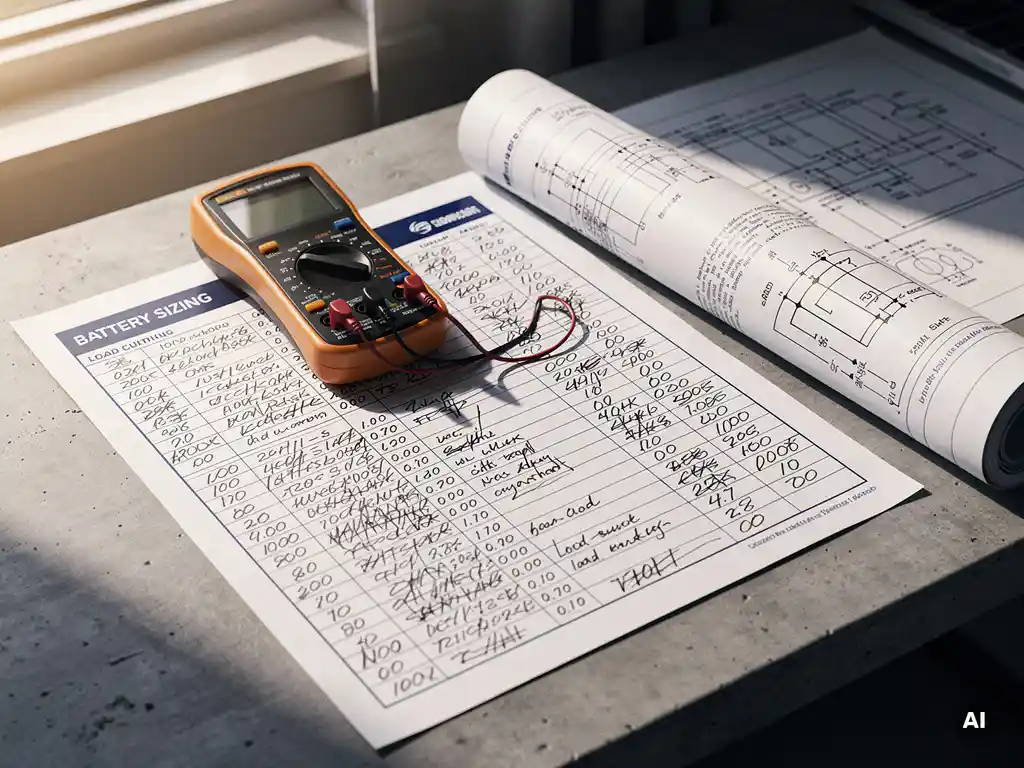
Battery sizing calculations are affected by several interconnected factors: daily energy consumption, depth of discharge, temperature, required autonomy days, inverter efficiency, and whether the system is off-grid or grid-tied. Each factor either increases or decreases the total battery capacity you need to install. Getting any one of them wrong can result in a system that underperforms, degrades prematurely, or fails to deliver power when it matters most. The sections below break down each factor in detail so you can size your battery bank with confidence.
How does daily energy consumption affect battery sizing?
Daily energy consumption is the starting point for every battery sizing calculation. The more energy your loads consume each day, the larger the battery bank needs to be to cover that demand. To find your baseline, total up the wattage of every connected load and multiply by the number of hours each load runs per day. This gives you your daily energy requirement in watt-hours (Wh) or kilowatt-hours (kWh).
This figure directly sets the floor for your battery capacity. If your system consumes 10 kWh per day and you want the battery to cover one full day of demand, you need at least 10 kWh of usable storage before any other correction factors are applied. In practice, that number grows once you account for depth of discharge limits, temperature derating, and system losses.
Accurate load assessment is critical here. Underestimating consumption leads to undersized batteries that cycle too deeply and wear out faster. Overestimating inflates costs unnecessarily. For commercial and industrial projects, a detailed load profile that captures seasonal variation and peak demand periods produces far more reliable results than a simple average.
What role does depth of discharge play in battery capacity?
Depth of discharge (DoD) defines how much of a battery’s total capacity can actually be used without damaging the cells or significantly shortening their lifespan. Because you cannot safely use 100% of a battery’s rated capacity, the usable capacity is always less than the nameplate figure. This means the total installed capacity must be larger than your daily energy requirement alone suggests.
Different battery chemistries have different recommended DoD limits. Lithium iron phosphate (LFP) batteries typically support a DoD of 80 to 90%, while lead-acid batteries are generally limited to 50% to preserve cycle life. The formula is straightforward: divide your required usable energy by the DoD percentage to find the minimum installed capacity.
For example, if you need 10 kWh of usable storage and your battery supports an 80% DoD, you need a minimum installed capacity of 12.5 kWh. Choosing a battery and regularly discharging it beyond its recommended DoD accelerates degradation, reduces total cycle count, and shortens the system’s economic life. Respecting DoD limits is not a conservative safety margin; it is a fundamental part of accurate battery sizing.
How does temperature affect battery sizing calculations?
Temperature directly reduces the effective capacity of a battery. Most battery manufacturers rate their products at a standard temperature, typically around 25°C. When operating temperatures fall below this reference point, available capacity drops. When temperatures rise significantly above it, capacity may increase slightly in the short term, but long-term degradation accelerates. Both extremes require attention during the sizing process.
For installations in cold climates, a temperature correction factor must be applied to account for capacity loss. A lead-acid battery, for instance, can lose 20 to 30% of its rated capacity at temperatures near freezing. Lithium chemistries are generally more stable across temperature ranges, but they still experience measurable capacity reduction in cold conditions and may require thermal management systems in extreme environments.
In practice, this means your battery sizing calculation should include a temperature derating factor based on the lowest expected operating temperature at the installation site. Ignoring this step leads to a system that cannot deliver its designed energy output during the coldest periods, precisely when reliable storage may be most critical. For utility-scale and commercial projects, reviewing the manufacturer’s temperature-capacity curves and applying site-specific derating is standard engineering practice.
What are autonomy days and how do they change battery size?
Autonomy days refer to the number of consecutive days a battery system must supply energy without any input from solar generation or the grid. The more autonomy days a system is designed for, the larger the battery bank must be. This factor is especially significant for off-grid systems or critical loads that cannot tolerate any interruption in supply.
The relationship is linear: two autonomy days require twice the usable storage of a one-day design, before other correction factors are applied. For a system consuming 10 kWh per day with a target of three autonomy days, the required usable storage is 30 kWh. After applying DoD limits and temperature derating, the installed capacity grows further.
Selecting the right number of autonomy days involves balancing reliability against cost. In regions with consistent solar irradiance and grid backup available, one to two autonomy days is often sufficient. In remote off-grid locations, areas prone to extended cloudy periods, or systems supporting critical infrastructure, three to five or more autonomy days may be warranted. The design choice should be driven by site-specific data on solar resource variability and the consequences of a supply interruption, not by a generic rule of thumb.
How does inverter efficiency factor into battery sizing?
Inverter efficiency determines how much energy is lost during the conversion from DC battery storage to AC power for connected loads. Because no inverter operates at 100% efficiency, the battery must store more energy than the loads actually consume. This conversion loss must be accounted for in the sizing calculation to ensure the system delivers the required output.
Modern inverters typically operate at efficiencies between 93% and 98%, depending on the technology and load conditions. To find the energy the battery must supply, divide the total AC load requirement by the inverter efficiency. If your loads require 10 kWh of AC energy and your inverter operates at 95% efficiency, the battery must deliver approximately 10.5 kWh of DC energy to meet that demand.
While this adjustment may seem small in isolation, it compounds with other correction factors. When you stack daily consumption, DoD limits, temperature derating, autonomy days, and inverter losses together, the cumulative effect on required installed capacity can be substantial. Omitting inverter efficiency from the calculation introduces a systematic underestimate that affects every day of system operation.
Should battery sizing calculations differ for off-grid versus grid-tied systems?
Yes, battery sizing calculations differ significantly between off-grid and grid-tied systems because the role the battery plays in each configuration is fundamentally different. In an off-grid system, the battery is the sole backup for all energy demand when solar generation is unavailable. In a grid-tied system with battery storage, the grid acts as a secondary backup, which changes how conservatively the battery needs to be sized.
Off-grid battery sizing
Off-grid systems require the most rigorous battery sizing approach. With no grid connection to fall back on, the battery must cover all load demand during periods of low or zero solar generation. This means autonomy days, temperature derating, and DoD limits all need to be applied conservatively. The cost of undersizing is a complete loss of power to critical loads, which is unacceptable in most off-grid applications. Engineers typically size off-grid batteries for worst-case solar resource conditions at the site, not average conditions.
Grid-tied battery sizing
Grid-tied systems with battery storage are typically sized for a specific purpose: self-consumption optimization, peak shaving, backup for critical loads during outages, or a combination of these. Because the grid provides a safety net, the battery does not need to cover all possible demand scenarios. Sizing is driven by the target use case rather than worst-case autonomy requirements. A system designed purely for peak shaving, for example, may only need enough capacity to shift a few hours of peak demand, while a system providing backup for critical loads during grid outages requires a more conservative approach similar to off-grid sizing.
Understanding which configuration you are designing for is the first question to answer before any battery sizing calculation begins. Mixing the assumptions of one approach into the other produces a system that is either dangerously undersized or unnecessarily expensive.
If you are working through battery sizing as part of a larger PV system design, the same engineering discipline applies across every component. Virto Solar builds tools that support this kind of integrated, calculation-driven design workflow for commercial and utility-scale projects. If you want to see how automated design software handles these interdependencies in practice, get in touch with our team to explore what fits your project requirements.
Frequently Asked Questions
What is the correct order to apply all the correction factors when sizing a battery bank?
The recommended approach is to start with your daily energy consumption in AC watt-hours, then divide by inverter efficiency to get the DC energy the battery must deliver. Next, multiply by the number of autonomy days, then divide by the DoD limit to get the minimum installed capacity, and finally apply the temperature derating factor on top of that. Applying the factors in a logical sequence prevents compounding errors and gives you a defensible, traceable calculation that can be reviewed and adjusted as project inputs change.
How do I estimate daily energy consumption accurately if my loads vary significantly throughout the year?
Rather than using a single annual average, build separate load profiles for your peak season (typically winter for heating-heavy sites or summer for cooling-heavy ones) and your minimum season, then size the battery for the worst-case month. For commercial and industrial sites, pulling interval data from utility bills or using a sub-metered energy audit gives you real consumption patterns rather than estimates. Sizing to the worst-case period ensures the system performs reliably year-round without relying on assumptions that only hold true part of the time.
What happens if I regularly discharge my batteries beyond the recommended depth of discharge?
Consistently exceeding the recommended DoD accelerates electrochemical degradation inside the cells, which reduces total cycle count and shortens the battery’s usable lifespan. For lead-acid batteries, chronic over-discharge can cause sulfation that permanently reduces capacity; for lithium chemistries, it stresses the anode and cathode materials in ways that are similarly irreversible. In practical terms, a battery rated for 3,000 cycles at 80% DoD might deliver fewer than 1,000 cycles if routinely discharged to 95%, dramatically increasing your cost per kilowatt-hour over the system’s life.
Is it worth investing in battery thermal management for a commercial installation in a moderate climate?
Even in moderate climates, temperature swings between seasons can meaningfully affect battery performance and longevity, making some level of thermal management a worthwhile investment for commercial projects. At minimum, the installation environment should be designed to keep batteries within the manufacturer’s recommended operating range, which often means insulated enclosures, ventilation, or passive thermal buffering. For larger systems where battery replacement costs are significant, active thermal management typically pays for itself through extended cycle life and more predictable capacity delivery across all seasons.
How many autonomy days should I design for if my off-grid site has highly variable solar irradiance?
For sites with high solar variability — such as those in high-latitude regions, areas with frequent overcast periods, or locations with a pronounced rainy season — a minimum of three to five autonomy days is a common engineering starting point, but the right number should be derived from site-specific solar resource data. Reviewing historical irradiance records to identify the longest consecutive low-generation periods at your specific location gives you a data-driven basis for the autonomy day target. Pairing a well-sized battery bank with a backup generator for extended low-irradiance events is often more cost-effective than sizing the battery alone to cover extreme outlier scenarios.
Can I add more batteries later to expand capacity, or do I need to get the sizing right from the start?
Expanding a battery bank after initial installation is possible but comes with important constraints: mixing batteries of different ages, states of health, or even different production batches from the same manufacturer can cause imbalanced charging and accelerated degradation across the entire bank. For lithium systems with battery management systems (BMS), adding new modules to an existing string often requires careful compatibility verification with the BMS and inverter. The most cost-effective and technically sound approach is to size accurately from the start, but if phased expansion is a project requirement, designing the system architecture — wiring, inverter capacity, and BMS — to accommodate future additions from day one avoids costly retrofits later.
What is the most common battery sizing mistake made in commercial and industrial solar projects?
The most common mistake is sizing the battery based on average daily consumption and a single correction factor — typically DoD — while ignoring temperature derating, inverter losses, and realistic autonomy requirements. This produces an installed capacity that looks adequate on paper but consistently underperforms in the field, especially during cold weather or periods of high demand. A close second is applying off-grid sizing logic to a grid-tied system (resulting in oversized, expensive storage) or grid-tied logic to an off-grid system (resulting in a bank that cannot sustain loads through low-generation periods). Treating battery sizing as an integrated calculation that accounts for all interdependent factors simultaneously is the only reliable way to avoid these outcomes.
Related Articles
This content was generated with the help of AI — it may contain mistakes
Source link