

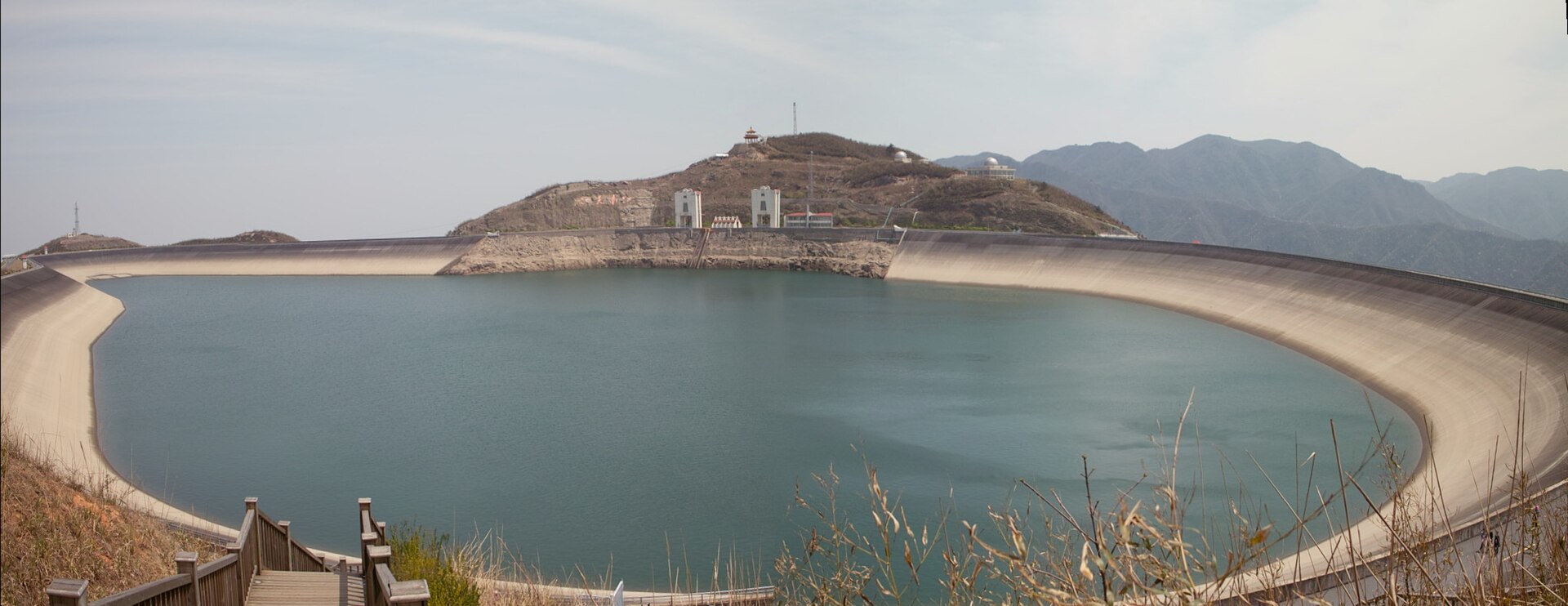
We need a plenty of long-duration rechargeable storage in solar- and wind- dominated electricity grids for night-time, and to ride through cloudy and windless days and weeks. Fortunately, there is unlimited off-river pumped hydro: 800,000 sites around the world with 86 million GWh of combined storage which is enough to absorb nearly 3 years of global electricity production.
Pumped hydro is highly mature, with more than 100 years of operating experience, and widely deployed, with over 200 GW of capacity. It has low water use because water is recycled in a closed loop, requires no mining, uses less land than equivalent batteries, and has high local content, unlike batteries, which are largely imported. No new dams on rivers are required. Its capital cost per kWh is substantially lower than that of equivalent batteries, and its lifespan is much longer, at up to 150 years.
Globally abundant pumped hydro sites
We may take 50 kWh (0.05 MWh) per person as a rule-of-thumb requirement for rechargeable storage for an affluent person relying on solar and wind for all energy. This is equivalent to an EV battery per person. For perspective, Australia (which generates the most solar electricity per person) will soon have 18 kWh per person of rechargeable pumped hydro and battery storage.
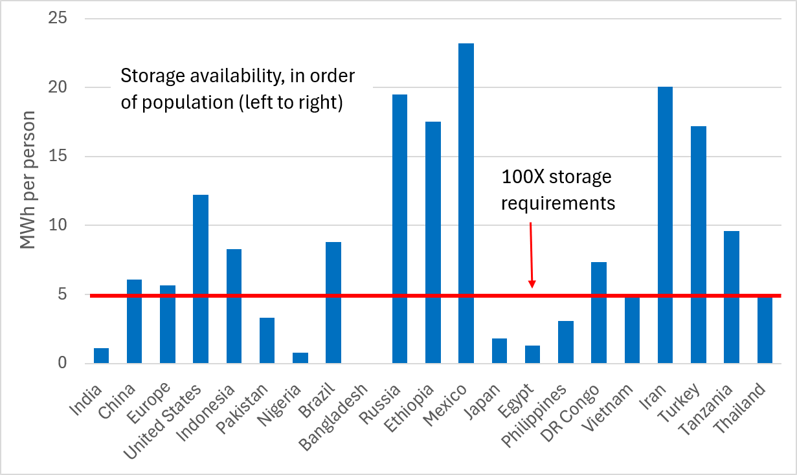
Global regions have 70 times to 500 times more pumped hydro storage potential than required.
The top 21 jurisdictions by population host 80% of the global population. Only Bangladesh has insufficient pumped hydro sites. Nigeria and India have 16 times and 22 times more sites than required, respectively. Most countries have more than 100 times the sites required, providing an abundant choice of potential sites. A detailed spreadsheet is here.
Pumped hydro
In the Global Pumped Hydro Atlas, sites are listed in the size range 5 GWh to 5000 GWh, and ranked by indicative capital cost as AAA, AA, A, B, C, D and E. Roughly speaking, 5000 GWh provides sufficient rechargeable storage for 100 million affluent and fully decarbonized people who derive all their energy from solar and wind.
For perspective, 5 GWh would be a very large utility battery, while Snowy 2.0 under construction in Australia has storage of 350 GWh at a cost of US$30-40 per kWh and with a lifetime of 150 years. Mountainous countries have many sites with indicative costs half that of Snowy 2.0. Pumped hydro is cheap ($/kWh) because the marginal cost of doubling energy storage is merely the cost of scooping more rock from the bed of the reservoirs to make the dam walls higher.
Pumped hydro and batteries together solve energy storage. Batteries provide high-power intra-day storage and mobility solutions in the size range of kilowatt-hours, megawatt-hours and gigawatt-hours. However, batteries are over-powered for deep storage, and that unnecessary power is expensive. A 100-hour 1 GW battery costs about the same as a 2-hour 50 GW battery (both 100 GWh). The lifetime of Li-ion battery is one tenth that of pumped hydro (150 years).
Authors: Prof. Ricardo Rüther (UFSC), Prof. Andrew Blakers (ANU)
ISES, the International Solar Energy Society is a UN-accredited membership NGO founded in 1954 working towards a world with 100% renewable energy for all, used efficiently and wisely.
Source link