

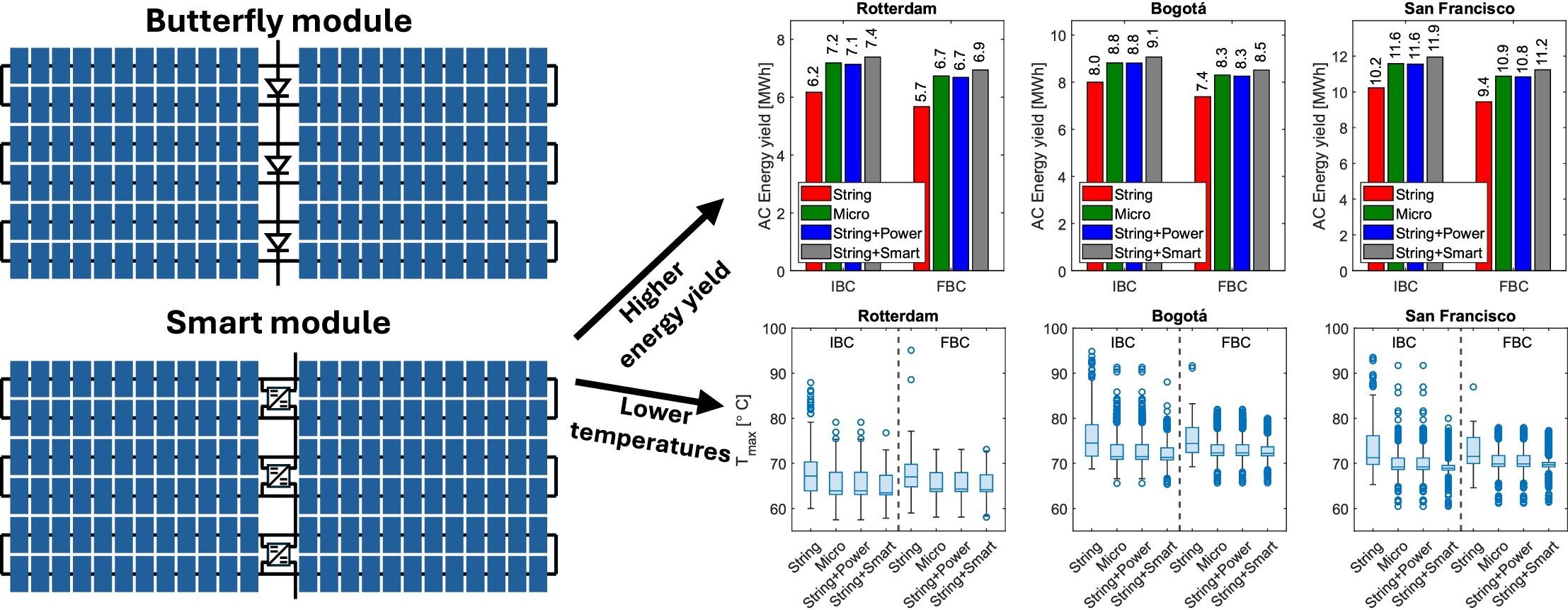
A research team from Delft University of Technology (TU Delft) in the Netherlands has investigated the potential of smart PV modules in urban environments. As simulated in the study, smart PV modules feature built-in buck converters that allow substrings within a module to operate independently, improving energy yield under shaded conditions.
“Although this concept has already been introduced in other studies, the novelty of our work is that we calculate the energy yield of systems with these smart modules under realistic conditions and compare them with conventional systems,” corresponding author Youri Blom told pv magazine. “The results show that the smart modules have the highest performance across all considered system topologies.”
Blom said his group plans to further investigate how power electronics can improve the performance of solar panels.
“This is also being applied to four-terminal perovskite-silicon modules. As these devices have two strings, integrated power electronics can play a key role in avoiding the need for additional converters,” he said.
For their research, the team simulated eight PV system configurations using the PVMD Toolbox. The systems combined two TOPCon cell architectures, interdigitated back contact (IBC) and front/back contact (FBC), with four converter topologies.
The reference butterfly modules used 156 mm × 78 mm half-cut cells arranged into six substrings with bypass diodes. The smart modules replaced the bypass diodes with buck converters, allowing each substring to operate independently at its own maximum power point.
The four configurations were butterfly modules with string inverters, butterfly modules with microinverters, butterfly modules with string inverters and power optimizers, and smart modules with string inverters.
The researchers simulated the systems on the same modeled rooftop, using 25 PV modules, in three locations: Rotterdam in the Netherlands, Bogotá in Colombia, and San Francisco in the United States. The rooftop faces southwest at an azimuth of 146 degrees and includes several surrounding objects that create partial shading. The simulations covered a full year.
“The most surprising result was that systems with smart modules can have up to 50% additional module costs and still have the same levelized cost of electricity (LCOE) as the other systems considered,” Blom said. “This means that if the increased cost of power electronics is lower than 50%, the smart modules will have better financial performance. Although it was expected that smart modules would have higher energy yields than conventional systems with microinverters, the fact that they require fewer power converters improves their financial performance.”
The results also showed that the system with smart modules had the highest energy yield among all considered topologies because the substrings can operate independently. This improved shade resilience, resulting in a 15%-20% gain in energy yield compared with the system with string inverters and a 2%-3% gain compared with systems using microinverters or power optimizers.
The novel approach was presented in “Investigating the energy yield performance of smart photovoltaic modules in shaded environments,” published in Solar Energy.
Source link