

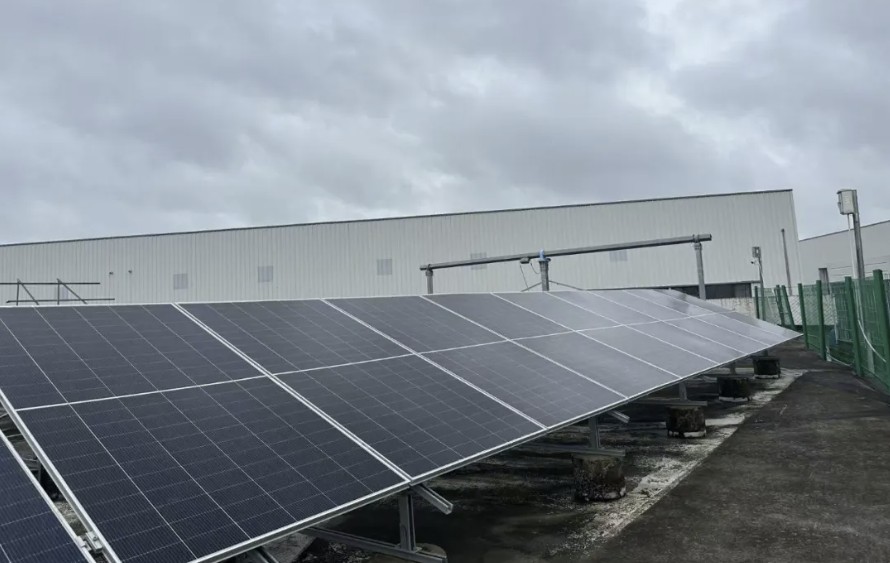
Trina Solar has launched a new series of typhoon-resistant PV modules for projects exposed to extreme winds, particularly in coastal China and other typhoon-prone Asian markets.
The Chinese manufacturer said it standard typhoon-resistant module is designed to withstand a rear-side mechanical load of 4,500 Pa, compared with 2,400 Pa for conventional products, adding that the new product is also subjected the design to static loading at 1.05 times its rated level and dynamic loading at 1.5 times the rated level.
At the top of the range is the typhoon-resistant MAX configuration, based on the company’s Vertex N Shield module. Trina lists a static mechanical load capability of over 8,000 Pa, with an optimized frame providing 30% higher downward and 67% higher upward mechanical load capacity.
The company said the load level is designed for conditions associated with China’s Force 17 super-typhoon classification. This designation represents the highest intensity level on the country’s extended wind scale, reserved for the most powerful and destructive tropical cyclones classified as super typhoons.
The design also addresses mounting-system failures. Trina has developed a patented slot-based, self-locking clamp inspired by traditional mortise-and-tenon joints. The clamp mechanically aligns the module and mounting structure and is intended to reduce installation errors and loosening caused by repeated vibration. Trina claims the design can cut installation time by about 25%. The module frame has also been widened by 10% and thickened by 11% to improve load transfer to the supporting structure.
For impact resistance, the MAX version uses reinforced dual glass. Trina’s official product data states that the Vertex N Shield can withstand 75 mm hailstones at a 60-degree tilt. The module has also received IEC 61730 A+A and UL 61730-2 Type 30 (A+A) fire certifications. Trina said earlier RETC testing gave the product “High Achiever” results in thermal cycling, damp heat, static and dynamic mechanical loading, and PID testing.
For tracker-based installations, Trina’s extreme-weather solution combines reinforced modules with its tracking systems and cloud-based wind monitoring. When wind speeds reach preset thresholds, the tracker can automatically move to protective angles, with different strategies applied according to weather conditions.
The focus on wind resilience reflects a growing asset-risk issue for solar developers across eastern and southern China and Southeast Asia. Extreme weather events regularly test energy and other infrastructure across the region. In the past week, Typhoon Dolphin, described by the World Meteorological Organization (WMO) as unusually long-lasting, triggered mass evacuations and severe coastal and inland flood risks, while rainfall records were broken across several Chinese provinces.
IEA PVPS research identifies structural deformation, cascading mounting failures, airborne debris and flooding among the main threats to PV plants during tropical cyclones. It recommends more robust fastening systems, higher wind-load resistance and improved tracker stow strategies.
Source link