

As India accelerates its transition toward a cleaner and more resilient energy system, the renewable energy sector is increasingly being assessed not only by installed capacity and power generation, but also by its approach to emissions, resource efficiency, responsible supply chains, technology, and long-term sustainability.

ReNew’s FY2025–26 Integrated Report, its third such report, provides an overview of the company’s operational, financial and sustainability performance for the year ended March 31, 2026. The report reflects ReNew’s growing integration and diversification across the clean-energy value chain, with separate disclosures, where appropriate, for its Independent Power Producer (IPP) and manufacturing businesses.
With a portfolio spanning renewable generation, solar manufacturing, energy storage and other clean-energy solutions, ReNew is positioning itself beyond conventional renewable power generation toward a more integrated clean-energy platform.
From Renewable Generator to Integrated Clean-Energy Platform
One of the key themes emerging from the report is ReNew’s evolution across the clean-energy value chain.
Its portfolio includes solar, wind, hydro and battery energy storage, alongside solar cell and module manufacturing. The report also highlights its transmission, energy markets and commercial and industrial businesses, reflecting an increasingly diversified clean-energy ecosystem.
This expansion is significant as India’s energy transition moves beyond adding renewable generation capacity toward building a more integrated domestic ecosystem covering generation, manufacturing, transmission, storage and energy solutions.
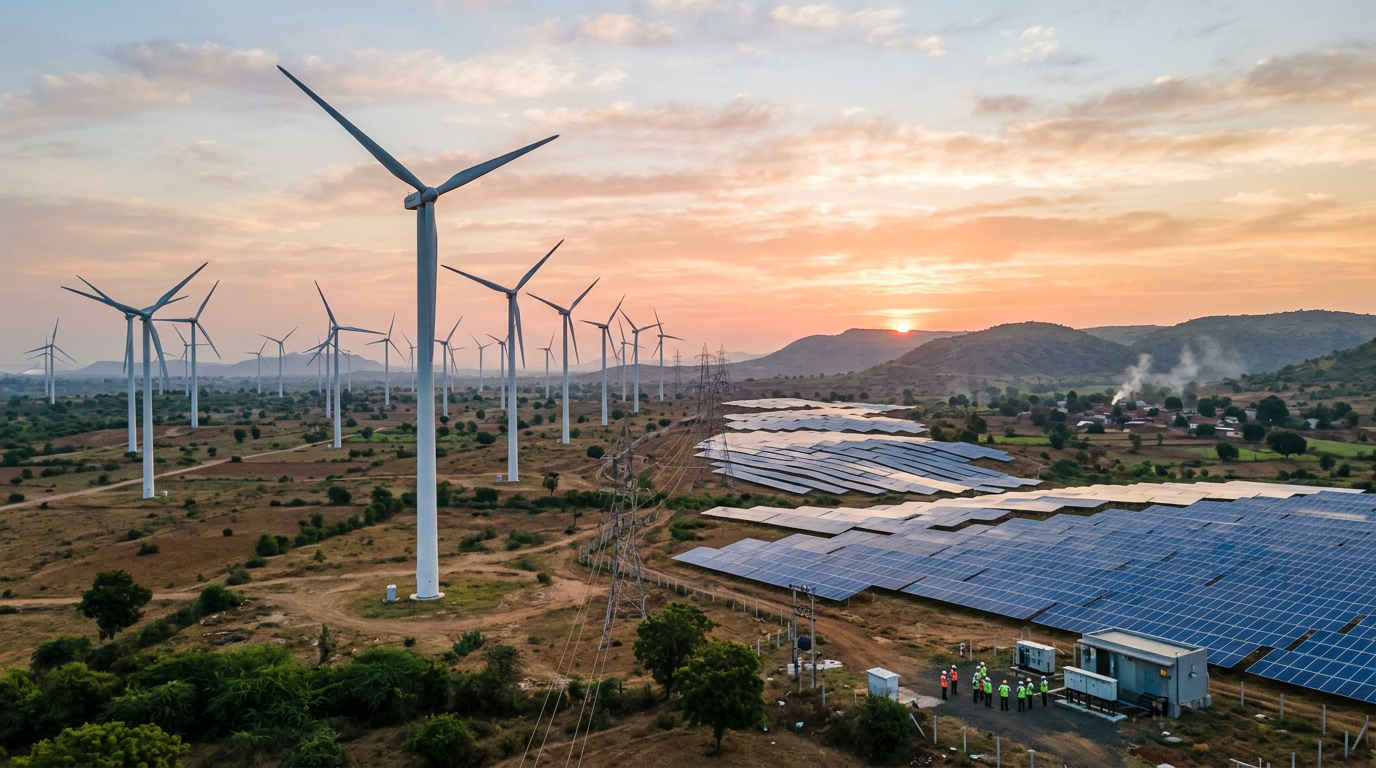
The company’s commissioned portfolio includes 6.8 GW of solar, 5.6 GW of wind and 0.1 GW of hydro capacity, alongside 0.1 GW/250 MWh of commissioned BESS capacity.
Climate Performance Moving Ahead of Targets
One of the report’s key takeaways is ReNew’s progress on operational emissions.
The company reported a 25.6% reduction in Scope 1 and Scope 2 emissions against its FY2021–22 baseline, exceeding its FY2025–26 target of 23.5%. ReNew also maintained carbon neutrality for Scope 1 and Scope 2 emissions for the sixth consecutive year and remains on its SBTi-validated pathway toward Net Zero by 2040.
The company also sourced 84% of its electricity from clean sources during FY2025–26, exceeding its renewable electricity target and progressing toward its ambition of sourcing 100% clean electricity by 2030.
The progress indicates that ReNew’s decarbonisation strategy is extending beyond the emissions avoided through renewable power generation to the emissions and energy footprint of its own operations.
Scaling Clean Energy With Measurable Impact
ReNew reported generating 24.7 billion units of clean power during FY2025–26, which the company states contributed approximately 8% of India’s clean-energy generation.
The generation was equivalent to powering approximately 21.2 million households and helped avoid an estimated 20.8 million tonnes of CO₂e annually.
These figures provide a measure of the wider environmental impact associated with ReNew’s renewable-energy portfolio and illustrate the scale at which clean-energy generation can contribute to India’s decarbonisation objectives.
Climate Resilience and Nature Enter the ESG Framework
The report also points to an evolution in ReNew’s climate strategy—from focusing primarily on emissions reduction to addressing climate resilience and nature-related risks.
During FY2025–26, ReNew completed its first IFRS S2-aligned climate risk assessment and incorporated mitigation and resilience measures into its strategy and risk-management framework. The company also published its first TNFD-aligned Nature Action Report and has a biodiversity management framework covering its operations, including site-specific management and restoration plans.
For a renewable-energy company with a growing physical footprint, this shift is relevant as climate change, water availability, biodiversity and other nature-related factors can increasingly influence project resilience and long-term operational performance.
Resource Efficiency, Water and Circularity
As ReNew expands its manufacturing operations, resource efficiency is becoming an increasingly important part of its sustainability strategy.
The company maintained Zero Liquid Discharge across its operations, while two sites achieved water-positive certification. The report also highlights efforts to improve energy efficiency, water stewardship, waste management and circularity.
The refreshed ReSTART framework includes specific manufacturing targets around resource consumption. These include reducing waste-generation intensity and electricity and water-consumption intensity, while targeting 10% recycled material content by weight in manufactured modules by 2030.
Such measures become increasingly relevant as India’s solar manufacturing base expands and the industry moves toward addressing the environmental footprint of equipment production alongside renewable deployment.
Responsible Supply Chains and Greater ESG Transparency
ReNew is also strengthening ESG oversight across its supply chain.
The company reports that 100% of critical suppliers have been assessed for ESG risk for three consecutive years, with ESG screening also incorporated into the onboarding of new critical suppliers. In addition, 41% of critical suppliers currently have SBTi-aligned Net Zero targets, against a 2030 target of 20% or more.
Another development highlighted in the report is the launch of ReNew’s first ESG Data Book, which consolidates ESG metrics across years and business units.
The company has also refreshed its Double Materiality Assessment (DMA), identifying 18 material topics. Each of these topics has been mapped to a quantitative target matrix, meaning that 100% of the identified material topics are now linked to specific ESG targets.
This reflects a wider shift in corporate sustainability reporting—from broad commitments toward measurable targets and more structured disclosure.
Turning ESG Priorities Into Measurable Targets
ReNew’s ReSTART — ReNew’s Sustainability Targets for Responsible Transformation — has been refreshed to reflect the company’s changing business profile, including the expansion of its manufacturing activities.
The framework now comprises two sets of targets: one covering the broader integrated clean-energy ecosystem and another specifically addressing manufacturing priorities.
The targets extend across environmental, social and governance priorities. They include areas such as emissions and energy management, circularity, water, diversity and inclusion, innovation, climate-risk assessment and responsible business practices.
The report states that the refreshed framework comprises 27 organisation-wide targets and eight manufacturing-specific targets, with all 18 material topics mapped to measurable sustainability ambitions for 2030.
Technology as an Enabler of Efficiency
Technology and digitalisation also feature in ReNew’s evolving strategy.
The company has established an AI Governance Framework and is expanding the use of agentic AI and generative AI through its enterprise-wide R.AI.SE programme. The report also links digital applications to operational performance, with ReNew reporting 1–1.5% yield improvement across its wind and solar portfolio through digital use cases.
This highlights how digitalisation is increasingly being considered alongside physical infrastructure as an enabler of renewable-energy performance, asset optimisation and operational efficiency.
Exploring Green Hydrogen and New Clean-Energy Markets
ReNew’s longer-term strategy also extends into emerging clean-energy markets.
The report highlights the company’s evaluation of opportunities in green hydrogen and derivatives, including green ammonia and green methanol. These solutions could potentially support decarbonisation across hard-to-abate sectors such as fertilisers, refining, shipping, aviation and steel.
The expansion into these areas suggests that ReNew is looking beyond renewable electricity generation toward a broader portfolio of decarbonisation solutions as new clean-energy markets develop.
Sustainability Extends to People and Communities
The report’s sustainability agenda also covers workforce development, diversity and community impact.
ReNew reported approximately 18% women in its overall workforce, against a 2030 target of 30%, while female representation in manufacturing reached approximately 16%. The company also recorded a 56% year-on-year increase in training investment during FY2025–26.
On community impact, ReNew reported having positively impacted more than 1.95 million lives cumulatively across 14 Indian states, against a 2030 target of 2.5 million people.
These indicators broaden the sustainability discussion beyond environmental performance to include workforce capability, inclusion and community outcomes.
ESG Performance Gains External Recognition
The report also highlights recognition from external ESG assessments. ReNew was positioned within the top 10% of Electric Utilities globally by S&P Global and was the only India-based Electric Utility included in the S&P Global Sustainability Yearbook 2026. The company also reported leadership positions across climate, water and supplier engagement through CDP and a second-place global sector ranking by LSEG.
While such rankings are not a substitute for measurable performance, they provide additional context around the company’s progress in embedding ESG considerations into its business.
What ReNew’s Report Signals for India’s Energy Transition
ReNew’s FY2025–26 Integrated Report reflects a broader transition underway in India’s renewable energy sector.
The next phase of the energy transition will require more than rapid additions of solar and wind capacity. It will also require domestic manufacturing, energy storage, transmission infrastructure, resource efficiency, responsible supply chains, climate resilience, digitalisation and transparent ESG performance.
ReNew’s expanding presence across renewable generation, manufacturing, BESS, transmission and emerging decarbonisation solutions reflects this changing landscape. At the same time, its refreshed ReSTART framework provides a structure for translating these ambitions into measurable environmental, social and governance targets.
The report therefore serves not only as a disclosure of ReNew’s FY2025–26 performance, but also as an indication of how the company is seeking to align business expansion with its longer-term climate, sustainability and value-creation objectives.
As India’s clean-energy market continues to scale, the ability to combine renewable deployment with responsible manufacturing, measurable climate performance, technology and resilient value chains is likely to become increasingly important to long-term growth.
Read the Full Report
Read/Download ReNew’s FY2025–26 Integrated Report:
Discover more from SolarQuarter
Subscribe to get the latest posts sent to your email.
Source link