

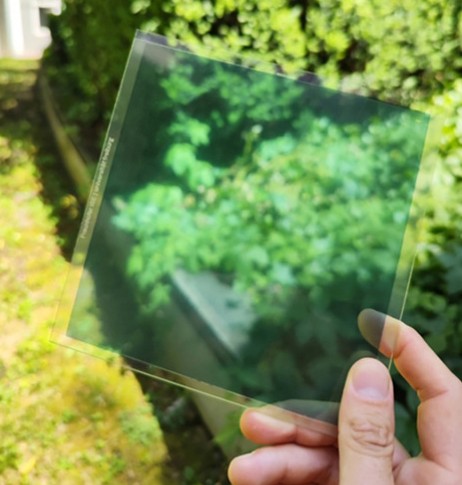
A research group from Germany and Austria has successfully manufactured slot-die-coated semitransparent organic PV (STOPV) modules with an aperture area of 210.25 cm².
The STOPVs incorporate a near-infrared-reflecting back electrode and a metal-free top electrode. Such devices have previously achieved light utilization efficiencies (LUEs) of up to 6% at the laboratory cell scale, but performance has typically declined substantially when scaled to larger modules.
“The novelty of our development lies in the innovative cell stack, and further, the successful upscaling to modules on areas larger than 200 cm2,” said corresponding author Uli Würfel to pv magazine. “Positively surprising was the fact that we could advance from small-area spin-coated cells to slot-die coated modules on these larger areas of more than 200 cm2 almost without any loss in performance.”
To fabricate the large STOPV modules, the researchers used 16 × 27.5 cm² glass substrates and created 116 monolithically interconnected cell stripes, each 1.25 mm wide.
The cell was fabricated with the stack glass | titanium dioxide (TiO₂) | silicon dioxide (SiO₂) | titanium dioxide (TiO₂) | aluminum-doped zinc oxide (AZO) | silver (Ag) | aluminum-doped zinc oxide (AZO) | zinc oxide (ZnO) | PV-X Plus | poly(3,4-ethylenedioxythiophene)(styrenesulfonate) (PEDOT) (HTL-X) | poly(3,4-ethylenedioxythiophene)(styrenesulfonate) (PEDOT) (SCA2003).
Glass served as the substrate and the TiO₂ and SiO₂ layers formed the optical dielectric stack. The AZO | Ag | AZO layers constituted a transparent, near-infrared (NIR)-reflecting electrode, while ZnO served as the electron-transport layer. PV-X Plus was theorganic absorber. PEDOT:PSS served as the hole-transport layer (HTL) and PEDOT: PSS (SCA2003) served as the metal-free top electrode.
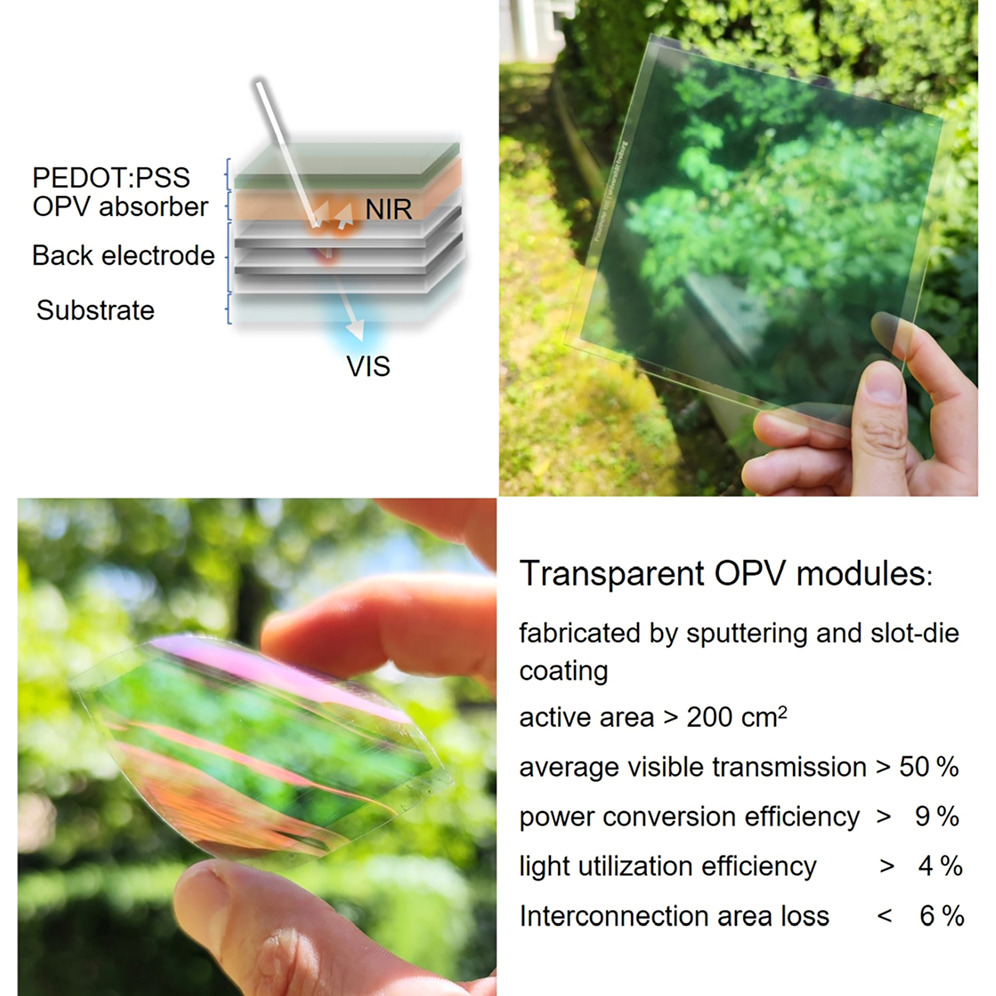
The back electrode was deposited by sputtering, while the ZnO electron-transport layer, PV-X plus absorber, and two PEDOT: PSS layers were deposited by slot-die coating. Three laser-scribing steps were used to pattern the layers and form the monolithic series interconnection, after which the modules were annealed at 110 C for 10 minutes. The manufactured modules underwent current-voltage (I–V) testing at different illumination intensities, optical transmission and reflection measurements, and defect analysis using illuminated lock-in thermography (ILIT) and electroluminescence (EL) imaging.
In addition, long-term stability testing was conducted separately on smaller 11.4 cm² rigid modules fabricated on glass substrates with distributed Bragg reflector (DBR) back electrodes that were aged under continuous illumination for more than 1,000 hours. Separate 11.4 cm² flexible modules fabricated on polyethylene terephthalate (PET) substrates with DBRflex electrodes were subjected to bending tests up to 1,275 cycles around a 15 mm-diameter rod.
The testing showed that the module with the highest LUE of 4.0% was reached with a photoactive layer thickness of 60 nm, reaching a power conversion efficiency of 9.3% and an average visible transmittance (AVT) of 43.2%. The flexible, smaller cells achieved average LUEs of 4.1%, an efficiency of 7.9%, and an AVT of 52.1%.
“The next steps are to enhance visual transmission further and to transfer these results to roll-to-roll manufacturing technology,” said Würfel. “There, the deposition techniques used in this work remain the same (i.e., sputtering for the near-infrared reflecting electrode and slot-die coating for all other layers), but the substrate is flexible, and the coating process is continuous.”
The module was presented in “Toward scalable semitransparent organic photovoltaics: Slot-die-coated 210-cm2 modules with visible transmission of up to 50% and LUE up to 4%,” published in Joule. Researchers from Germany’s Fraunhofer Institute for Solar Energy Systems ISE, the University of Freiburg, and Austria’s University of Innsbruck have participated in the study.
Source link