

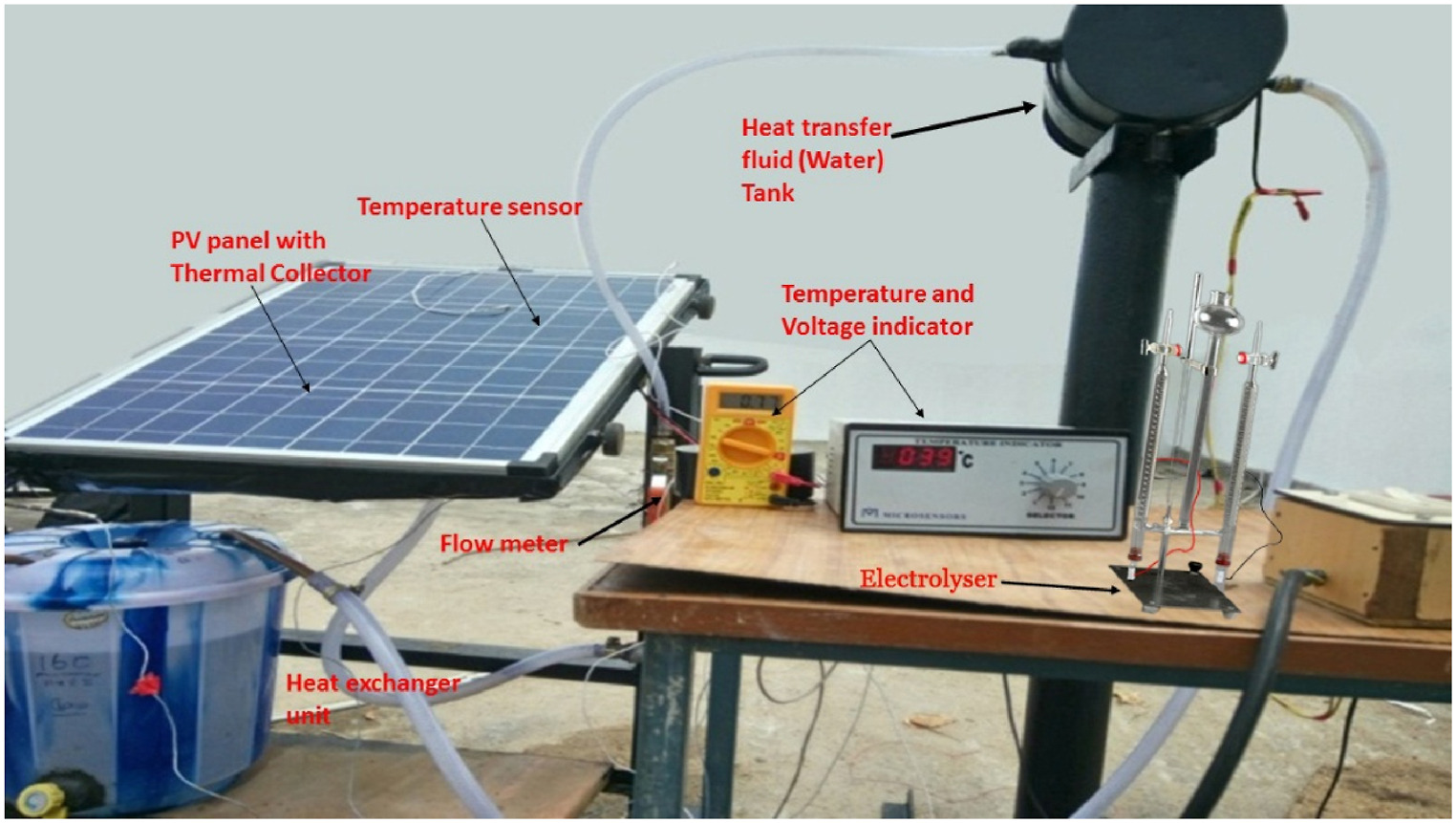
A research group in India has developed a novel photovoltaic-thermal (PVT) hydrogen-generation system that integrates air-bubble injection to improve system performance. The researchers also sought to isolate the effect of air-bubble injection on PVT cooling, allowing them to assess its contribution independently of the hydrogen-generation process. The system was experimentally tested on the rooftop of a building in Tiruchengode, Tamil Nadu, in southern India, under real-world outdoor conditions. The results provide insights into the potential of air-bubble injection as a cooling technique for PVT systems while simultaneously supporting hydrogen production.
“Numerous researchers have used several cooling methods, including air cooling, liquid cooling, and phase change materials, but failed to explore the impact of air bubbles on the performance of PV system efficiency and hydrogen yield rate,’” said the research team. “This study’s findings will be advantageous for both developed and emerging nations, taking into account environmental pollution and energy requirements.”
The novel PVT-water system with air-bubble injection was compared with three other configurations: conventional PV, PVT-air, and PVT-water. The conventional PV system operated without a thermal collector, while the PVT-air and PVT-water systems used air and water, respectively, to remove heat from the rear of the module. In the novel configuration, air bubbles were injected into the circulating water at mass flow rates of 0.006, 0.008, and 0.011 kg/s to enhance heat transfer.
All four experimental setups used a 20 W, 36-cell polycrystalline PV module with a surface area of 0.303 m² and a conversion efficiency of 16.5%. A spiral-flow thermal collector with an area of 0.213 m² was attached to the rear of the module. The system also included a 10-liter horizontal cylindrical water tank with a radius of 100 mm and a height of 350 mm, as well as a Hoffman electrolyzer equipped with platinum electrodes.
The outdoor experiments were conducted over seven consecutive summer days, with measurements taken daily from 08:00 to 16:00. The researchers monitored solar irradiance, ambient temperature, wind speed, PV module surface temperature, coolant inlet and outlet temperatures, air and water flow rates, electrical output, and hydrogen production. Seven-day average values were then used for the analysis.
The PVT-water-air system was tested at air-injection mass flow rates of 0.006, 0.008, and 0.011 kg/s and compared with the conventional PV, PVT-air, and PVT-water configurations. The systems were also tested under a constant irradiance of 600 W/m² and an ambient temperature of 26 C.
The researchers reported that the PVT configurations, particularly those using water as a coolant, substantially improved thermal efficiency. The PVT-water system with air injection at 0.011 kg/s achieved a peak thermal efficiency of around 45.5%, compared with about 30% for the PVT-air system.
The air-injected PVT-water configuration also delivered the highest electrical efficiency. At an air-injection rate of 0.011 kg/s, it reached a maximum electrical efficiency of around 11.1%, compared with 8.1% for the conventional PV system.
According to the results, the PVT-water system with air injection achieved the highest hydrogen production rate, reaching approximately 15.5 ml/min at an air-injection rate of 0.011 kg/s. This compares with a maximum of 8.3 ml/min for the conventional PV system.
The same configuration achieved a maximum electrolyzer efficiency of approximately 15.5%, compared with 8.3% for the conventional PV system.
The researchers said further work is needed to determine the optimal air-injection rate under different operating conditions and for different system configurations. They also called for the development of advanced control algorithms for integrated PVT-electrolyzer systems to optimize energy management and hydrogen production.
The research results were presented in “Experimental study on the influence of air bubble injection on the performance of photovoltaic – Thermal solar collector based hydrogen production system,” published in Case Studies in Thermal Engineering. Researchers from India’s K.S.Rangasamy College of Technology and SRM Institute of Science and Technology have participated in the study.
Source link