

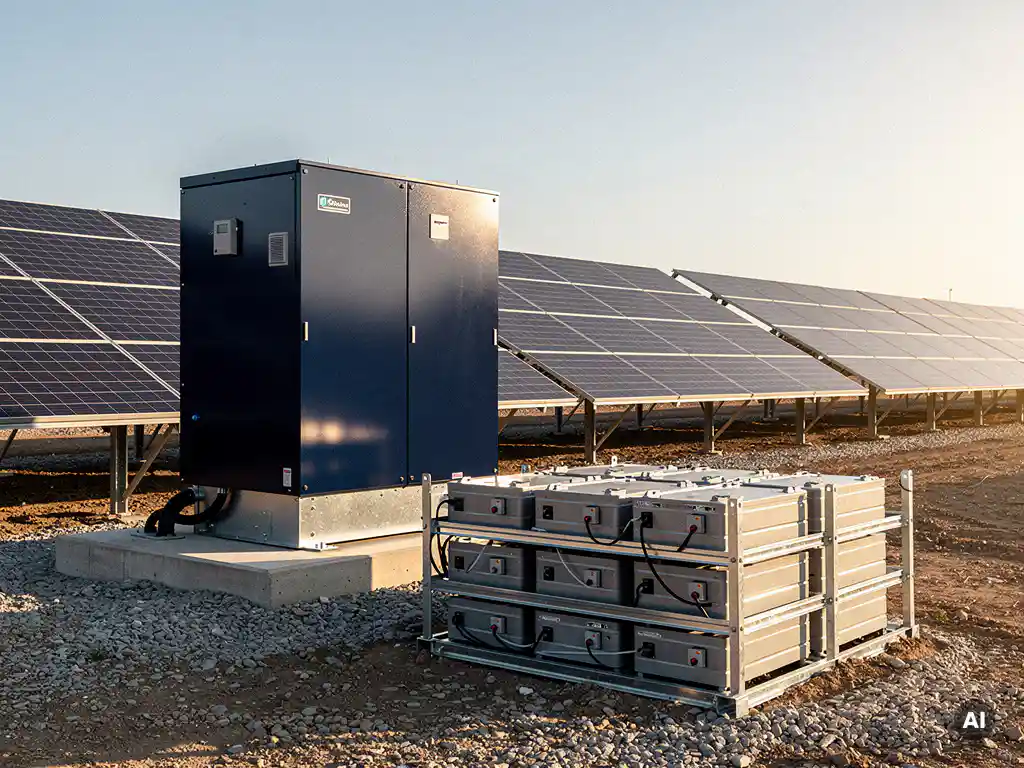
How does inverter size affect how fast a battery charges?
Inverter size directly controls the maximum charge rate a battery can receive. A larger inverter can push more power into the battery bank per hour, reducing charge time. A smaller inverter limits the charge current, meaning the same battery bank takes significantly longer to reach full capacity, which matters most in systems with limited solar generation windows.
In practical terms, charge time is governed by the relationship between inverter output power (in kilowatts) and battery capacity (in kilowatt-hours). If a 5 kWh battery bank is being charged by an inverter with a 2.5 kW charge capability, you are looking at roughly two hours of charge time under ideal conditions. Scale the inverter up to 5 kW charge capacity and that window halves. This becomes critical in off-grid and hybrid systems where the battery must be fully recharged before the next load cycle begins.
It is also worth noting that most batteries have a maximum continuous charge rate, often expressed as a C-rate. A battery rated at 1C can accept a charge current equal to its full capacity in one hour. Pushing charge current beyond the manufacturer’s recommended C-rate generates excess heat, accelerates degradation, and in some chemistries creates safety risks. So while a larger inverter can charge faster, the battery’s own charge acceptance limit sets the ceiling: inverter sizing must respect that boundary.
What happens if your inverter is too small for your battery bank?
If your inverter is undersized relative to your battery bank, the system cannot deliver the full power the battery is capable of supplying. The inverter becomes the bottleneck, capping output below what loads actually require and leaving stored energy stranded in the battery. In practice, this means the system may fail to support peak loads even when the battery is fully charged.
Beyond peak load failure, an undersized inverter also extends charge times unnecessarily. If the inverter’s charging circuit cannot push enough current into the battery, the system spends more time in partial charge states. This is particularly damaging in daily cycling applications, where a battery that never reaches full charge gradually loses effective capacity through a phenomenon known as partial state of charge (PSOC) degradation, a well-documented issue with lead-acid chemistries and a concern with some lithium variants as well.
From an engineering standpoint, an undersized inverter also creates thermal stress. Running an inverter continuously at or near its rated limit generates heat, reduces efficiency, and shortens component lifespan. The fix is straightforward: size the inverter to handle peak load demand with a reasonable margin, typically 20 to 25 percent above the calculated maximum load, and verify that this sizing also supports the battery’s required charge rate.
What happens if your inverter is too large for your battery bank?
An oversized inverter relative to the battery bank creates a different set of problems. The inverter can demand more power than the battery is capable of safely delivering, which drives excessive discharge rates, voltage sag, and accelerated battery wear. In worst-case scenarios, the battery management system (BMS) will disconnect the battery under high load to protect the cells, cutting power to the load entirely.
Oversizing also introduces efficiency losses at the inverter level. Inverters operate most efficiently at a certain percentage of their rated load, typically between 50 and 80 percent. An inverter that is significantly oversized for the battery and load it serves will spend most of its operating time at low load fractions, where conversion efficiency drops noticeably. This translates directly into higher energy losses and lower overall system performance.
There is also a cost dimension. Larger inverters carry higher capital costs, and if the battery bank cannot support the inverter’s full capacity, that investment is never fully utilized. Proper battery sizing ensures the battery can sustain the inverter’s output at peak demand without triggering protective shutdowns or operating outside safe discharge parameters.
What is the recommended inverter-to-battery capacity ratio?
A commonly applied rule of thumb is that the battery bank should be able to supply the inverter’s full rated output for a minimum of one to two hours without dropping below the battery’s recommended depth of discharge (DoD). This translates to a battery capacity of at least one to two times the inverter’s kilowatt rating in kilowatt-hours, adjusted for the usable DoD of the specific battery chemistry.
For example, a 10 kW inverter paired with lithium iron phosphate (LFP) batteries rated at 80 percent usable DoD would require a minimum of roughly 12.5 to 25 kWh of total installed capacity to meet a one-to-two-hour runtime target. Lead-acid batteries, with a more conservative usable DoD of around 50 percent, would require proportionally larger banks to deliver the same usable energy.
These ratios are starting points, not fixed rules. The correct ratio depends on load profiles, autonomy requirements, available solar generation, and the specific battery chemistry in use. In commercial and industrial projects, engineers typically model the full load cycle before finalizing sizing, a process that accounts for seasonal variation, peak demand windows, and grid interaction where applicable. Tools like Virto Solar’s design platform automate much of this calculation work, reducing the risk of sizing errors that only surface during commissioning.
How does the DC/AC ratio influence battery sizing decisions?
The DC/AC ratio, the relationship between total installed PV capacity (DC) and inverter rated output (AC), influences battery sizing because it determines how much excess generation is available to charge the battery. A higher DC/AC ratio means more solar energy is produced relative to what the inverter can export, creating more opportunity to divert surplus power into storage. Battery sizing must account for how much of that surplus can realistically be captured each day.
In systems with a high DC/AC ratio, the inverter clips generation during peak irradiance hours. That clipped energy is lost unless a battery is present to absorb it. Sizing the battery to capture a meaningful portion of clipped generation requires understanding the daily clipping profile, how many hours per day clipping occurs and at what power level. Undersizing the battery in this scenario wastes generation potential; oversizing it adds cost without proportional benefit.
Conversely, in systems with a low DC/AC ratio, the PV array rarely produces more than the inverter can handle, so clipping is minimal. Battery sizing in these systems is driven more by load autonomy requirements than by generation surplus. The DC/AC ratio therefore acts as a key input variable when determining whether battery sizing should be optimized for surplus capture, load shifting, or backup duration.
Should battery sizing change for hybrid versus AC-coupled inverter setups?
Yes, battery sizing considerations differ meaningfully between hybrid and AC-coupled inverter configurations. In a hybrid inverter setup, the battery connects directly on the DC bus, allowing the system to charge from PV without converting to AC first. This improves round-trip efficiency and simplifies control logic. In an AC-coupled setup, the battery inverter and the grid or PV inverter operate on the AC side, introducing an additional conversion step that reduces overall efficiency.
Hybrid inverter battery sizing
In hybrid configurations, the battery is sized primarily around the inverter’s DC charge input rating and the load autonomy target. Because the charge path is direct and efficient, the battery can be sized more tightly to actual energy needs without building in large efficiency buffers. The inverter’s maximum charge current rating is the key constraint: battery capacity must be large enough to accept the full charge current without exceeding the battery’s C-rate limit.
AC-coupled inverter battery sizing
AC-coupled systems introduce additional conversion losses, typically in the range of 5 to 10 percent per conversion cycle. When sizing a battery for an AC-coupled setup, engineers must account for these losses by increasing total installed capacity to deliver the same usable energy at the load. AC-coupled systems also require careful attention to frequency-shift control and inverter compatibility, as the battery inverter must be able to communicate with the PV inverter to regulate charge and prevent overloading.
The choice between hybrid and AC-coupled architectures also affects retrofit scenarios. Adding battery storage to an existing grid-tied PV system typically favors AC coupling because it avoids replacing the existing inverter. New installations, particularly at commercial scale, often favor hybrid configurations for their efficiency advantage and simpler integration. In either case, getting the battery sizing right from the start prevents costly redesigns later, something our engineering team at Virto Solar helps clients avoid through accurate, automated design workflows. If you are working through a complex sizing decision, reaching out to our team is a practical next step.
Frequently Asked Questions
How do I know if my existing battery bank is compatible with a new or upgraded inverter?
Start by comparing your battery’s maximum continuous discharge rate (in amps or kilowatts) against the new inverter’s peak power demand. If the inverter can draw more power than the battery is rated to deliver, you risk triggering the BMS protection cutoff or accelerating cell degradation. Also verify that the inverter’s charge current output does not exceed the battery’s maximum C-rate, and confirm voltage compatibility between the inverter’s DC input range and the battery bank’s nominal voltage.
What is the most common sizing mistake installers make when pairing inverters with batteries?
The most frequent mistake is sizing the battery purely around energy capacity (kWh) while ignoring power delivery requirements (kW). A battery bank may hold enough energy to meet daily load needs but still be unable to supply the inverter’s peak demand without voltage sag or BMS disconnection. Always validate both dimensions: total usable energy for autonomy targets and maximum continuous discharge power for peak load support.
Can I add more batteries later if I undersize my bank initially?
Expanding a battery bank after initial installation is possible but comes with important caveats. For lithium chemistries, mixing batteries of different ages or cycle counts within the same bank can cause imbalanced charging and accelerated degradation of the older cells. Lead-acid banks are even less forgiving of mixed-age configurations. If future expansion is anticipated, it is best to design the inverter and BMS from the start to accommodate the target final bank size, even if you commission with fewer batteries initially.
How does temperature affect the inverter-to-battery sizing relationship?
Battery capacity and charge acceptance both degrade at low temperatures, meaning a bank that meets your sizing targets at 25°C may fall short in cold climates or unheated enclosures. LFP batteries, for example, can lose 20 to 30 percent of usable capacity at temperatures near freezing and may refuse fast charging below 0°C to prevent lithium plating. When sizing for installations in temperature-variable environments, apply a derating factor to usable capacity and verify that the inverter’s charge algorithm supports low-temperature charge current limiting.
Does battery sizing need to change if the system is also connected to the grid?
Yes, grid connection changes the sizing logic significantly. In a grid-tied system, the grid can serve as a backup power source and absorb excess generation, which reduces the autonomy burden on the battery. This allows the battery to be sized around specific use cases such as peak shaving, time-of-use arbitrage, or short-duration backup rather than full load autonomy. However, if the system must also operate in islanded mode during outages, the battery must still be sized to support critical loads independently for the required backup duration.
What role does the battery’s BMS play in inverter compatibility, and what should I check?
The BMS is the communication and protection layer between the battery and the inverter, and incompatibility here is a common source of commissioning failures. Key things to verify include whether the inverter supports the BMS communication protocol used by the battery (common options include CAN bus, RS485, and Modbus), whether the inverter can respond to BMS charge and discharge limit signals in real time, and whether the BMS voltage and current thresholds align with the inverter’s operating parameters. Always consult the compatibility documentation from both manufacturers before finalizing equipment selection.
Are there any software tools or platforms that can automate inverter and battery co-sizing calculations?
Yes, purpose-built solar design platforms can significantly reduce the manual effort and error risk involved in co-sizing inverters and batteries. Tools like Virto Solar’s design platform allow engineers to model load profiles, DC/AC ratios, battery chemistry parameters, and autonomy targets together in a single workflow, producing sizing outputs that account for all the interdependencies covered in this post. Using an automated platform is especially valuable for commercial and industrial projects where manual calculations across multiple variables become error-prone and time-consuming.
Related Articles
This content was generated with the help of AI — it may contain mistakes
Source link