
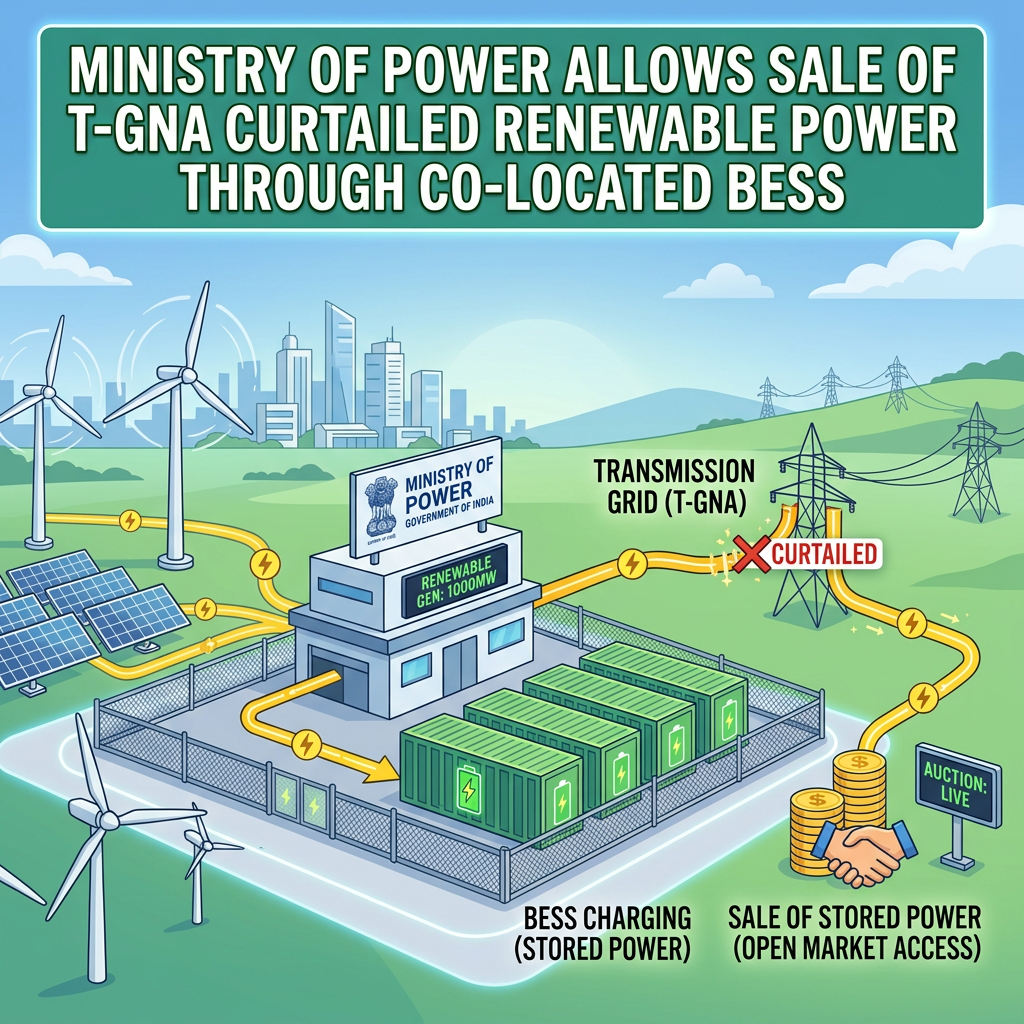
The Ministry of Power, Government of India, has issued a directive allowing renewable energy developers to commercially use electricity that is curtailed under Temporary General Network Access (T-GNA), provided the power is captured through voluntarily deployed, co-located Battery Energy Storage Systems (BESS).

The directive was issued on August 27, 2026, and signed by Director Sunil Kumar Sharma. It was circulated to state energy departments, electricity regulatory commissions, public sector undertakings and industry bodies, including FICCI and ASSOCHAM. The move is aimed at reducing renewable energy wastage and improving the utilization of generation and storage assets.
The decision follows a memorandum issued by the Ministry of New and Renewable Energy (MNRE) on July 22, 2026. Renewable energy developers had requested clarity on whether electricity that could not be supplied because of grid curtailment under T-GNA could be stored in additional, co-located BESS and subsequently sold in the market.
Under the new provisions, renewable energy projects awarded through standard bidding guidelines are permitted to use electricity curtailed under T-GNA to charge additional co-located energy storage systems. The storage assets can be deployed voluntarily by project developers and do not have to form part of the original Power Purchase Agreement (PPA) or Power Sale Agreement (PSA).
Once the curtailed renewable electricity is stored, developers can sell the recovered energy to any buyer. Sales can be undertaken through power exchanges or bilateral arrangements, giving developers greater flexibility in monetising electricity that would otherwise have been lost due to grid constraints.
The Ministry has also removed an important procedural requirement. Developers will not need to obtain a No-Objection Certificate (NOC) from intermediary procurers or end procurers before storing and selling the curtailed electricity.
The clarification is expected to provide renewable energy developers with a clearer commercial pathway for using surplus generation during periods of grid curtailment. It could also encourage greater deployment of co-located storage capacity at renewable energy projects, particularly in locations where transmission constraints frequently result in generation being backed down.
The measure comes as India continues to expand renewable energy capacity while increasing its focus on energy storage and grid flexibility. By allowing curtailed renewable power to be captured and sold separately from the project’s contracted supply arrangements, the directive seeks to improve asset utilization and reduce avoidable renewable energy losses.
The policy could also support the development of additional market-based storage models, enabling renewable developers to generate additional revenue while making better use of available clean electricity.
Discover more from SolarQuarter
Subscribe to get the latest posts sent to your email.
Source link