
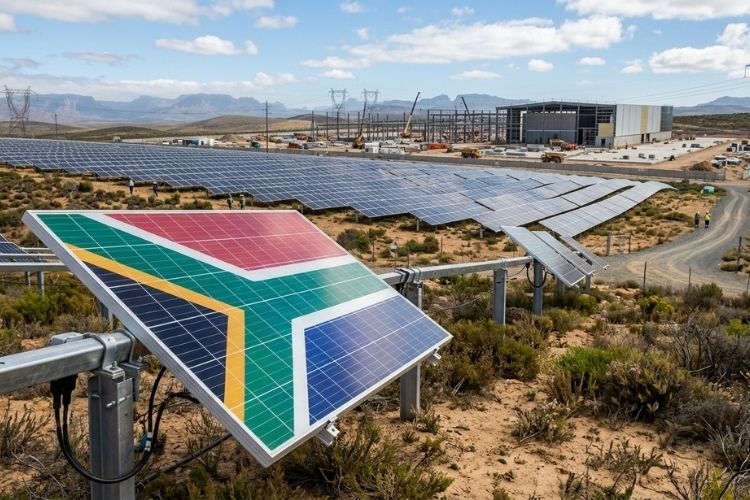

While other countries are only now confronting the strain data centers put on their grids, South Africa has been here before. Customers, not the utility, solved a decade of rolling blackouts through solar, driving the most market-driven energy transition anywhere. Now the data center boom threatens to tax that resilience, creating a two-tier energy system that could unfold in other markets.
Contributed by Daniel Domingues, founder and CEO of Planno
Around the world, a new wave of data centers is placing large and constant power demand on electricity grids that are not ready for it. From Virginia’s “Data Center Alley” to the Netherlands, regulators are grappling with the same tension: the infrastructure of the AI economy needs enormous, continuous power, and it needs it faster than grids can add clean supply.
Ireland offers a sharp example. Data centers there now consume more than a fifth of the country’s electricity, and the strain was severe enough that the regulator effectively froze new grid connections around Dublin from 2021 until late 2025, lifting the block only on the condition that large new facilities supply most of their own power from new renewables. The question every one of these markets now faces is not only whether the power can be found, but who gets access to it first.
South Africa paints an unusually clear view of where that question leads. It is the country that already lived through a decade of grid failure and solved much of it from the bottom up, and it is now watching a data center boom test whether that hard-won progress holds against even more energy pressure. What is emerging there is not a shortage of clean power so much as a divide in who can reach it, and the businesses now finding themselves shut out of it are the same ones that kept the lights on when the utility could not.
An energy crisis solved by customers, not the utility
For years, South Africa grappled with rolling blackouts, known locally as load shedding, which became a regular part of life from the end of 2007. Eskom, the state-owned utility and long-dominant supplier, could not keep pace with demand or maintain its aging generation fleet, forcing the country to ration supply to reduce the risk of a wider grid failure.
In response, businesses and households stopped waiting for a central solution. Commercial property owners, homeowners, manufacturers, and retailers invested billions into solar power, not because of government mandates but because reliable electricity is an economic necessity. Private rooftop capacity climbed from around 2,260 megawatts (MW) in mid-2022 to about 7,300 MW by late 2025. What followed was one of the most market-driven energy transitions anywhere in the world.
But it may also prove fragile, and the reason is instructive for every market facing the same buildout.
South Africa’s new chapter as a data center hub
With 56 data centers and counting, South Africa is the most dominant data center hub on the African continent, holding roughly 1% of global AI data center capacity. The ten largest facilities account for around 278 MW of load capacity, with Teraco’s Isando campus the largest among them.
The concern is the speed of the buildout, with the wave of investment concentrated in the last two years. Some $1.5 billion worth of new data center projects are currently planned or underway. In Cape Town alone, four proposed facilities could collectively consume electricity equivalent to more than a third of the city’s current power demand. Durban recently announced plans for what could become South Africa’s largest AI-focused data center, requiring hundreds of megawatts of capacity, with Reuters reporting that the gold rush now risks a broader resource crunch.
Data centers can bring investment, jobs and a stronger position in the AI economy. But they also place heavy, continuous demand on an electricity system that has only recently begun to stabilize, and against a backdrop in which Eskom has flagged further delays to its coal-closure schedule.
Two tiers of access
The largest hyperscalers in the country are building their own sustainable energy supplies, with Teraco currently constructing a 120 MW solar facility, and many AI operators are also looking to secure renewable energy through wheeling arrangements, purchasing electricity from utility-scale solar plants and using Eskom’s network to deliver that power to their facilities.
At first glance, this is positive, because data center operators can help finance new renewable generation rather than simply drawing more power from aging coal plants. But wheeling requires the long contract tenors and balance-sheet strength that a mid-size manufacturer cannot offer, and the clean energy it delivers still depends on the same transmission infrastructure that is already under strain. What separates the two groups is not the availability of the electrons but access to the mechanism itself.
The result is a two-tier energy transition, in which one group gains privileged access to large-scale renewable infrastructure and grid capacity, while the smaller users who built the grid’s resilience during load shedding are left to compete for what remains, facing rising electricity costs and a growing patchwork of registration requirements and municipal charges.
The asset being taxed out of existence
The Public Affairs Research Institute published a report this month that quantifies what that second tier is actually worth to the system, showing that Johannesburg, Ekurhuleni and Tshwane accounted for over half of the more than 2,260 MW of rooftop solar installed by December 2024, and that most residential installations produce excess electricity across a 12-month period which is curtailed because it has nowhere to go.
The report calculates that if commercial and industrial installations grew by 20% and residential installations by 50%, and municipalities bought the surplus at a discount to the Megaflex tariff and stored it in leased battery systems for dispatch during peak periods, the three metros would save close to R2.5 billion a year, an amount roughly equal to their combined annual capital budgets. Securing supply this way, the finding argues, would be considerably simpler than negotiating the long-term and complex power purchase agreements that independent producers require.
Municipalities are moving in the opposite direction, and the report warns that forcing installation owners onto more expensive tariff structures, adding compliance costs, and making them carry the full cost of new meters against a backdrop of rapidly rising tariffs is almost certain to accelerate grid defection. It describes that outcome as the worst of all available options, because the municipality loses both the customer and access to cheap generating infrastructure that a third party has already paid for and continues to maintain.
A survey cited in the report found that 40% of Johannesburg solar owners would be willing to feed surplus power back into the grid at a zero tariff, simply to avoid migrating to a time-of-use tariff carrying a fixed charge on the order of R1,500 a month before any consumption at all.
Read alongside the wheeling story, the symmetry is difficult to miss: hyperscalers are granted network access, long contracts and regulatory structures built to accommodate them, while distributed generators are handed punitive tariffs, and the utility itself ends up worse off for the arrangement.
The choice arriving everywhere
If the economic benefits of becoming a leading AI hub are captured while distributed generation is allowed to keep scaling rather than being taxed out of the market, the grid can absorb the new demand without risking another decade of load shedding. If distributed generation is left to compete on unequal terms, the buildout locks in unequal access to clean power and leaves an asset that the system has already paid for stranded.
That choice is not unique to South Africa. Utilities across California, Arizona, and increasingly PJM territory are facing the same collision between unprecedented large-load growth on one side and rate structures that penalize the distributed capacity that would help absorb it on the other, which means South Africa has not encountered a distinctly South African problem so much as arrived at a common one first.
About the Author

Daniel Domingues is a Portuguese, Dubai-based energy engineer and entrepreneur, and the founder and CEO of Planno, a geospatial AI platform for commercial and industrial solar prospecting across 16 markets in Europe, the Middle East and the US. He has nearly two decades of experience managing global clean energy projects and infrastructure, with prior roles at Enviromena and Dutco Group.
Source link