

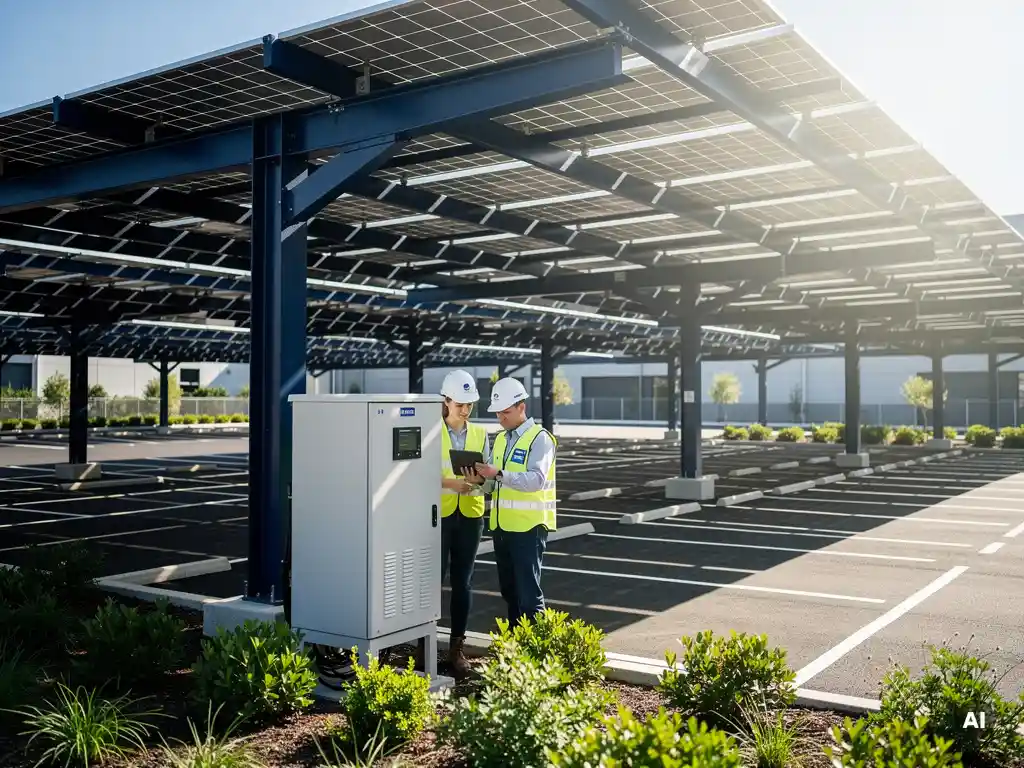
To size battery storage for a solar carport project, calculate your daily energy demand from EV charging and facility loads, determine how many hours of autonomy or peak shaving you need, then select a battery with enough usable capacity to cover that window, typically accounting for depth of discharge, round-trip efficiency, and system losses. The right battery size depends heavily on whether you are optimizing for self-consumption, peak demand reduction, or EV charging support, since each use case drives a very different capacity requirement. The sections below walk through each sizing factor in detail so you can build a technically sound storage specification.
What factors determine battery storage capacity for a solar carport project?
Battery storage capacity for a solar carport is determined by four core factors: the daily energy consumption profile of the site, the intended use case of the battery (self-consumption, peak shaving, or backup), the depth of discharge (DoD) rating of the chosen chemistry, and the round-trip efficiency of the inverter-battery system. Together, these variables define how large a battery bank you actually need to meet your project goals.
Beyond those fundamentals, carport-specific conditions add further complexity. Carport arrays are often shaded by vehicles, surrounding structures, or their own canopy geometry, which means PV output can be less predictable than that of a rooftop or ground-mount system of equivalent capacity. This variability pushes designers toward slightly larger battery reserves to buffer against generation shortfalls during peak demand periods.
Other factors that shape the sizing decision include:
- Grid tariff structure: Time-of-use pricing or demand charges directly influence how aggressively you need to store and discharge energy.
- Available roof or canopy area: PV array size sets the upper limit on daily solar generation available to charge the battery.
- Autonomy requirements: Whether the site needs to operate independently during grid outages changes the required capacity significantly.
- Regulatory and grid connection constraints: Some utilities cap export or impose minimum battery sizing for grid-connected storage.
How do you calculate the usable capacity needed for a solar carport battery?
To calculate usable battery capacity for a solar carport, start with your total daily energy demand in kilowatt-hours, subtract the solar energy consumed directly during daylight hours, and size the battery to cover the remaining demand. Then divide that figure by the battery’s depth of discharge rating to get the required nominal capacity. Always add a system efficiency buffer of around 10 to 15 percent for inverter and cable losses.
A simplified calculation looks like this: if your carport site consumes 200 kWh per day and the PV array directly covers 120 kWh during daylight, you need the battery to supply 80 kWh. If your chosen battery chemistry supports 90% DoD and the system has 90% round-trip efficiency, the required nominal capacity is approximately 80 / (0.9 × 0.9) = roughly 99 kWh nominal.
In practice, engineers also factor in seasonal variation. A battery sized for a summer self-consumption scenario may be undersized in winter when solar generation drops and demand patterns shift. Running the calculation for both worst-case and average conditions gives you a defensible sizing range rather than a single point estimate. Tools that automate energy yield simulation, like Virto Solar’s design platform, can model these seasonal profiles directly within your project workflow, reducing the manual iteration that spreadsheet-based sizing typically requires.
What’s the difference between sizing for self-consumption versus peak shaving in a carport project?
Sizing for self-consumption means the battery is sized to store surplus solar generation and discharge it when the sun is not producing, maximizing the share of on-site solar energy consumed by the facility. Sizing for peak shaving means the battery is sized to reduce the highest demand spikes on the grid connection, regardless of whether that energy comes from solar or the grid. These two objectives lead to fundamentally different capacity and power requirements.
Self-consumption sizing
In a self-consumption scenario, capacity is king. You want enough kilowatt-hours stored during peak solar hours to carry the site through evening and overnight demand. The battery charge and discharge cycles are relatively predictable and tied to the solar generation curve. Sizing is driven by the gap between daytime generation and daytime consumption, plus the overnight load that cannot be met by solar at all.
Peak shaving sizing
Peak shaving is primarily a power-driven requirement. The battery must be able to discharge at a high enough rate (measured in kilowatts) to flatten demand spikes, often for short windows of 15 to 60 minutes. The required energy capacity may actually be smaller than a self-consumption system, but the C-rate, the ratio of power output to capacity, must be higher. A battery optimized for peak shaving may need to deliver its full rated power for only 30 minutes, whereas a self-consumption battery might discharge at a lower rate over six to eight hours.
Many carport projects combine both objectives, which means sizing for the more demanding of the two requirements and verifying that the chosen battery chemistry and inverter can handle both discharge profiles without degrading cycle life prematurely.
How does EV charging load affect battery sizing for solar carports?
EV charging is often the dominant and most unpredictable load in a solar carport system, and it can dramatically increase the required battery capacity. A single DC fast charger can draw 50 to 150 kW, meaning a brief charging session can create a demand spike that exceeds what the PV array can supply in real time. The battery must bridge that gap, which means EV charging load directly drives both the power rating and the energy capacity of the storage system.
The key challenge is that EV charging demand is stochastic: it depends on how many vehicles arrive, when they arrive, and how depleted their batteries are. In a workplace carport, morning arrival clustering creates a sharp demand peak that coincides with the early ramp-up of solar generation, not its peak output. This misalignment means the battery must absorb grid or stored energy in advance and release it during the charging rush.
To size correctly for EV charging, engineers typically need to:
- Estimate the number of simultaneous charging sessions at peak occupancy.
- Determine the charger power level (AC Level 2 at 7 to 22 kW, or DC fast charging at 50 kW and above).
- Model the expected daily charging energy demand across all sessions.
- Identify the worst-case demand peak and size the battery’s power output to shave that peak below the grid connection limit.
- Verify that the battery can recharge sufficiently between peak demand windows using available solar generation.
If EV charging is a primary use case, smart charging management systems that coordinate battery dispatch with charger scheduling can reduce the required battery size by spreading demand more evenly across the day.
What battery chemistry is best suited for solar carport storage?
Lithium iron phosphate (LFP) is the most widely recommended battery chemistry for solar carport storage in 2026. LFP offers a strong balance of cycle life (typically 3,000 to 6,000 cycles at 80% DoD), thermal stability, and safety, all critical in outdoor carport environments where temperature management is more challenging than in climate-controlled buildings. Its slightly lower energy density compared to NMC is an acceptable trade-off for most carport applications where space is less constrained than in a rooftop installation.
LFP versus NMC for carport applications
Nickel manganese cobalt (NMC) chemistry offers higher energy density, which can be advantageous when space inside the carport structure is genuinely limited. However, NMC batteries are more sensitive to high temperatures and have a shorter cycle life under aggressive cycling conditions. In a carport environment where the battery may be exposed to ambient heat and is expected to cycle daily for 10 to 15 years, LFP’s thermal resilience and longevity typically make it the more cost-effective choice over the project lifetime.
Lead-acid and flow batteries
Lead-acid batteries are rarely specified for new solar carport projects due to their low cycle life, large footprint, and maintenance requirements. Vanadium flow batteries are an emerging option for very large-scale carport installations where long-duration storage (four hours or more) is required, but their higher upfront cost and complexity make them a niche choice rather than a standard specification for most commercial carport projects.
How do you match battery storage to the inverter and PV array in a solar carport system?
Matching battery storage to the inverter and PV array in a solar carport requires aligning three key parameters: the battery’s voltage range must be compatible with the inverter’s DC input window, the inverter’s charge and discharge power rating must match the battery’s maximum C-rate, and the PV array’s peak output must not exceed the inverter’s maximum PV input power. Mismatches in any of these parameters lead to clipping losses, premature battery degradation, or inverter faults.
The DC/AC ratio is a critical design variable here. In a carport system with battery storage, the inverter must manage both PV input and battery charge/discharge simultaneously. A hybrid inverter with a dedicated battery port simplifies this, but the sizing logic still applies: if the PV array generates 100 kW at peak and the battery is charging at 50 kW, the inverter must handle up to 150 kW of combined power flow on the AC side without being overloaded.
Practical matching steps include:
- Define the inverter topology first: Hybrid inverters, AC-coupled systems, and DC-coupled systems each have different wiring and sizing implications for the battery.
- Check battery voltage compatibility: Most utility-scale LFP systems operate at 48 V, 600 V, or higher, confirm the inverter’s DC input range matches.
- Verify maximum charge current: The inverter’s battery charge rate must not exceed the battery manufacturer’s maximum continuous charge current.
- Size the PV array relative to battery capacity: A common rule of thumb is that the PV array should be able to fully recharge the battery within one to two days of average solar irradiance to maintain daily cycling.
- Account for temperature derating: Both inverters and batteries derate output at high ambient temperatures, which is especially relevant in sun-exposed carport installations.
Getting this integration right from the start prevents costly redesigns during commissioning. If you are working through these calculations manually across multiple project variants, the engineering overhead adds up quickly. Our tools at Virto Solar are built to automate exactly this kind of iterative sizing work within the CAD environment engineers already use, so the system integration checks happen as part of the design process rather than as a separate manual review. If you want to explore how that fits your workflow, get in touch with our team for a direct conversation about your project requirements.
Frequently Asked Questions
How do I account for battery degradation when sizing storage for a solar carport?
Battery capacity degrades over time, typically 2–3% per year for LFP chemistry under normal cycling conditions, so a battery sized exactly to meet today’s demand will be undersized within a few years. The standard approach is to add a degradation buffer of 15–20% to your calculated nominal capacity at the time of installation, ensuring the system still meets its performance targets at end-of-warranty (usually year 10). Some engineers also specify a minimum end-of-life usable capacity in the procurement documents, shifting the sizing responsibility to the battery supplier.
What is a realistic payback period for battery storage added to a solar carport, and what drives it?
Payback periods for carport battery storage typically range from 6 to 12 years depending on local electricity tariffs, demand charge structures, and how aggressively the battery is cycled. Projects in markets with high demand charges or steep time-of-use differentials tend to see the shortest payback, since every avoided peak-demand kW directly reduces the monthly utility bill. Stacking multiple revenue streams — self-consumption savings, demand charge reduction, and grid services like frequency response — is the most effective way to compress the payback period.
How many hours of autonomy should a solar carport battery provide during a grid outage?
The required autonomy duration depends entirely on the criticality of the loads the carport serves. For a standard commercial facility where EV charging is a convenience rather than an operational necessity, 2–4 hours of backup is often sufficient to ride through short outages or manage a controlled shutdown. If the carport supports critical operations — such as fleet charging for emergency vehicles or a hospital campus — sizing for 8–24 hours of backup with a defined load-shedding hierarchy is more appropriate. Always define the backup load list separately from the full operational load, since running only essential circuits dramatically reduces the required battery capacity.
Can a solar carport battery system participate in grid services or demand response programs?
Yes, and this is increasingly common for commercial-scale carport installations above 100 kWh. Many grid operators allow behind-the-meter batteries to participate in demand response, frequency regulation, or capacity market programs, generating additional revenue that improves project economics. However, participation requires a battery management system (BMS) and inverter capable of responding to external dispatch signals, and the grid service commitment must be carefully coordinated with the site’s own peak shaving and EV charging schedules to avoid conflicts. Confirm eligibility with your local utility or grid operator early in the design phase, as interconnection requirements vary significantly by region.
What are the most common sizing mistakes engineers make on solar carport battery projects?
The most frequent mistake is sizing the battery based on average daily demand rather than peak demand windows, which results in a system that handles typical days but fails during high-occupancy or high-charging events. A close second is ignoring the power rating (kW) in favor of focusing only on energy capacity (kWh), leading to a battery that has enough stored energy but cannot discharge fast enough to suppress demand spikes. Engineers also commonly underestimate the impact of seasonal solar variability on battery recharge cycles, leaving the system chronically undercharged during winter months if the PV array is sized only for summer performance.
How does the physical placement of the battery system within a carport structure affect sizing and performance?
Battery placement directly affects thermal performance, which in turn affects both usable capacity and cycle life. Batteries installed in outdoor enclosures or within the carport canopy structure are exposed to higher ambient temperatures than those in climate-controlled rooms, and most LFP cells lose measurable capacity above 35–40°C. If active thermal management (heating and cooling) is not included in the enclosure design, engineers should apply a temperature derating factor to the nameplate capacity and expect accelerated degradation. Factoring in HVAC energy consumption for the battery enclosure also slightly increases the site’s total energy demand, which should be reflected in the original sizing calculation.
At what project scale does it make sense to move from a single battery system to a modular or distributed storage architecture?
For carport projects above roughly 500 kWh of required storage, a modular architecture — using multiple battery cabinets distributed across the carport structure — often becomes more practical than a single centralized system. Distributed placement reduces DC cable runs, simplifies load balancing across multiple inverters, and allows phased capacity expansion as EV charging demand grows. The trade-off is added complexity in the BMS and communication layer, since all modules must be coordinated as a single logical system. Projects with multiple carport canopies serving different load zones are strong candidates for distributed storage from the outset.
Related Articles
This content was generated with the help of AI — it may contain mistakes
Source link