

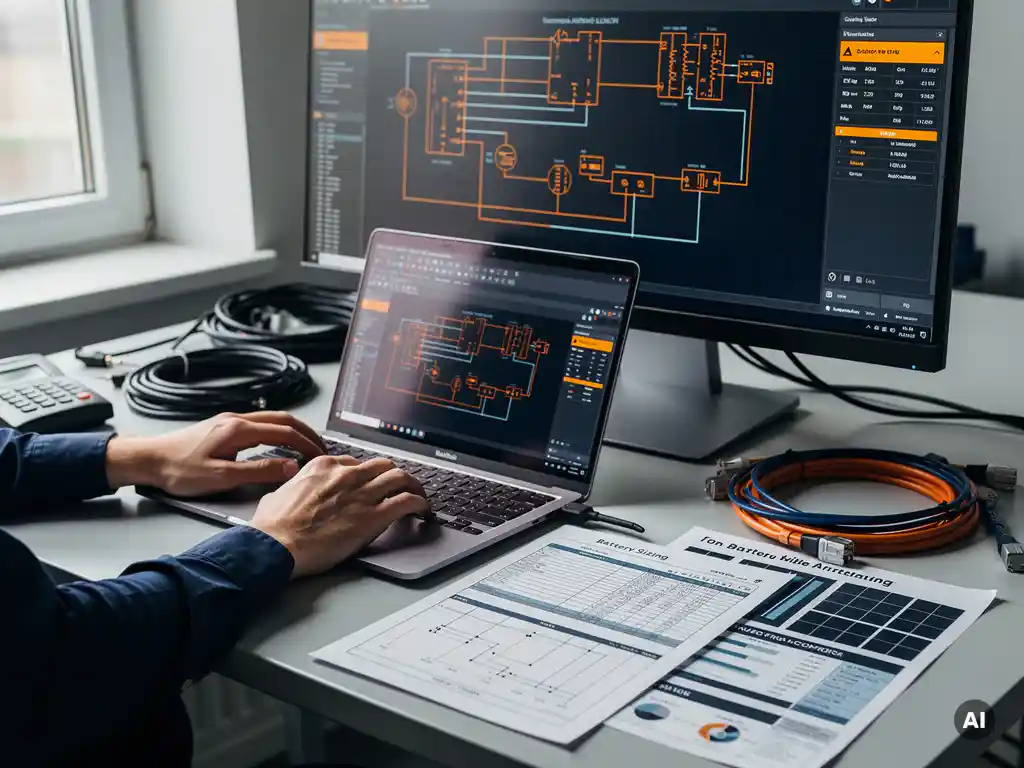
Dedicated battery sizing software can automate the calculations needed to correctly size a battery storage system for a solar project. Tools like PVsyst, HOMER Pro, and specialized storage modules within PV design platforms handle the core math automatically once you feed in the right inputs. The sections below walk through exactly how these tools work, what they need, and where they fit in your design workflow.
What inputs does battery sizing software actually need?
Battery sizing software needs three core categories of input: load data, solar generation data, and system parameters. Load data defines how much energy the system must deliver and when. Solar generation data tells the software how much the PV array will produce across different periods. System parameters cover battery chemistry, depth of discharge, round-trip efficiency, and autonomy requirements.
Getting these inputs right is where most engineers spend the bulk of their time before automation can do its job. For load data, the software typically wants hourly or 15-minute interval consumption profiles rather than just a daily average. A flat daily kWh figure hides peak demand events that can force the battery to discharge far faster than average calculations suggest.
On the generation side, the software pulls from either a connected PV simulation or an imported energy yield file. This is why battery sizing and PV design are increasingly handled within the same platform or at least with direct data handoffs between them. Feeding a battery sizing tool with an accurate irradiance-corrected yield profile rather than a rough estimate makes a significant difference in the final battery capacity recommendation.
System parameters are the engineering layer. Key inputs include:
- Battery chemistry (lithium iron phosphate, NMC, lead-acid), which determines usable capacity and cycle life
- Depth of discharge limits set by the manufacturer
- Round-trip efficiency, typically between 90% and 98% for modern lithium systems
- Desired autonomy, meaning how many hours or days the battery must cover without solar input
- Temperature correction factors for sites with significant seasonal variation
How does software automate the battery sizing calculation process?
Battery sizing software automates the process by running iterative energy balance simulations across a full year of hourly data, testing different battery capacities against the load and generation profile until it finds the configuration that meets the defined performance criteria. What would take an engineer hours of spreadsheet work is resolved in seconds.
The core calculation loop works like this: for every time step in the simulation, the software computes the net energy balance between PV generation and load demand. When generation exceeds demand, surplus energy charges the battery up to its usable capacity limit. When demand exceeds generation, the battery discharges to cover the gap. The software tracks state of charge continuously and flags any time steps where the battery hits its minimum threshold, which represents an unmet load or a grid draw event depending on the system type.
From this simulation, the software derives the minimum battery capacity needed to meet the autonomy or self-consumption target you defined. More sophisticated tools then run sensitivity analyses, showing how capacity, cost, and performance shift across a range of battery sizes so engineers can make an informed trade-off rather than just accepting the minimum viable result.
Automation also handles the downstream calculations that follow sizing: string configuration for the battery bank, inverter compatibility checks, protection device sizing, and, in some platforms, automatic updates to the single-line diagram. This is where the real time savings compound, because every manual recalculation triggered by a design change is eliminated.
What types of software tools handle battery sizing for solar projects?
Battery sizing for solar projects is handled by three main categories of software: dedicated energy storage design tools, full-system simulation platforms, and integrated PV design suites that include storage modules. Each serves a different point in the project workflow and a different level of engineering depth.
Dedicated energy storage design tools
Tools like HOMER Pro and HOMER Grid are purpose-built for storage system optimization. They excel at multi-scenario analysis, comparing different combinations of PV capacity, battery size, and grid interaction to find the lowest cost of energy or highest self-sufficiency. These tools are well suited for feasibility studies and early-stage project economics, though they require clean input data and some familiarity with energy modeling concepts.
Full-system simulation platforms
PVsyst is the industry standard for PV yield simulation and includes battery storage modeling for off-grid and hybrid systems. Its battery module runs detailed electrochemical simulations and produces results that are widely accepted by lenders and technical advisors. For grid-tied storage, the platform handles self-consumption optimization and peak shaving scenarios.
Integrated PV design suites
Increasingly, PV design platforms are building storage sizing directly into the design workflow so that battery calculations update automatically when the PV layout or load assumptions change. This integration removes the manual data transfer step between a yield simulation tool and a separate storage calculator, reducing both effort and the risk of version mismatches between files.
What’s the difference between battery sizing for off-grid and grid-tied systems?
The fundamental difference is what the battery is sized to do. In an off-grid system, the battery must cover 100% of load demand during periods without solar generation, so sizing is driven by autonomy requirements and worst-case irradiance conditions. In a grid-tied system, the battery is sized around a specific economic or operational objective, such as maximizing self-consumption or avoiding peak demand charges, with the grid acting as a backup.
For off-grid sizing, engineers work from the longest expected period of low solar production at the site, often called the critical design period. The battery must store enough energy to carry the load through that window without the array fully recharging it. This typically produces larger battery banks relative to PV capacity, and the autonomy target, often expressed in days, is the primary design constraint.
Grid-tied battery sizing is more nuanced because the optimization target varies by project. A commercial site trying to eliminate demand charges needs a battery sized around its peak demand profile and the utility’s demand window. A residential self-consumption project needs a battery matched to the gap between daytime generation and evening load. Software handles these different objectives by letting engineers define the target, then optimizing capacity against it rather than applying a fixed autonomy formula.
The software inputs also differ. Off-grid sizing demands conservative worst-case generation data. Grid-tied sizing benefits from time-of-use tariff data so the software can model the economic value of each dispatch decision across the day.
Which battery sizing tools integrate with PV design software?
Several battery sizing tools offer direct integration or structured data exchange with PV design platforms. PVsyst connects its storage module directly to its yield simulation engine, so the battery model uses the same irradiance and temperature data as the PV performance calculation. HOMER Pro accepts PVsyst output files, allowing engineers to use best-in-class yield data within HOMER’s optimization framework.
Within CAD-based design environments, integration is evolving. Platforms that combine electrical design with yield simulation can pass array output data directly into storage sizing routines, keeping all calculations within a single project file. This matters practically because when a module specification changes or the array layout is revised, the battery sizing updates alongside it rather than requiring a separate recalculation in a disconnected tool.
For engineering teams already working inside AutoCAD or BricsCAD, the priority is tools that fit into that environment rather than requiring a platform switch. Virto Solar’s design suite is built around exactly that principle, keeping the full electrical design workflow inside the CAD environment engineers already use, which reduces the friction of connecting PV design outputs to downstream calculations, including storage.
When should battery sizing be done during the solar project design phase?
Battery sizing should happen in two stages: a preliminary sizing during the feasibility or concept phase to validate the project’s technical and economic case, and a detailed sizing during the engineering phase once the PV layout and load data are confirmed. Attempting to finalize battery sizing before the PV design is stable leads to rework when array capacity changes.
In the feasibility stage, a rough battery sizing based on estimated load profiles and target self-consumption or autonomy ratios is enough to assess whether storage makes sense for the project and to ballpark the system cost. This early calculation informs the go/no-go decision and shapes the commercial proposal without requiring full engineering detail.
Detailed battery sizing belongs in the engineering phase, after the PV array layout is fixed, the yield simulation is complete, and the actual load profile data is available. At this point, the software can run a full annual simulation with real hourly data and produce a sizing result that is accurate enough to specify equipment and submit for permitting.
Leaving battery sizing too late, for example after the inverter selection is locked in, creates compatibility problems. Battery systems impose specific requirements on inverter topology and DC bus voltage ranges, so storage sizing needs to inform inverter selection, not follow it. Building this sequencing into the project workflow from the start avoids costly redesign cycles late in the project.
If you want to see how an integrated design environment handles these workflows in practice, get in touch with our team to walk through a project scenario together.
Frequently Asked Questions
How accurate is battery sizing software compared to manual calculations?
Battery sizing software is significantly more accurate than manual calculations because it runs full annual simulations across thousands of hourly time steps, capturing seasonal variation, peak demand events, and state-of-charge dynamics that spreadsheet models routinely miss. Manual calculations typically rely on daily averages and fixed autonomy multipliers, which can under- or over-size the battery by 20–40% depending on the load profile. That said, the software output is only as accurate as the inputs you provide — garbage in, garbage out still applies, particularly for load profiles and irradiance data.
What’s the most common mistake engineers make when using battery sizing software for the first time?
The most common mistake is using a flat daily kWh average for the load profile instead of an actual interval-based consumption dataset. A single daily average obscures peak demand spikes that can force the battery to discharge at rates far beyond what the average implies, leading to an undersized system that fails to meet real-world performance targets. Before running any simulation, verify that your load data is at least hourly resolution and reflects actual usage patterns, including seasonal shifts and any high-draw equipment cycles.
Can battery sizing software account for battery degradation over the system’s lifetime?
Yes, most professional-grade tools like PVsyst and HOMER Pro include degradation modeling that reduces usable battery capacity over time based on cycle count, depth of discharge, and calendar aging. This is critical for long-term performance guarantees and financial modeling, since a battery sized to meet targets in year one may fall short by year eight if degradation isn’t factored in. When configuring the simulation, look for settings related to end-of-life capacity (typically 70–80% of nameplate for lithium systems) and make sure the sizing result meets your performance targets at that degraded state, not just at beginning of life.
How do I choose between HOMER Pro and PVsyst for a battery sizing project?
The choice largely depends on the project stage and primary objective. PVsyst is the stronger choice when detailed PV yield accuracy and lender-accepted documentation are the priority, particularly for off-grid and hybrid systems where the battery model needs to align tightly with the irradiance simulation. HOMER Pro is better suited for early-stage feasibility work and multi-scenario economic optimization, especially when you need to compare several combinations of PV capacity, battery size, and grid interaction side by side. For many projects, using both tools at different stages — HOMER for concept validation, PVsyst for detailed engineering — is a practical approach.
What happens if the battery sizing output conflicts with the inverter already selected for the project?
If the battery sizing result is incompatible with the inverter already locked in — for example, the required DC bus voltage range or charge/discharge current exceeds what the inverter supports — you face either a redesign of the battery bank configuration or an inverter change, both of which are costly late in the project. This is exactly why battery sizing needs to inform inverter selection, not follow it. If you’re already in this situation, first check whether adjusting the battery string configuration (series/parallel arrangement) can bring the bank within the inverter’s operating window before escalating to a full equipment change.
Is battery sizing software suitable for small residential projects, or is it only practical for commercial and utility-scale work?
Battery sizing software is useful at any scale, but the level of tool sophistication you need scales with project complexity. For straightforward residential self-consumption projects, simplified sizing tools built into PV design platforms or even manufacturer-provided sizing calculators are often sufficient and faster to use than full simulation platforms. For residential projects with more complex objectives — time-of-use tariff optimization, backup power requirements, or unusual load profiles — running a proper hourly simulation in PVsyst or a similar tool is worth the additional effort and produces a more defensible result.
How should I validate the battery sizing output before finalizing the design?
Validation should involve at least three checks: confirming the simulation’s key assumptions match real project conditions (load profile source, irradiance dataset, and battery chemistry parameters), reviewing the state-of-charge profile across the critical design period to ensure the battery never hits its minimum threshold at unacceptable frequency, and cross-checking the result against a simplified manual calculation to catch any order-of-magnitude errors from misconfigured inputs. If the software includes sensitivity analysis output, review how the performance metrics shift across a ±20% range of battery capacity — a robust design should show relatively stable performance across that range rather than a sharp cliff at the minimum viable size.
Related Articles
This content was generated with the help of AI — it may contain mistakes
Source link