

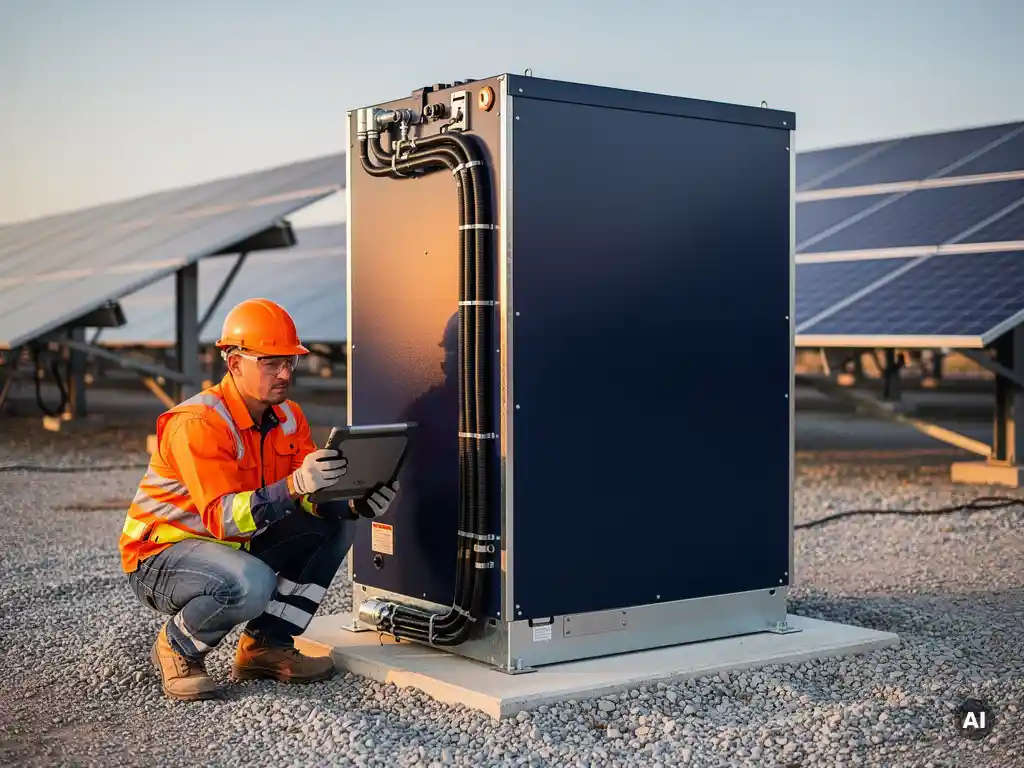
To calculate battery sizing for load shifting, multiply your target load (in kilowatts) by the number of hours you want to shift, then divide by the battery’s usable depth of discharge and round-trip efficiency. This gives you the gross capacity your system needs to reliably move energy from off-peak generation or grid import to peak demand periods. The sections below break down each variable in detail so you can size your system with confidence.
What variables determine battery capacity for load shifting?
Battery capacity for load shifting is determined by four core variables: the load you want to shift (kW), the duration of the shift (hours), the battery’s depth of discharge (DoD), and its round-trip efficiency (RTE). Together, these variables define how large a battery bank you actually need to deliver the required energy at the point of use.
Before running any numbers, you need a clear picture of your load profile. This means knowing not just peak demand in kilowatts, but when that peak occurs, how long it lasts, and how consistently it repeats. A site with a predictable two-hour evening peak is sized very differently from one with irregular demand spikes throughout the day.
The four primary variables to gather before sizing are:
- Target load (kW): The power demand you intend to supply from stored energy during the peak period
- Shift duration (hours): How long the battery must sustain that load before grid power or solar generation takes over
- Depth of discharge (%): The fraction of total battery capacity you are permitted to use without degrading cycle life
- Round-trip efficiency (%): The energy lost in the charge and discharge cycle, expressed as a ratio of energy out to energy in
Secondary variables that refine the calculation include temperature derating (battery capacity drops in cold conditions), system losses in inverters and wiring, and any safety margin you build in for unexpected demand increases. For commercial and industrial projects, regulatory requirements around minimum state of charge may also constrain your usable capacity.
How do you calculate the usable energy capacity needed?
The usable energy capacity needed for load shifting equals the target load multiplied by the shift duration. For example, if you need to supply 50 kW for four hours, your usable energy requirement is 200 kWh. This is the net energy the battery must deliver at the output terminals, before accounting for efficiency losses.
The formula is straightforward:
- Calculate raw energy requirement: Load (kW) x Duration (hours) = Required usable energy (kWh)
- Adjust for round-trip efficiency: Required usable energy / RTE = Energy that must be stored
- Adjust for depth of discharge: Energy that must be stored / DoD = Gross battery capacity required
Using the 50 kW example with a round-trip efficiency of 90% and a depth of discharge of 80%, the calculation runs as follows. The raw requirement is 200 kWh. Dividing by 0.90 gives approximately 222 kWh that must enter storage. Dividing again by 0.80 gives a gross battery capacity of around 278 kWh. That is the nameplate capacity you need to specify when selecting battery modules.
It is worth building a small buffer into this figure, typically 10 to 15%, to account for real-world variation in load, seasonal temperature effects on capacity, and battery degradation over the system’s lifetime. A battery that is sized exactly to the minimum on day one will fall short within a few years as cells age.
What is depth of discharge and how does it affect sizing?
Depth of discharge (DoD) is the percentage of a battery’s total capacity that can be used in a single cycle without causing accelerated degradation. A battery with a 100 kWh nameplate capacity and an 80% DoD delivers 80 kWh of usable energy per cycle. The higher the DoD, the more energy you extract per cycle, but the faster the battery degrades if the manufacturer’s limit is exceeded.
DoD directly affects battery sizing because it sets the ceiling on how much of the nameplate capacity you can actually count on. If you need 200 kWh of usable energy and your battery chemistry supports an 80% DoD, you need at least 250 kWh of nameplate capacity. If your chemistry only supports 60% DoD, you need over 333 kWh for the same job. The relationship is inverse: lower DoD means larger and more expensive battery banks for the same load-shifting task.
Different battery chemistries have very different DoD characteristics. Lithium iron phosphate (LFP) batteries are commonly rated for 80 to 100% DoD and are widely used in commercial energy storage for this reason. Lead-acid batteries typically operate at 50% DoD or less to maintain acceptable cycle life. When comparing battery options, always evaluate DoD alongside cycle life ratings, since a battery that tolerates deep discharge but degrades rapidly after 500 cycles may not be economical over a 10-year project horizon.
How does round-trip efficiency change the required battery size?
Round-trip efficiency (RTE) measures how much of the energy put into a battery comes back out as usable electricity. An RTE of 90% means that for every 100 kWh charged into the battery, 90 kWh is available at discharge. The remaining 10% is lost as heat during the charge and discharge process. Lower efficiency means you must store more energy to deliver the same usable output, which increases the required battery capacity.
The impact of RTE on sizing is multiplicative. If your usable energy requirement is 200 kWh and your system has an RTE of 85%, you need to store approximately 235 kWh. At 90% RTE, that drops to around 222 kWh. The difference may seem modest on a single project, but at utility scale or across a portfolio of commercial sites, it translates to meaningful differences in capital cost and physical footprint.
RTE is not a fixed number across all operating conditions. Batteries tend to be less efficient at very high or very low charge rates, at temperature extremes, and as they age. When sizing for load shifting, use a conservative RTE figure that reflects real-world operating conditions rather than the peak efficiency quoted in a datasheet. A figure 3 to 5 percentage points below the manufacturer’s best-case rating is a reasonable starting point for commercial project planning.
What’s the difference between peak shaving and load shifting in battery sizing?
Peak shaving and load shifting are related but distinct strategies, and they produce different battery sizing requirements. Peak shaving targets brief demand spikes to reduce peak demand charges on utility bills, requiring high power output for short durations. Load shifting moves energy consumption from one time period to another, typically requiring sustained output over several hours. Peak shaving favors high-power batteries; load shifting favors high-energy batteries.
Peak shaving sizing priorities
For peak shaving, the critical specification is power capacity in kilowatts, not energy capacity in kilowatt-hours. A site might only need to suppress a 100 kW demand spike for 15 to 30 minutes. The battery must deliver that power instantly, but the total energy involved is relatively small, perhaps 25 to 50 kWh. Sizing is driven by the C-rate (charge/discharge rate relative to capacity) and the inverter’s peak power rating rather than by hours of runtime.
Load shifting sizing priorities
Load shifting requires the battery to sustain output over a longer window, often two to six hours. Here, energy capacity in kilowatt-hours is the primary sizing driver. The power rating still matters, but a battery sized for load shifting is typically operating at a lower C-rate over a longer period. This distinction matters when selecting battery chemistry: some chemistries optimized for high-power applications are less cost-effective when the primary need is energy throughput over time.
Many commercial and industrial projects combine both strategies. The battery handles peak shaving during brief demand events and performs load shifting to move solar or off-peak grid energy into the evening hours. When sizing for a combined strategy, calculate the peak shaving power requirement and the load shifting energy requirement separately, then select a battery system that satisfies both constraints simultaneously.
How does solar generation affect load-shifting battery sizing?
When solar generation is part of the system, it changes load-shifting battery sizing in two important ways. First, the battery may be charged primarily by solar rather than the grid, which means the available charge window is limited to daylight hours and subject to weather variability. Second, solar generation during peak demand periods may directly offset load, reducing the amount of energy the battery actually needs to deliver. Both effects must be modeled carefully to avoid over- or under-sizing.
The starting point is a realistic solar generation profile for the site, ideally based on measured irradiance data or a validated yield simulation rather than generic averages. You need to know how much solar energy is available during the charging window, how much of that energy is consumed directly by on-site loads, and how much surplus is available to charge the battery. The difference between total solar generation and direct consumption is the energy available for storage.
If solar generation is intermittent or the site has limited roof or ground space, the battery may not reach full charge every day. In that case, you need to size the battery conservatively enough that partial charges on cloudy days still deliver adequate load-shifting performance. A common approach is to model the system against the worst consecutive days of low irradiance in your target location and ensure the battery can still meet the load-shifting target under those conditions.
For solar-plus-storage projects at commercial or utility scale, accurate yield simulation is essential to getting battery sizing right. Tools like Virto Solar’s design platform integrate layout, shading analysis, and energy production modeling, giving engineers the generation data they need to size storage accurately rather than relying on rule-of-thumb estimates. If you are working through a complex solar-plus-storage sizing challenge, speaking with a specialist can help you validate your assumptions before committing to equipment specifications.
Frequently Asked Questions
How do I account for battery degradation when sizing a load-shifting system for a 10-year project?
Battery capacity typically degrades by 20–30% over a 10-year lifespan, depending on chemistry, cycling frequency, and operating conditions. To account for this, size your system to meet your load-shifting target at end-of-life rather than day one — this usually means adding 20–25% to your calculated gross capacity. Alternatively, some project developers size to year-one requirements and plan a partial battery augmentation midway through the project life, which can be more capital-efficient depending on battery price trends.
What is a good starting point for building a load profile if I don’t have interval meter data?
If interval meter data isn’t available, start by requesting 15-minute demand data from your utility provider, as most commercial accounts have this recorded even if it isn’t automatically shared. Failing that, you can build an estimated load profile by cataloging major equipment, their rated power draws, and their typical operating schedules. For critical sizing decisions, investing in a temporary power logger for two to four weeks of real-world measurement is almost always worth the cost, since undersized or oversized systems both carry significant financial consequences.
What happens if my battery is undersized and can’t cover the full load-shifting window?
If the battery is undersized, it will either deplete before the peak period ends or be forced to draw from the grid during the period you intended to avoid — negating some or all of the economic benefit. In grid-tied systems, the inverter will automatically supplement from the grid once the battery reaches its minimum state of charge, so there is no risk of a power outage, but the demand charge or time-of-use cost savings will be reduced. This is why building a 10–15% buffer into your gross capacity calculation is strongly recommended, especially for commercial projects where demand charge savings are the primary financial driver.
Can I use second-life EV batteries for load shifting, and does the sizing calculation change?
Second-life EV batteries can be a cost-effective option for load shifting, but the sizing calculation must be adjusted to reflect their reduced and less predictable capacity. These batteries typically retain 70–80% of their original nameplate capacity, and their actual DoD limits and round-trip efficiency may be lower than a new commercial storage system. You should apply a more conservative RTE figure (often 80–85%) and a tighter DoD limit, and build in a larger degradation buffer — typically 25–30% — since second-life cells age less predictably than purpose-built stationary storage.
How does ambient temperature affect battery sizing for outdoor or unconditioned installations?
Battery capacity can drop by 10–20% in cold temperatures (below 10°C) and efficiency degrades at temperature extremes in both directions, meaning your real-world usable energy will be lower than datasheet values if the system isn’t thermally managed. For outdoor or unconditioned installations, apply a temperature derating factor to your capacity calculation based on the lowest expected operating temperature at your site. Many commercial battery systems include integrated thermal management, but if yours does not, sizing up by an additional 10–15% in cold climates is a practical safeguard.
Is it better to install one large battery system or multiple smaller units for a load-shifting application?
For most commercial and industrial load-shifting applications, a modular approach using multiple smaller units offers advantages in redundancy, scalability, and maintenance flexibility — if one module fails, the rest of the system continues operating. A single large system may have a lower upfront cost per kWh but carries more risk if a fault takes the entire system offline during a critical peak period. The right choice depends on your site’s reliability requirements, available space, and whether you anticipate needing to expand capacity in the future as loads grow or tariff structures change.
What common mistakes should I avoid when sizing a battery for load shifting for the first time?
The most common mistakes are using nameplate capacity as if it were usable capacity (ignoring DoD), applying the manufacturer’s peak RTE rather than a real-world operating figure, and sizing to current loads without accounting for future load growth or battery degradation. Another frequent error is failing to model the charging window carefully — if the battery cannot be fully recharged between discharge cycles due to limited solar generation or grid import constraints, it will underperform regardless of how well the discharge side was sized. Always validate your sizing assumptions against at least one pessimistic scenario before finalizing equipment specifications.
Related Articles
This content was generated with the help of AI — it may contain mistakes
Source link