

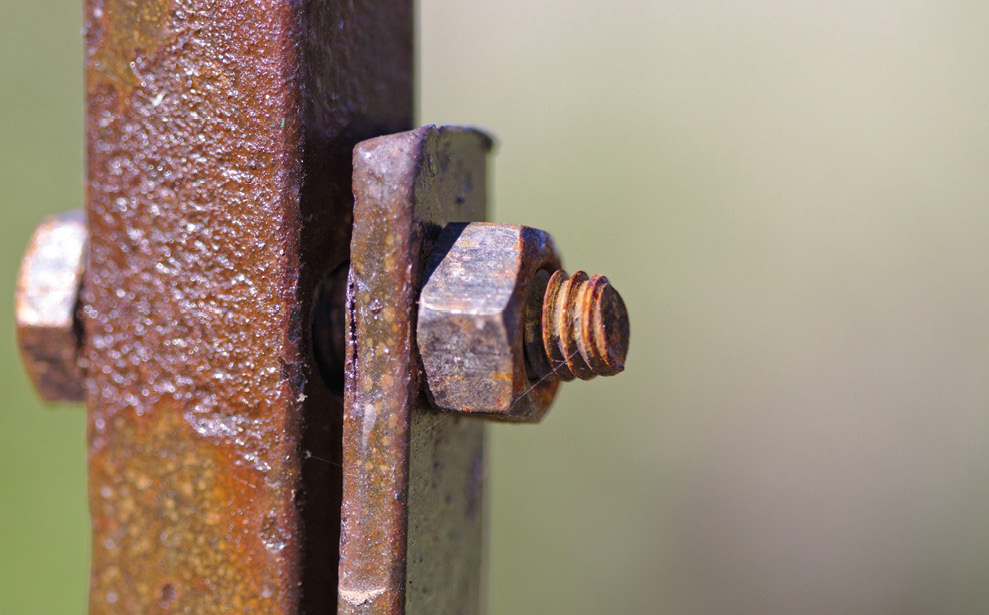
The owner of a solar park on Portugal’s Atlantic coast was walking his dog when he noticed something. His solar park was only two years old, but there were rusting bolts.
The project was built by a German EPC company with a workmanship guarantee. The owner called the EPC to invoke the warranty, a quality manager inspected the site, and issues were found.
This is the go-to anecdote for Alexander Gebert, sales director at German distributor and wholesaler Tobsteel, who is passionate when selling the importance of quality fasteners.
In the case of the rusty coastal solar plant, the EPC chose hot-dip galvanized fasteners at the site. Workers installing the racking had scratched the galvanized coating during the installation and, as Gebert explained, once the coating was scratched, the corrosion protection was finished.
“The bolts, they will rust. They won’t stop. For the moment there is nothing, but what will we have in five or six years? If the wind from the sea will come, the panels will fly away,” Gebert said. Not good. On the Portuguese coast, the EPC sent seven men to change all the fasteners. But they used the wrong bolts. Expensive.
“He gave these invoices to the insurance and three or four weeks later he called saying ‘I have nothing in my account, please send me the money.’ But the insurance rejected the case and justified: ‘We can’t do that, it’s negligent what you did’.”
Corrosion ratings
Since 2015, DIN EN 1993-1-4:2015-10/Eurocode 3 has been the relevant standard in Europe for selecting materials. It was developed by the European Committee for Standardization (CEN) and takes precedence over national standards. The corrosion resistance classes in accordance with DIN EN 1993-1-4;2015-10/Eurocode 3 – Annex A are mandatory for material selection when designing steel structures.
To get a payout, the EPC needed to use Eurocode 3 compliant fasteners. Eurocode 3 regulations are applied across the European Union and United Kingdom, and this is why failing to invest in the right fasteners can prove a false economy.
The regulations set out corrosion resistance factors (CRF) that EPCs need to follow. The CRF figure is calculated by adding up three subcategories: F1, F2 and F3. F1 is the big one for solar and it covers risk of chloride (salt) exposure. Installations near the coast need to use fasteners with a CRF that meets the F1 standard. F2 relates to sulfur dioxide, which is more relevant for environments with significant vehicle exhaust pollution such as road tunnels. F3 relates to the effects of cleaning and rain-washing.
There are different ways to achieve the right CRF, including by using regular steel fasteners that are galvanized to protect against corrosion, and which come at a lower upfront cost. A steel screw with a zinc-magnesium-aluminum coating that’s installed correctly will do the job – but Gebert, at least, argued that human error and environmental factors leave EPCs open to corrosion risk.
“If you hot dip galvanize or put other coatings on the surface, you have usually the basic normal steel screw. A lot of guys working outside on a solar field do not have time – they have their tool on the highest torque, and they just go ‘boom, boom, boom’. And if they damage the screw a tool – if they just scratch the surface of the bolt, the protection is finished. It will start to rust, and it won’t end,” he said.
Stainless steel corrosion modes
Surface corrosion: Rust in general means surface corrosion, or the uniform attack and removal of the surface.
Extraneous rust: Particles of low-alloy steel can start to rust while adhering to a stainless-steel bolt. This can interrupt the passivation layer and cause pitting. Causes include using tools that were previously used on normal steel, flying sparks from an angle grinder or during welding work, contact between rusting objects and stainless-steel surfaces, or rust-contaminated water dripping onto stainless-steel surfaces.
Crevice corrosion: This occurs in narrow gaps and cracks when the passive layer of the stainless steel is destroyed and the oxygen required to form the passive layer cannot reach the surface.
Pitting: The passivation layer is only destroyed at specific points. This can occur in wastewater areas, in particular, as many chlorine ions attack the surface.
Intergranular corrosion: Chromium carbides precipitate at the grain boundaries. Depletion occurs in the surrounding area and the passivating effect is lost. This can be avoided by reducing the chromium content or adding titanium or niobium.
Stress corrosion cracking: Occurs in components under strong mechanical tensile and bending loads.
Bimetallic (contact) corrosion: Occurs when stainless steel comes into contact with other metallic materials.
Numbers game
As a distributor of stainless-steel fasteners, Gebert argues there are better long-term options for EPCs and solar installation owners, and he explained that the appropriate fastener rating will depend on the project. Going up the grading scale, the stainless steel will have a higher pitting resistance – the localized corrosion that creates small holes in metal – described by a pitting resistance equivalent number (PREN). There are a few different formulas for calculating the PREN value, but each uses the percentage of component metals such as chromium in the alloy.
The classifications for fasteners used by Tobsteel are defined in DIN EN ISO 3506 and DIN EN 10088, respectively, and are based on their PREN value and the metals contained in the stainless-steel alloy. Grade A2 contains chromium and nickel; grade A4 adds molybdenum; and in grade A8, the nickel content is increased to about 25% and the molybdenum content to about 6% to 7%.
For standard utility-scale solar and rooftop solar, A2 rated fasteners are sufficient. Anything near a coastline, however, needs a minimum of A4. True offshore installations, such as on platforms or floating installations, would require minimum D6 grade fasteners. Gebert said at the Portugal site, the EPC used hot dip galvanized bolts instead of A4 – an upfront saving that turned out to be far more costly in the long run, given the roughly €34,000 ($39,745) the EPC spent on replacing the rusty fasteners, which was not reimbursed by the insurer.
Quality assurance
Whether an EPC or investor chooses a galvanized or stainless-steel fastener for PV mounting structures, protecting the investment requires quality assurance.
Tobsteel is based in Öhringen, southwest Germany – far from the original equipment manufacturers in China that produce its stainless-steel screws. However, Gebert explained that the company is registered with Germany’s Deutsches Institut für Bautechnik (DIBt), and as a result must buy compliant products.
To ensure quality, Gebert said that of the 100 employees at the company, 10 are working in quality management. Starting from the A4 level, the company conducts material analysis to ensure the alloy will stand up to the elements.
“We have material analysis machines, and we make a shot from every lot that is coming in,” Gebert said.
It’s a more expensive initial investment, but for solar in high salt environments, the sales director claims it is worth it in the long run.
The post Fighting coastal corrosion appeared first on pv magazine Global.
Source link