

From ESS News
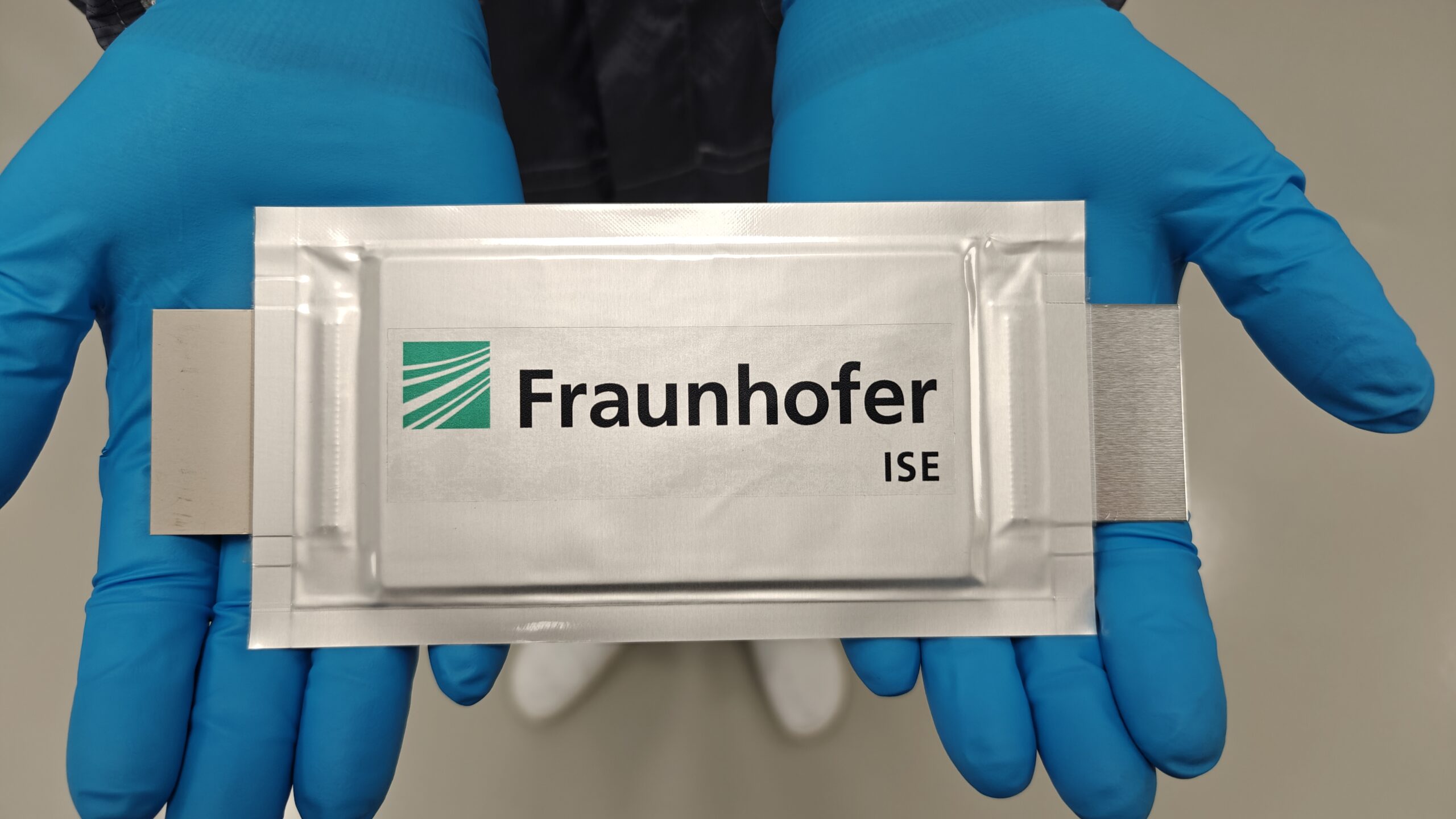
A consortium led by Germany’s Fraunhofer Institute for Solar Energy Systems (Fraunhofer ISE) has developed thicker battery electrodes that could increase cell-level energy density by 10% to 15% without adding weight.
The researchers demonstrated the concept in lithium-ion, sodium-ion, and zinc-ion cells. They also manufactured lithium-ion pouch-cell prototypes.
“The new cell architecture was developed with future mass production in mind: A potential electrode production line exhibits significantly lower process complexity compared to a state-of-the-art wet-coating system,” Fraunhofer ISE said in a statement. “As a result, capital costs are significantly lower. Operating costs are also lower because it requires less space and energy. This technology thus opens up the possibility, particularly for small and medium-sized enterprises, to establish their own battery cell production facilities in Germany.”
Oliver Fitz, group leader for battery cell technology at Fraunhofer ISE, said the researchers increased electrode coating thickness from the conventional range of 100 µm to 200 µm to as much as 800 µm. The thicker electrodes reduce the number of current collectors required inside a cell, leaving more space and weight for active energy-storing material.
The resulting battery cells are also PFAS-free and are manufactured without toxic solvents. PFAS, or per- and polyfluoroalkyl substances, are a large group of synthetic chemicals that are highly persistent in the environment and are often referred to as “forever chemicals.”
The research team developed the electrode and cell design as part of three projects: “VORAN – Innovative Sodium-Ion Battery Storage for Stationary and Mobile Applications,” “INFAB – Zinc-Ion Batteries for Stationary Energy Storage – Manufacturing and Assembly,” and “WinZIB2 – Globally Deployable, Innovative Zinc-Ion Battery System.”
Project partners include Acp systems, Helmut Hechinger, the University of Stuttgart‘s Institute for Photovoltaics (ipv), and the Karlsruhe Institute of Technology/Helmholtz Institute Ulm.
“In a climate-neutral energy system with fluctuating energy sources like solar and wind, stationary battery storage is an integral component for covering morning and evening electricity peaks,” said Andreas Bett, director of Fraunhofer ISE. “Germany would be well advised to build up manufacturing capacity to meet the growing demand for batteries and thereby create value within the country. If we can contribute to that, we’d be very happy.”
Source link