

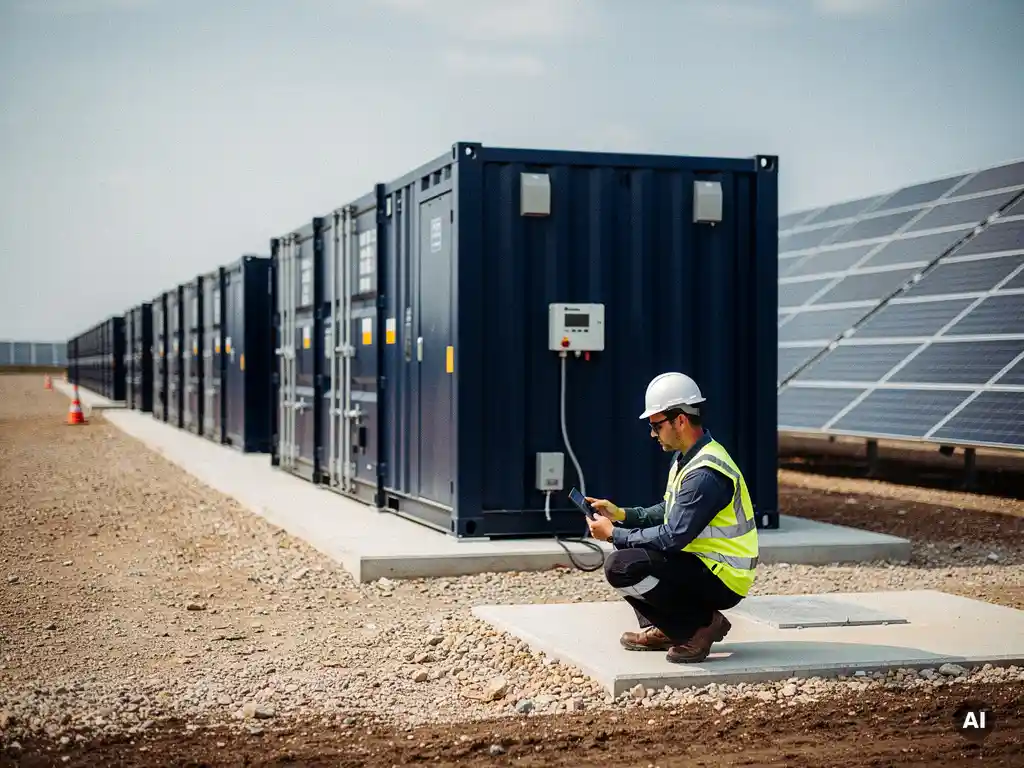
To size a battery for a utility-scale storage project, you need to determine the required energy capacity in megawatt-hours and the power output in megawatts based on your project’s discharge duration, grid obligations, and revenue strategy. A typical utility-scale battery is sized to deliver its rated power for two to four hours, though the right configuration depends heavily on the specific use case. The sections below walk through each key sizing decision in detail.
What factors determine the right battery size for a utility-scale project?
The right battery size for a utility-scale project is determined by four core factors: the intended use case, the required discharge duration, the grid interconnection capacity, and the project’s revenue model. No single formula applies universally because a frequency regulation asset behaves very differently from a peak-shaving or solar-firming installation.
Start with the use case. A battery designed for frequency regulation needs fast response and high cycle frequency but relatively short discharge windows, often just 15 to 30 minutes. A battery built for energy arbitrage or capacity firming needs to sustain output for two to four hours or longer. These two requirements lead to very different sizing outcomes even when the rated power is identical.
Grid interconnection limits are another hard constraint. If your point of interconnection allows a maximum export of 50 MW, your battery power rating cannot meaningfully exceed that figure without wasting capacity. Similarly, if the project is co-located with a solar array, the combined AC output must stay within the interconnection limit, which directly shapes how much storage you can deploy.
Finally, the revenue model drives the economic sizing logic. Projects relying on capacity market payments are sized to meet a specific guaranteed output duration. Projects targeting time-of-use arbitrage are sized around the spread between off-peak charging windows and peak discharge periods. Getting the use case and revenue stack right before running capacity calculations is the most important first step in battery sizing.
How do you calculate the required energy capacity for a utility-scale battery?
To calculate the required energy capacity, multiply the target power output in megawatts by the required discharge duration in hours, then adjust upward for round-trip efficiency losses and the battery’s usable state-of-charge window. The result gives you the nameplate energy capacity you need to procure.
For example, a project that must deliver 20 MW for four hours requires a baseline of 80 MWh. However, lithium iron phosphate batteries typically operate between 10% and 90% of their nameplate capacity to protect cycle life, meaning only around 80% of nameplate capacity is usable. Accounting for this, the nameplate capacity should be closer to 100 MWh. Round-trip efficiency losses, typically in the range of 85% to 92% for modern lithium-ion systems, add another layer of adjustment if the battery is charging from a source with a cost, such as grid power purchased for arbitrage.
Degradation over the project lifetime is also worth factoring in at this stage. Battery capacity fades with each charge-discharge cycle and with calendar aging. A system sized precisely to meet today’s requirements may fall short of its obligations in year eight or ten. Many developers add a degradation buffer of 10% to 20% to the initial nameplate capacity, or they specify augmentation provisions in the supply contract to top up capacity at defined intervals.
Finally, confirm that your energy capacity calculation aligns with the interconnection agreement and any grid code requirements in your jurisdiction. Some markets specify minimum discharge durations for capacity payments, which effectively set a floor on the energy-to-power ratio your system must achieve.
What is the ideal C-rate for utility-scale battery storage systems?
The ideal C-rate for utility-scale battery storage systems is typically 0.25C to 0.5C, meaning the battery is designed to fully discharge over two to four hours. A 0.5C system delivers its full energy capacity in two hours, while a 0.25C system takes four hours. This range balances cost efficiency, cycle life, and the most common grid-scale revenue applications.
C-rate is simply the ratio of power output to energy capacity. A 100 MWh battery with a 50 MW inverter operates at 0.5C. The same battery paired with a 25 MW inverter operates at 0.25C. Higher C-rates, such as 1C or 2C, are used in frequency regulation applications where the battery must respond instantly and discharge rapidly, but these configurations stress the cells more and typically result in faster degradation.
For most utility-scale projects in 2026, the two-hour and four-hour durations dominate because they align with the peak pricing windows in most electricity markets and with capacity market requirements in regions like the US, UK, and Australia. Four-hour systems have grown in popularity as battery costs have fallen, making longer durations economically viable for the first time at scale.
When selecting a C-rate, also consider the battery chemistry. Lithium iron phosphate cells, which now dominate the utility-scale market, are well suited to continuous operation at 0.25C to 0.5C and tolerate this range without significant thermal stress. Higher C-rates may require additional thermal management investment, which adds cost and complexity to the balance-of-plant design.
How does the solar-to-storage ratio affect battery sizing in co-located PV systems?
In a co-located solar-plus-storage system, the solar-to-storage ratio directly determines how much of the PV generation the battery can absorb, how often it cycles, and whether the system can meet its firming or curtailment obligations. A ratio that is too high leaves excess solar energy uncaptured; a ratio that is too low leaves the battery underutilized and the economics weaker.
There is no universal ideal ratio, but a common starting point for co-located systems is a battery sized to store between one and two hours of the solar array’s peak AC output. For a 100 MWac solar plant, this suggests a battery in the range of 100 to 200 MWh. The right figure depends on the local irradiance profile, the grid operator’s curtailment rules, and the project’s firming commitments.
Interconnection constraints add another dimension. Many co-located projects share a single grid connection point, meaning the combined output of the solar array and the battery cannot exceed the interconnection limit at any moment. In this configuration, the battery is often charged during periods when the solar array would otherwise be curtailed, then discharged during evening peak hours. This clipping-and-firming strategy makes the interconnection more productive and can significantly improve project revenue without requiring a larger grid connection.
From an engineering standpoint, modeling the solar-to-storage ratio requires hourly or sub-hourly generation data, a realistic dispatch strategy, and a clear view of the market rules governing when and how the battery can charge and discharge. Tools that integrate energy yield simulation with storage dispatch modeling are particularly valuable here, since the interaction between the two assets is dynamic and highly site-specific. If you are working through this analysis and want guidance on the engineering workflow, reach out to our team for support.
What are the most common battery sizing mistakes in utility-scale projects?
The most common battery sizing mistakes in utility-scale projects are undersizing for degradation, ignoring auxiliary loads, over-optimizing for a single revenue stream, and failing to account for the usable state-of-charge window. Each of these errors can result in a system that underperforms against its contractual obligations or generates less revenue than projected.
- Ignoring degradation: Battery capacity declines over time. A system sized to just meet its obligations at commissioning may fall short within three to five years. Always build in a degradation buffer or include augmentation provisions in the supply contract.
- Overlooking auxiliary loads: Thermal management systems, power conversion equipment, and control systems all consume energy. These parasitic loads reduce the net energy available for export and must be accounted for in the capacity calculation.
- Optimizing for one use case only: Revenue stacks in most markets combine multiple value streams, such as capacity payments, frequency regulation, and energy arbitrage. A battery sized purely for one stream may be poorly positioned to capture others, leaving money on the table.
- Confusing nameplate and usable capacity: Nameplate energy capacity is not the same as the energy the battery can actually deliver. Failing to apply the usable state-of-charge window leads to systematic undersizing.
- Skipping sensitivity analysis: Battery sizing assumptions, including electricity prices, cycle frequency, and degradation rates, carry real uncertainty. Projects that skip sensitivity analysis often discover that their business case is fragile when real-world conditions differ from the base case.
A disciplined sizing process treats each of these factors as a distinct calculation step rather than a rounding consideration. The difference between a well-sized and a poorly sized utility-scale battery can easily represent tens of millions of dollars in lifetime revenue or penalty exposure. Getting the engineering right from the start is always the more cost-effective path.
For solar professionals looking to streamline the broader engineering workflow around large-scale PV and storage projects, Virto Solar’s design tools are built to automate the repetitive calculations that slow teams down, freeing up time for the kind of detailed analysis that battery sizing decisions genuinely require.
Frequently Asked Questions
How do grid interconnection agreements affect battery sizing decisions after the project is already permitted?
If your interconnection agreement is already executed, it sets a hard ceiling on both your export capacity and, in many cases, your import capacity for charging. This means your battery sizing must work backward from those limits rather than forward from an ideal configuration. If you find the interconnection capacity is too restrictive for your target revenue stack, you may need to explore a capacity upgrade request with the grid operator, though this adds cost and timeline risk. It is far better to flag interconnection constraints during the feasibility stage than to discover them after permitting.
What happens if my battery is undersized and can’t meet its capacity market obligations?
Failing to meet capacity market obligations typically triggers financial penalties, which vary by market but can be substantial enough to wipe out a significant portion of the capacity payment revenue the project was designed to capture. In some markets, repeated non-performance can result in de-rating or disqualification from future capacity auctions. To mitigate this risk, developers should size with a degradation buffer, include augmentation provisions in the battery supply contract, and model performance obligations under conservative degradation scenarios before committing to a capacity market bid.
How do I decide between a two-hour and a four-hour battery duration for my project?
The right duration depends on three things: the electricity market structure in your region, the specific revenue streams you are targeting, and the relative cost of adding energy capacity versus the incremental revenue it generates. In markets where peak pricing windows last four or more hours, a four-hour system will capture significantly more arbitrage revenue than a two-hour system. However, if the primary revenue stream is frequency regulation or spinning reserve, a shorter duration at higher power may be more economical. Running a dispatch simulation with real market price data for your location is the most reliable way to identify which duration maximizes your project’s net present value.
Can battery sizing be adjusted after commissioning if the project’s revenue strategy changes?
Physical augmentation is possible if the system was designed with future expansion in mind, including spare inverter capacity, additional DC combiner slots, and a battery management system that can accommodate new modules. However, retrofitting a system that was not designed for augmentation is expensive and technically complex. The most practical approach is to include contractual augmentation provisions with your battery supplier at the outset, specifying the price and timeline for adding capacity at defined intervals, typically every three to five years as degradation accumulates. Changing the revenue strategy without augmentation is possible but may require re-optimizing the dispatch algorithm rather than physically resizing the system.
What tools or data inputs do I need to run a reliable battery sizing analysis?
A reliable sizing analysis requires at minimum: hourly or sub-hourly electricity price data for your target market, a realistic dispatch model that reflects market rules and operational constraints, the battery’s technical specifications including round-trip efficiency, usable state-of-charge window, and degradation curve, and the interconnection agreement’s export and import limits. For co-located solar-plus-storage projects, you also need high-resolution solar irradiance data and an energy yield model for the PV array. Integrated platforms that combine energy yield simulation with storage dispatch modeling significantly reduce the risk of errors that arise when these calculations are done in separate tools and reconciled manually.
How does battery chemistry choice affect the sizing calculation?
Battery chemistry affects sizing through three key parameters: round-trip efficiency, usable state-of-charge window, and degradation rate. Lithium iron phosphate, which dominates the utility-scale market today, offers a well-understood degradation curve, a usable window of roughly 80% of nameplate capacity, and round-trip efficiency in the 88–92% range. Alternative chemistries, such as sodium-ion or flow batteries, may offer different trade-offs, including wider usable windows or slower degradation, which would change the nameplate capacity you need to procure. Always base your sizing calculation on the specific datasheet values for the chemistry and cell format you intend to use rather than on generic industry averages.
At what project stage should battery sizing be finalized, and how detailed does it need to be at each stage?
Battery sizing typically goes through three levels of refinement: a high-level feasibility estimate at the development stage, a detailed engineering basis at the point of financial close, and a final confirmed specification before the equipment procurement contract is signed. At feasibility, order-of-magnitude sizing based on use case and interconnection capacity is sufficient to assess viability. By financial close, the sizing must be detailed enough to underpin the revenue model, the equipment budget, and the performance guarantees in the offtake agreement. Final procurement specifications should incorporate the full degradation analysis, augmentation schedule, and auxiliary load accounting described in this post, since these details directly affect the contract terms and pricing you will negotiate with the battery supplier.
Related Articles
This content was generated with the help of AI — it may contain mistakes
Source link