

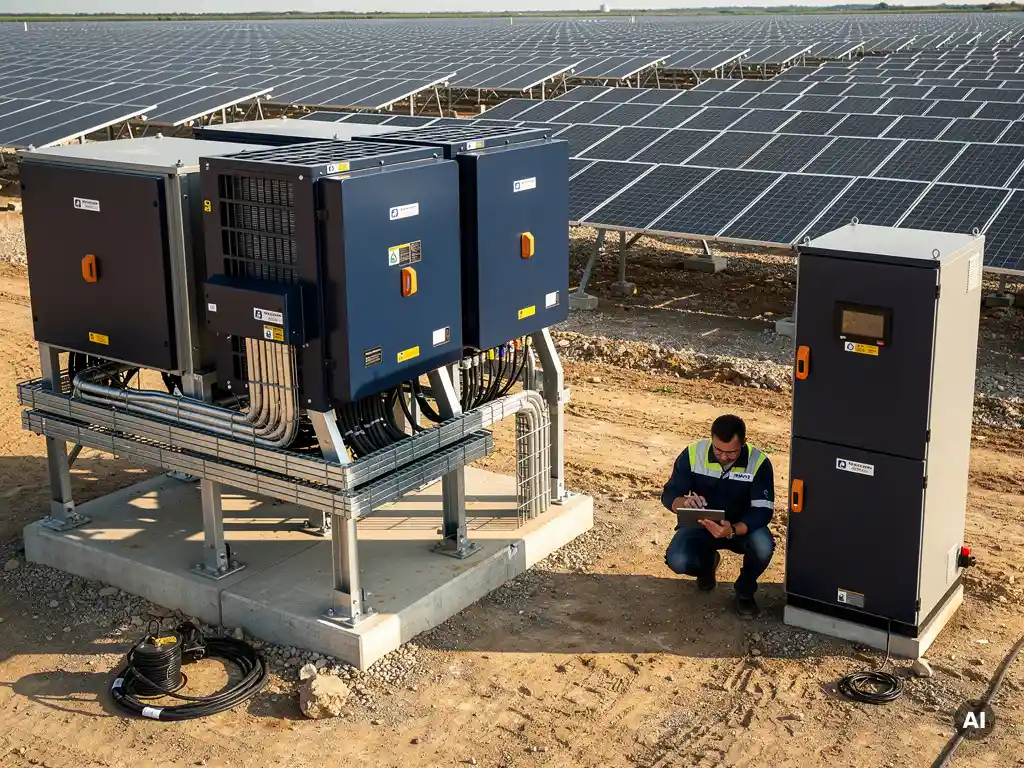
Battery sizing and DC/AC ratio are directly linked: the higher your DC/AC ratio, the more clipping loss your system produces, and a correctly sized battery can capture that clipped energy instead of wasting it. In practical terms, the DC/AC ratio determines how much excess DC power your inverter regularly rejects, which in turn defines the minimum useful battery capacity. Understanding this relationship helps engineers make smarter decisions about both inverter sizing and storage capacity from the very start of a project.
How does adding battery storage change the DC/AC ratio calculation?
Adding battery storage does not change the DC/AC ratio itself, but it changes how you interpret and act on that ratio. The DC/AC ratio is still calculated the same way: total DC array capacity divided by total AC inverter capacity. What changes is that a battery system gives you a productive outlet for the excess DC power that an aggressive ratio would otherwise clip and discard.
In a system without storage, engineers typically keep the DC/AC ratio between 1.1 and 1.3 to limit clipping losses to an acceptable level. Push the ratio higher and you waste too much energy at the inverter. With a battery in the loop, that threshold shifts. A ratio of 1.4 or even 1.5 can become economically justifiable because the battery absorbs the power the inverter cannot export, storing it for later dispatch.
This means that when you introduce storage into a project, the DC/AC ratio calculation becomes a two-part question: first, what ratio maximizes energy harvest given the inverter’s AC limit, and second, what battery capacity is needed to capture the surplus without overflow? The two decisions are inseparable, and sizing one without considering the other leads to either wasted capacity or an undersized battery that fills up before peak clipping ends.
What is clipping loss and why does it matter for battery-storage systems?
Clipping loss is the energy that an inverter discards when the incoming DC power from the solar array exceeds the inverter’s rated AC output capacity. When the sun is at its strongest and the array is producing more power than the inverter can convert and export, the inverter simply limits its output and the excess DC energy is lost as heat. In a storage-free system, clipping loss is an accepted cost of oversizing the array.
For battery-storage systems, clipping loss becomes the central design variable rather than an accepted trade-off. The battery’s job, in part, is to intercept that clipped power before it is lost. This makes the magnitude and timing of clipping loss critical inputs to battery sizing.
Two factors define how much clipping loss matters in your specific project:
- Peak clipping duration: If clipping only occurs for 30 to 60 minutes around solar noon, a relatively small battery can absorb most of it. If clipping extends across several hours due to a very high DC/AC ratio or a location with long peak irradiance windows, the required battery capacity grows significantly.
- Clipping frequency: A system in a high-irradiance climate clips more days per year than one in a cloudy northern location. More frequent clipping means more recoverable energy, which strengthens the financial case for storage and increases the optimal battery size.
Ignoring clipping loss when sizing a battery leads to one of two outcomes: an oversized battery that charges only partially on most days, or an undersized battery that fills before peak clipping ends and then wastes the remainder anyway.
How do you size a battery system based on your DC/AC ratio?
To size a battery system based on your DC/AC ratio, calculate the total clipped energy your system produces on a representative peak day, then size the battery to absorb that volume within the clipping window. The starting point is the difference between your array’s peak DC output and your inverter’s AC capacity, multiplied by the duration of clipping each day.
Here is a practical approach to working through the calculation:
- Determine your clipping power: Subtract the inverter’s AC capacity from the array’s peak DC output. For example, a 1 MWp array paired with a 750 kW inverter clips at 250 kW during peak hours.
- Estimate daily clipping duration: Use irradiance data or a yield simulation to find how many hours per day the array exceeds the inverter limit. This varies by season, location, and tilt angle.
- Calculate daily clipped energy: Multiply clipping power by clipping duration. In the example above, 250 kW of clipping for 2 hours produces 500 kWh of clipped energy per peak day.
- Account for round-trip efficiency: Batteries lose energy in the charge-discharge cycle, typically 10 to 20 percent depending on chemistry. Size the battery to store the gross clipped energy, not the net, so that the usable output meets your target.
- Set your capture target: Decide what percentage of clipped energy you want to recover. Capturing 80 percent of clipped energy is often more cost-effective than designing for 100 percent, because the last fraction requires disproportionately more battery capacity.
Tools that automate yield simulation and DC/AC ratio analysis make this process significantly faster and less error-prone. If you want to see how this works in a real project environment, try Virto Solar’s software to run these calculations within your existing design workflow.
Does a higher DC/AC ratio always justify adding battery storage?
No, a higher DC/AC ratio does not automatically justify adding battery storage. The decision depends on whether the value of the recovered clipped energy exceeds the cost of the battery system over its lifetime. A high DC/AC ratio creates the opportunity to capture clipped energy, but that opportunity only translates into a sound investment under specific conditions.
Three conditions strengthen the case for storage alongside a high DC/AC ratio:
- High electricity prices during off-peak hours: If the grid pays well for energy dispatched in the evening or during demand peaks, the battery earns revenue that justifies its cost. If prices are flat around the clock, the financial case weakens.
- Significant and consistent clipping: A DC/AC ratio of 1.5 in a high-irradiance location with long peak windows produces far more recoverable energy than the same ratio in a low-irradiance climate. The more energy available to capture, the stronger the return on battery investment.
- Grid constraints or self-consumption requirements: Projects with export limits or high on-site consumption needs benefit from storage regardless of clipping, and a high DC/AC ratio amplifies that benefit by providing more energy to store and dispatch.
Conversely, if clipping is minimal because the DC/AC ratio is only modestly above 1.0, or if energy prices offer no time-of-use premium, adding battery storage purely to recover clipped energy rarely pencils out. The battery cost must be weighed against the incremental revenue from the recovered energy across the system’s full operational life.
What happens to battery sizing when the DC/AC ratio changes mid-project?
When the DC/AC ratio changes mid-project, the battery sizing calculation must be redone from scratch. Any shift in the ratio, whether caused by a module substitution, an inverter change, or a layout revision, alters the volume and timing of clipped energy, which directly affects the required battery capacity. Treating the battery size as fixed after a ratio change is one of the most common and costly engineering oversights in storage-integrated projects.
The most frequent mid-project triggers for a DC/AC ratio change include:
- Module availability issues forcing a switch to panels with different wattage or temperature coefficients
- Inverter procurement delays leading to a substitution with a different AC rating
- Site layout revisions that reduce the number of modules and lower the total DC capacity
- Grid connection limits that force a reduction in inverter AC output
Each of these changes ripples through the entire electrical design. A lower DC/AC ratio reduces clipping and may mean the originally specified battery is oversized for the actual energy available. A higher ratio increases clipping and may leave the battery undersized, filling before peak clipping ends and wasting the remainder.
This is precisely why engineering teams working on storage-integrated projects benefit from design environments where changing one parameter automatically updates all dependent calculations. Manual workflows built on spreadsheets and separate CAD files make these cascading revisions slow and error-prone. If your team regularly navigates mid-project changes like these, talk to our team about how automated design tools can keep your battery sizing accurate through every revision cycle.
Frequently Asked Questions
Can I retrofit a battery to an existing solar system that was not originally designed with storage in mind?
Yes, but retrofitting requires a full re-evaluation of your existing DC/AC ratio and clipping profile before specifying any battery hardware. Start by pulling historical production data or running a yield simulation on your current configuration to quantify how much clipped energy is actually available to recover. In many cases, a retrofit also triggers a review of inverter compatibility, since not all inverters support DC-coupled or AC-coupled storage without additional hardware or firmware upgrades.
What is the difference between DC-coupled and AC-coupled battery storage, and does it affect how I size the battery relative to my DC/AC ratio?
In a DC-coupled system, the battery is connected on the DC side of the inverter, allowing clipped energy to charge the battery directly before it ever reaches the inverter’s AC limit — this is the most efficient way to capture clipping losses. In an AC-coupled system, the battery sits on the AC side and charges from grid or inverter output, meaning clipped DC power is still lost at the inverter and cannot be recovered by the battery. For projects where recovering clipped energy is a primary goal, DC-coupled architecture is almost always the right choice, and your battery sizing calculation should reflect the higher round-trip efficiency that comes with it.
How does battery state of charge at the start of the day affect clipping capture, and should I account for it in my sizing?
Absolutely — a battery that enters the morning partially charged from overnight grid charging or a previous day’s incomplete discharge will have less headroom to absorb the midday clipping peak. This is especially relevant for systems with time-of-use charging strategies, where the battery may be intentionally pre-charged from the grid during cheap overnight hours. When sizing, model the battery’s expected state of charge at the onset of the clipping window, not just its total nameplate capacity, to ensure the available headroom matches the volume of clipped energy you need to capture.
What common mistakes do engineers make when sizing a battery for a high DC/AC ratio system?
The three most frequent mistakes are: sizing the battery based on nameplate capacity rather than usable capacity after accounting for depth-of-discharge limits and round-trip efficiency losses; designing for 100% clipping capture when capturing 80–85% is significantly more cost-effective per kWh recovered; and treating the battery size as a fixed value after any mid-project change to the DC/AC ratio. Each of these errors either inflates project costs unnecessarily or leaves recoverable energy on the table, both of which erode the financial case for storage.
How does battery degradation over time interact with a system designed around a specific DC/AC ratio?
Battery capacity degrades over time — typically 2–3% per year for lithium iron phosphate chemistries — which means a battery sized to capture today’s clipping volume will capture progressively less as it ages. A well-designed system accounts for this by either oversizing the battery at commissioning to maintain adequate capture capacity through year 10 or beyond, or by accepting a planned reduction in clipping recovery as part of the long-term yield model. Ignoring degradation in your initial sizing leads to optimistic energy yield projections that fail to match real-world performance in later project years.
Are there project types or grid environments where optimizing the DC/AC ratio and battery size together matters most?
The co-optimization of DC/AC ratio and battery sizing delivers the greatest value in three scenarios: projects subject to hard export limits set by the grid operator, where a higher DC/AC ratio paired with storage maximizes energy harvest within the allowed export ceiling; merchant or merchant-hybrid projects where time-of-use price spreads are large enough to reward evening dispatch; and behind-the-meter commercial and industrial projects with high daytime self-consumption and demand charge exposure. In all three cases, the interaction between how much the array clips and how much the battery can store and dispatch is a primary driver of project economics.
How frequently should I re-run battery sizing calculations during the project development lifecycle?
Battery sizing should be revisited at every major design milestone where the DC/AC ratio could have shifted — including module selection, inverter procurement, layout finalization, and grid connection confirmation. In practice, this means treating battery sizing as a living calculation rather than a one-time output. Teams using integrated design platforms can automate this re-calculation so that any change to array capacity or inverter rating immediately propagates through to an updated battery size recommendation, eliminating the manual reconciliation that makes spreadsheet-based workflows so error-prone.
Related Articles
This content was generated with the help of AI — it may contain mistakes
Source link