

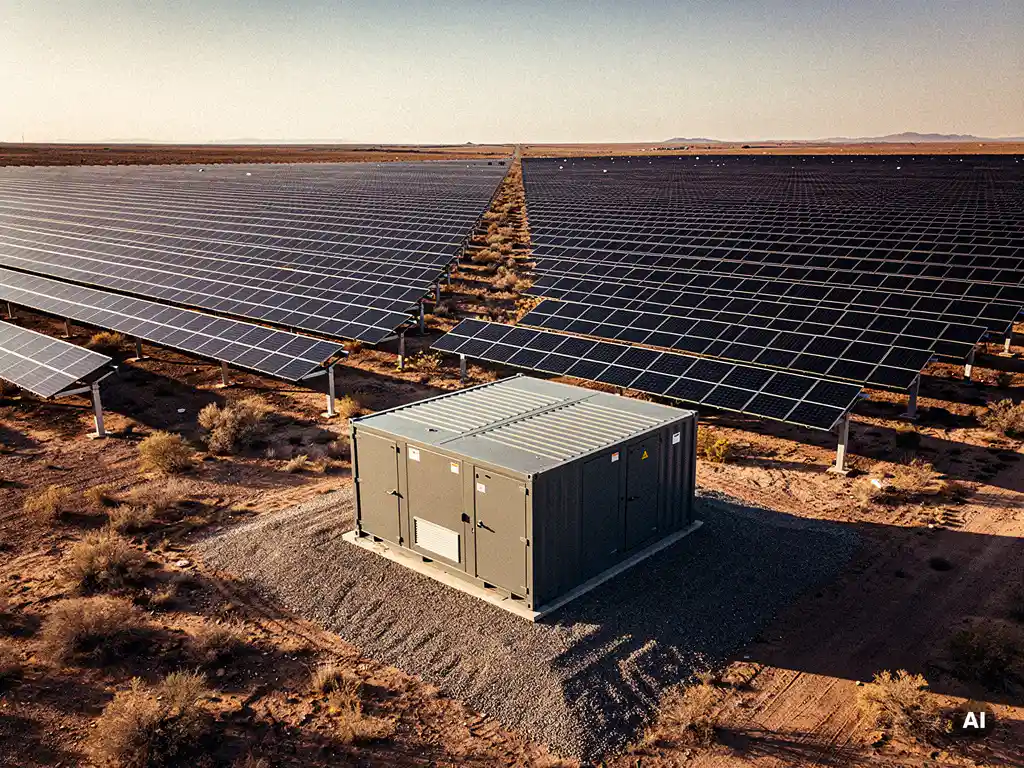
Battery storage supports utility-scale solar projects by capturing surplus electricity generated during peak sunlight hours and releasing it when the sun is not shining or when grid demand spikes. This transforms a solar plant from an intermittent generator into a dispatchable power source, giving grid operators and project owners far greater control over when and how energy is delivered. The sections below unpack the key engineering, financial, and operational questions that every solar professional should understand before designing or evaluating a solar-plus-storage project.
What happens to excess solar energy without battery storage?
Without battery storage, excess solar energy that cannot be immediately consumed or exported to the grid is simply curtailed, meaning the inverters are throttled back and the generation potential is wasted. This happens when solar output exceeds local demand or when grid operators impose export limits during periods of oversupply, a situation that becomes more common as solar penetration on the grid increases.
Curtailment is not just a theoretical concern. As more utility-scale solar capacity comes online, grid operators in many markets are increasingly forced to manage oversupply during midday hours. Without a way to store that energy, project owners lose revenue on generation they have already paid to build. In markets with time-of-use pricing or capacity payments, the financial impact of curtailment can be significant over the lifetime of a project.
Beyond curtailment, the absence of storage also means that a solar plant contributes nothing to grid stability after sunset or during cloudy periods. This limits the plant’s value to the grid and, in some regulatory frameworks, restricts the types of contracts and revenue streams the project can access.
How does a battery energy storage system work with a solar plant?
A battery energy storage system (BESS) paired with a solar plant charges during periods of high solar generation and discharges when output drops or when grid conditions make it more valuable to release stored energy. The system is managed by a battery management system (BMS) and a power conversion system (PCS) that controls the flow of DC and AC power between the solar array, the battery bank, and the grid.
In a DC-coupled configuration, the battery connects directly to the solar array’s DC bus before the inverter, allowing the system to store energy with fewer conversion losses. In an AC-coupled configuration, the battery connects on the AC side and uses a separate bidirectional inverter, which offers more flexibility for retrofitting storage onto existing plants. Each approach has trade-offs in efficiency, cost, and design complexity that engineers must evaluate on a project-by-project basis.
The dispatch strategy, when to charge, when to hold, and when to discharge, is typically governed by an energy management system (EMS). This software layer can optimize dispatch based on electricity prices, grid signals, weather forecasts, and contractual obligations such as capacity agreements or ancillary service contracts. The sophistication of the EMS is often what separates a well-performing storage asset from one that underdelivers on its financial projections.
What are the main benefits of pairing battery storage with utility-scale solar?
Pairing battery storage with utility-scale solar delivers four core benefits: it reduces curtailment, shifts generation to higher-value time periods, enables the plant to provide grid services, and improves the overall bankability of the project by smoothing revenue streams.
- Curtailment reduction: Energy that would otherwise be wasted during midday oversupply can be stored and dispatched later, improving the plant’s capacity factor and revenue.
- Time-shifting: Storing solar energy generated at midday and releasing it during evening peak demand periods allows project owners to capture higher electricity prices and meet time-of-use tariff requirements.
- Grid services: A BESS can respond to grid frequency deviations and voltage fluctuations within milliseconds, enabling the project to participate in ancillary service markets such as frequency regulation and spinning reserve, revenue streams that a solar-only plant cannot access.
- Firming capacity: Storage allows a solar plant to commit to delivering a defined output level during specific hours, which is increasingly required for capacity market participation and long-term power purchase agreements.
- Improved project economics: By stacking multiple revenue streams, a solar-plus-storage project can achieve better returns and attract financing on more favorable terms than a solar-only asset in markets with high renewable penetration.
What is the difference between short-duration and long-duration storage for solar?
Short-duration storage typically refers to systems that can discharge at full power for one to four hours, while long-duration storage refers to systems capable of discharging for six hours or more, sometimes measured in days. The distinction matters because each serves a different grid need and carries different technology, cost, and design implications for a solar project.
Short-duration storage
Lithium-ion battery systems dominate the short-duration segment. They are well-suited for daily charge-discharge cycles, peak shaving, and fast-response ancillary services. A two-hour or four-hour lithium-ion BESS paired with a solar plant is currently the most common configuration in utility-scale projects because the technology is mature, costs have fallen substantially, and the use cases are well understood by lenders and offtakers alike.
Long-duration storage
Long-duration storage technologies, including flow batteries, compressed air energy storage, and emerging iron-air or hydrogen-based systems, are designed to address multi-hour or multi-day energy shifting. These systems are better suited to seasonal balancing or replacing firm generation capacity, but most technologies in this category are still in early commercial deployment. Project developers considering long-duration storage in 2026 should carefully evaluate technology maturity, warranty terms, and the availability of experienced O&M providers before committing to a specific solution.
How does battery storage affect the engineering design of a solar project?
Adding battery storage to a utility-scale solar project introduces significant engineering complexity across the electrical, civil, and controls layers of the design. The integration must be planned from the earliest stages of the project, retrofitting storage onto a completed solar plant is possible but considerably more expensive and constrained than designing for storage from the outset.
On the electrical side, the choice between DC-coupled and AC-coupled architectures affects inverter sizing, transformer ratings, and grid connection capacity. The DC/AC ratio of the solar array may need to be adjusted to account for the additional charging load, and cable sizing calculations must reflect the bidirectional power flows that a BESS introduces. Protection coordination and fault current analysis become more complex because the battery can inject current into the system independently of the solar array.
Civil and structural considerations include the footprint and weight of battery enclosures, fire suppression system requirements, and thermal management infrastructure. Many jurisdictions now require specific separation distances between battery enclosures and other plant equipment, which affects site layout and land use planning.
From a controls perspective, integrating the EMS with the plant’s SCADA system and the grid operator’s dispatch signals requires careful specification and testing. Engineers must also design for degradation, battery capacity declines over time, and the system must be sized to meet its contractual obligations at end-of-warranty, not just at commissioning. Tools that automate electrical calculations and generate accurate single-line diagrams are particularly valuable at this stage, since any error in the base design compounds across the storage integration. Virto Solar’s design software is built to handle exactly this kind of engineering complexity within the CAD environment engineers already use.
When does adding battery storage make financial sense for a solar project?
Battery storage makes financial sense for a utility-scale solar project when the additional revenue it enables, through time-shifting, ancillary services, or capacity market participation, exceeds the combined capital cost, operating cost, and financing cost of the storage system over the project’s life. The answer depends heavily on the specific market, the regulatory framework, and the project’s existing revenue structure.
Several conditions tend to make the economics favorable:
- High price spreads: Markets where the difference between off-peak and on-peak electricity prices is large reward time-shifting strategies and improve storage returns.
- Curtailment risk: Projects in grids with high renewable penetration and limited export capacity benefit most from storage because it converts curtailed generation into dispatchable revenue.
- Ancillary service revenues: In markets with well-developed ancillary service markets, a BESS can generate meaningful revenue from frequency regulation and reserve capacity, improving the overall project return.
- Capacity market requirements: Some offtake agreements and capacity contracts now require a storage component to qualify, making storage a prerequisite rather than an option in those markets.
- Incentive programs: Tax credits, grants, and accelerated depreciation schemes available in various jurisdictions in 2026 can materially shift the investment case for storage.
When the economics are less clear, a detailed financial model that stress-tests revenue assumptions across multiple dispatch scenarios is essential before committing to a storage investment. If you are evaluating whether storage is the right fit for a specific project, speaking with an expert who understands both the engineering and the commercial side of solar-plus-storage can help clarify the decision.
Frequently Asked Questions
How do I choose the right battery capacity and duration for a utility-scale solar project?
Start by modeling your site’s generation profile against local demand patterns, grid export limits, and the revenue streams you intend to target. A project optimized for daily peak-shifting typically needs two to four hours of storage capacity, while one targeting capacity market commitments may require four hours or more. Work with your energy management system vendor and a financial modeler to run multiple dispatch scenarios before locking in a battery size, since oversizing adds capital cost while undersizing can leave contracted obligations unmet at end-of-warranty.
What are the most common mistakes developers make when integrating storage into a solar project?
The most frequent mistake is treating storage as an afterthought rather than a core design input, which leads to costly retrofits, constrained grid connection capacity, and suboptimal DC/AC ratios. Developers also commonly underestimate battery degradation, sizing the system to meet contractual output at commissioning rather than at end-of-warranty. A third pitfall is selecting an energy management system that cannot interface cleanly with the grid operator’s dispatch signals, which limits the project’s ability to capture ancillary service revenues.
Can battery storage be added to an existing solar plant, and what are the main challenges?
Yes, retrofitting storage onto an operational solar plant is technically feasible, but it is significantly more expensive and constrained than designing for storage from the start. The main challenges include limited spare capacity at the grid connection point, inverter and transformer ratings that were not sized for bidirectional power flows, and civil constraints such as insufficient land area or inadequate separation distances for battery enclosures. A thorough feasibility study covering electrical, civil, and permitting requirements is essential before committing to a retrofit.
How does battery degradation affect long-term project performance and revenue?
Lithium-ion batteries typically lose between 2% and 3% of usable capacity per year under normal cycling conditions, meaning a system commissioned today may retain only 70–80% of its original capacity by the end of a ten-year warranty period. This degradation directly reduces the amount of energy the system can dispatch during peak hours, which can erode time-shifting and capacity market revenues if the system was not sized with end-of-life performance in mind. Project developers should require performance guarantees tied to end-of-warranty capacity, not just nameplate capacity at commissioning, and factor degradation curves into all financial models.
What fire safety and permitting requirements should developers expect for utility-scale battery storage?
Most jurisdictions now require battery enclosures to comply with standards such as NFPA 855 or equivalent local codes, which specify minimum separation distances between battery containers, suppression system types, and ventilation requirements. Permitting timelines for storage projects have lengthened in many markets as fire authorities and building departments develop familiarity with large-scale lithium-ion systems, so developers should engage the authority having jurisdiction early in the design process. Factoring fire suppression infrastructure, thermal management systems, and required separation distances into the site layout from day one avoids costly redesigns during permitting.
Which electricity markets currently offer the strongest revenue case for solar-plus-storage projects?
Markets with large on-peak to off-peak price spreads, active ancillary service markets, and capacity market mechanisms that recognize storage tend to offer the strongest economics. In the United States, markets such as CAISO, ERCOT, and PJM have well-established ancillary service and capacity market structures that storage assets can access. In Europe, markets with high renewable penetration and balancing mechanism participation rights, such as Great Britain and parts of the Iberian Peninsula, are increasingly attractive. The specific revenue stack available in any market evolves quickly, so validating assumptions against current market rules and recent clearing prices is critical before finalizing a financial model.
How should project developers evaluate energy management system (EMS) vendors before selecting one?
Evaluate EMS vendors on four criteria: their ability to integrate with your specific battery hardware and SCADA platform, the sophistication of their dispatch optimization algorithms (particularly whether they incorporate real-time price signals and weather forecasts), their track record on comparable utility-scale projects, and the quality of their performance reporting and remote monitoring tools. Ask vendors for audited performance data from operating projects rather than relying solely on modeled projections. A poorly specified or underperforming EMS is one of the leading causes of solar-plus-storage projects missing their financial targets, so this selection deserves as much rigor as the hardware procurement process.
Related Articles
This content was generated with the help of AI — it may contain mistakes
Source link