

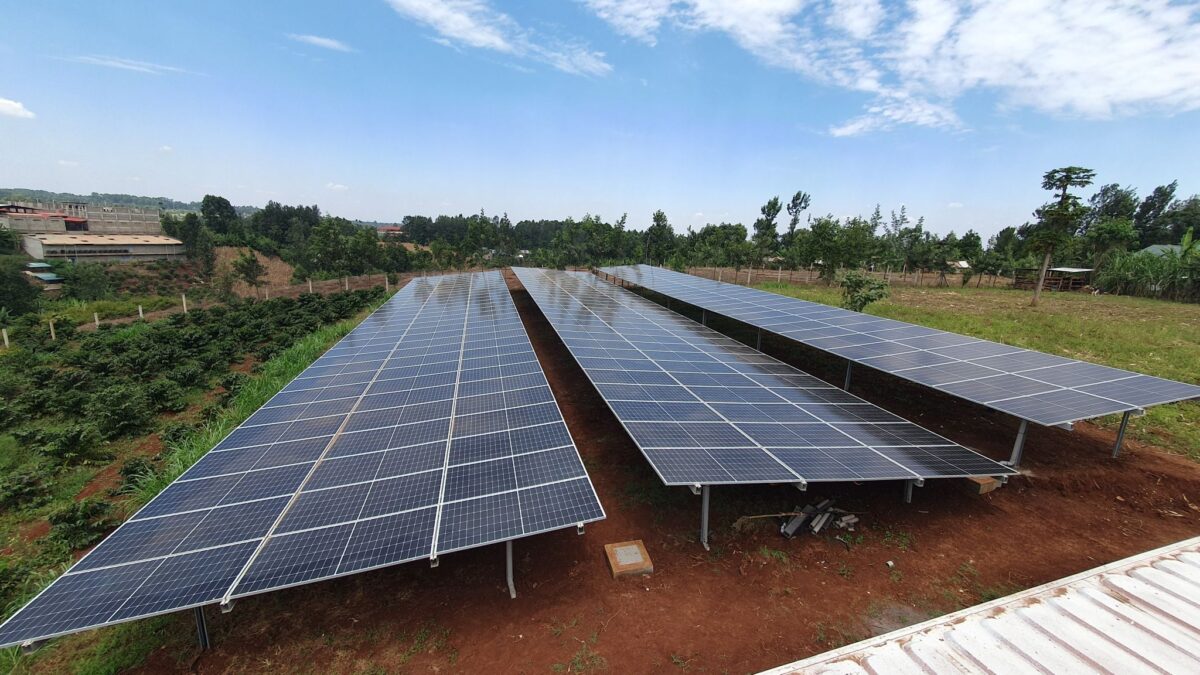
Kenya’s electricity regulator has formally codified charges for unauthorized solar power exports and confirmed net-metering credit provisions in a statement that takes retroactive legal effect more than a year before its publication date, with no public explanation given for the backdating.
Kenya backdated new solar-export rules by more than 14 months, and no one has explained why. The regulator’s changes, reported Sept. 21, are legally in effect retroactive to July 1, 2025 – but neither the government nor local media have said what’s behind the delayed disclosure.
The amendment introduces a formal definition of “dumping” – the unauthorized injection of electricity from a customer’s generation system into the Kenya Power and Lighting Co.’s (KPLC) network without company approval or a valid net-metering agreement. Energy dumped into the grid will be billed at the standard base tariff, and the Energy and Petroleum Regulatory Authority (EPRA) or KPLC may pursue further action if the practice damages equipment, according to the notice.
The notice also codifies a net-metering export credit of 50% of a customer’s exported electricity, applied as a bill credit before pass-through costs, taxes and levies are calculated on total energy supplied. That rate is not new: it traces to Kenya’s Energy (Net-Metering) Regulations of 2024, which took effect in July of that year. The recent statement formalizes the existing rate within the tariff schedule rather than introducing a cut.
Net metering under the amended schedule remains capped at 1 MW of installed capacity per customer, also constrained by each customer’s maximum recorded demand over the prior 12 months. Commercial and industrial (C&I) customers seeking to self-consume solar power above that threshold must pursue separate embedded-generation or open-access arrangements rather than net metering.
Formal net-metering approval requires bidirectional metering and EPRA-licensed installation – conditions some industry observers say not all earlier installations meet, though no public estimates exist.
EPRA has not issued any enforcement notices or retroactive billing advisories under the new dumping definition. The Kenya Renewable Energy Association and solar installer organizations have also not made any public statement on either change.
The change comes as KPLC reported fiscal 2026 revenue up 8.6% to KES 238.24 billion ($1.8 billion) and profit up 2.1% to KES 24.99 billion for the year ended June. Management has cited the tariff structure as limiting revenue growth despite higher sales, though it hasn’t linked that constraint to the net-metering amendment.
Separately, the notice sets Kenya’s e-mobility tariff at KES 16 per unit for standard hours and KES 8 off-peak, removing a prior 15,000 kWh monthly cap that had constrained larger EV-charging operators. It gives no rationale for the change.
EPRA also confirmed three September pass-through charges – a KES 3.00 fuel energy cost charge, a KES 1.1443 foreign exchange adjustment, and a Water Resource Management Authority levy – adding KES 4.16 per unit to bills. All three are calculated before net-metering credits are applied, magnifying their impact on net-metered customers.
The 1 MW ceiling and the underlying net-metering framework aren’t new: EPRA first floated a draft version of the rules in 2022, capping eligible systems at the same 1 MW threshold and targeting roughly 100 MW of initial distributed solar deployment. What’s changed since is the retroactive codification of the export-credit rate and the new “dumping” penalty regime – additions that formalize enforcement around a policy Kenya has been building toward for four years.
Source link