

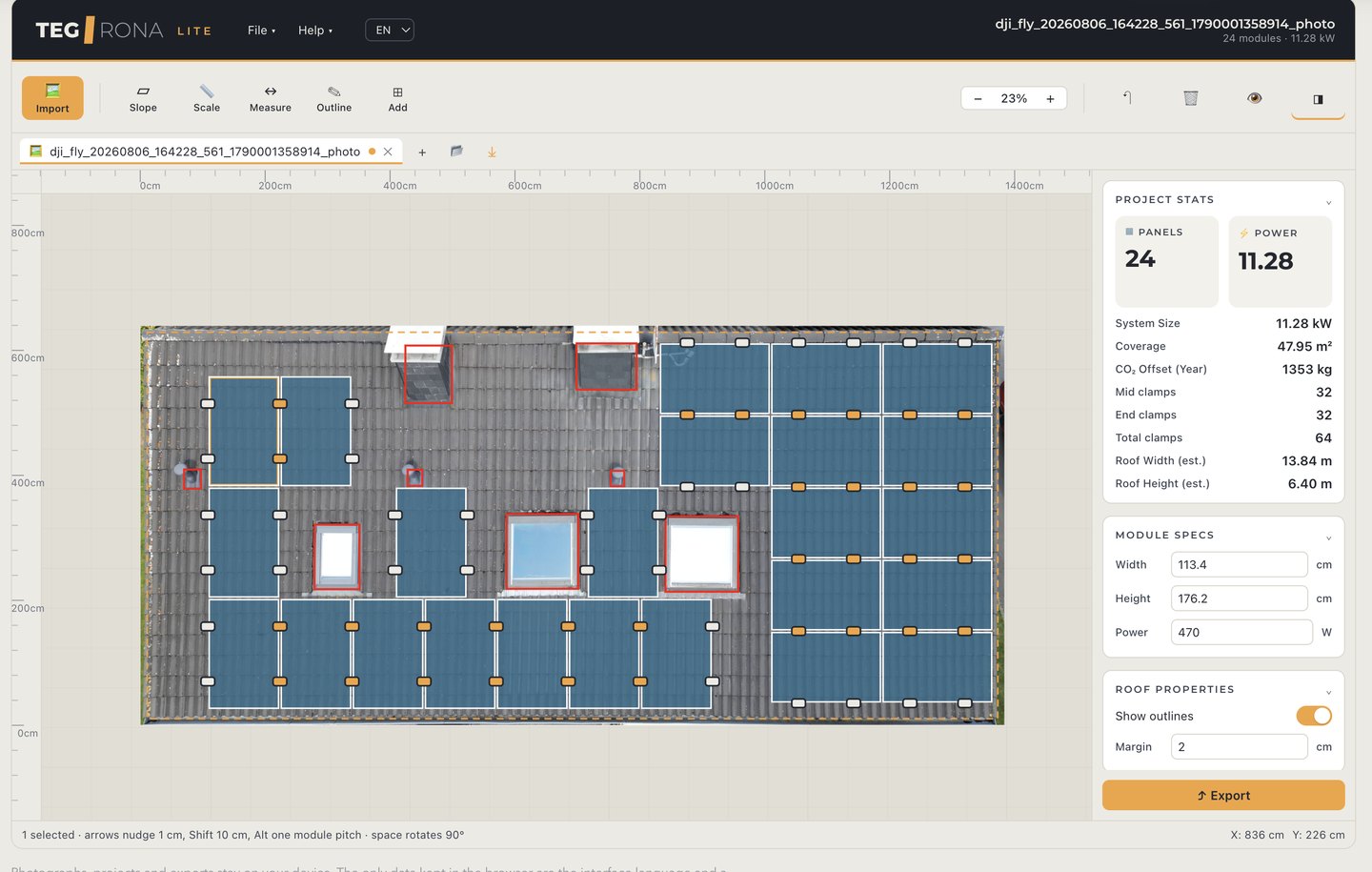
German company Tegrona has introduced Tegrona Lite, free software for planning the layout of photovoltaic systems directly on a photograph of a roof. The tool is aimed at installers and project planners who need to estimate during an initial site visit how many modules can be installed on a roof without using CAD tools or taking on-site measurements.
The software accepts drone photographs, images taken from the ground, and roof plans. Using the image, the user outlines the roof surface with three or four points and defines exclusion zones for obstacles such as chimneys, dormers, skylights and ventilation ducts.
Correcting perspective using roof tiles
One of Tegrona Lite’s technical features is perspective correction for photographs taken from the ground. In such images, eaves and ridgelines may appear distorted, while rows of roof tiles converge toward vanishing points.
The software uses the tiles themselves as a geometric reference. Because rows and columns of tiles are parallel on the roof, their lines can be used to identify vanishing points and calculate the transformation required to rectify the image.
The procedure also allows users to work with trapezoidal or triangular roof surfaces, for which a correction based solely on four corners would not accurately reproduce the surface geometry. Once the image has been rectified, the eave appears horizontal and the module rows can be aligned with it.
Tegrona Lite uses the known dimensions of the roofing material to convert the image into a scaled representation. The user selects the type of roof tile, and the software identifies and counts the tiles visible in the image to calculate the relationship between pixels and actual dimensions.
The application includes tile profiles such as Frankfurter Pfanne and Hohlfalzziegel and allows users to enter other tile types based on their coverage dimensions. A single known measurement, such as the dimensions of a roof window, can also be used to establish the scale.
Automatic module layout
Once the geometry and scale have been defined, the algorithm distributes modules across the roof surface according to the specified module dimensions and power rating. Modules can be placed in portrait or landscape orientation, or the two orientations can be combined when this makes better use of the available space.
On roof surfaces that narrow toward the ridge, rows can be shifted laterally and modules rotated to make use of remaining spaces. Users can also specify minimum distances from roof edges and create exclusion zones around obstacles.
With each modification, the program updates the module count, total installed capacity, occupied area, and the number of mid and end clamps required.
The resulting layout can be exported as a technical sheet in PDF or PNG format, showing the module arrangement overlaid on the original photograph.
All calculations are performed locally on the user’s device. In the web version, processing takes place within the browser, and photographs are not uploaded to a server. According to Tegrona, this approach also avoids transferring geolocation metadata that may be embedded in photographs taken by drones.
Tegrona Lite does not include energy yield simulations, shading analysis, string design or structural checks. These functions are outside the scope of the tool and require dedicated PV design software.
The tool does not require registration or an internet connection for processing. Desktop applications are available for macOS 14 and later and Windows 10 and later, while the web version runs on a range of operating systems and devices. The web version is available in 11 languages, including Spanish.
Source link