

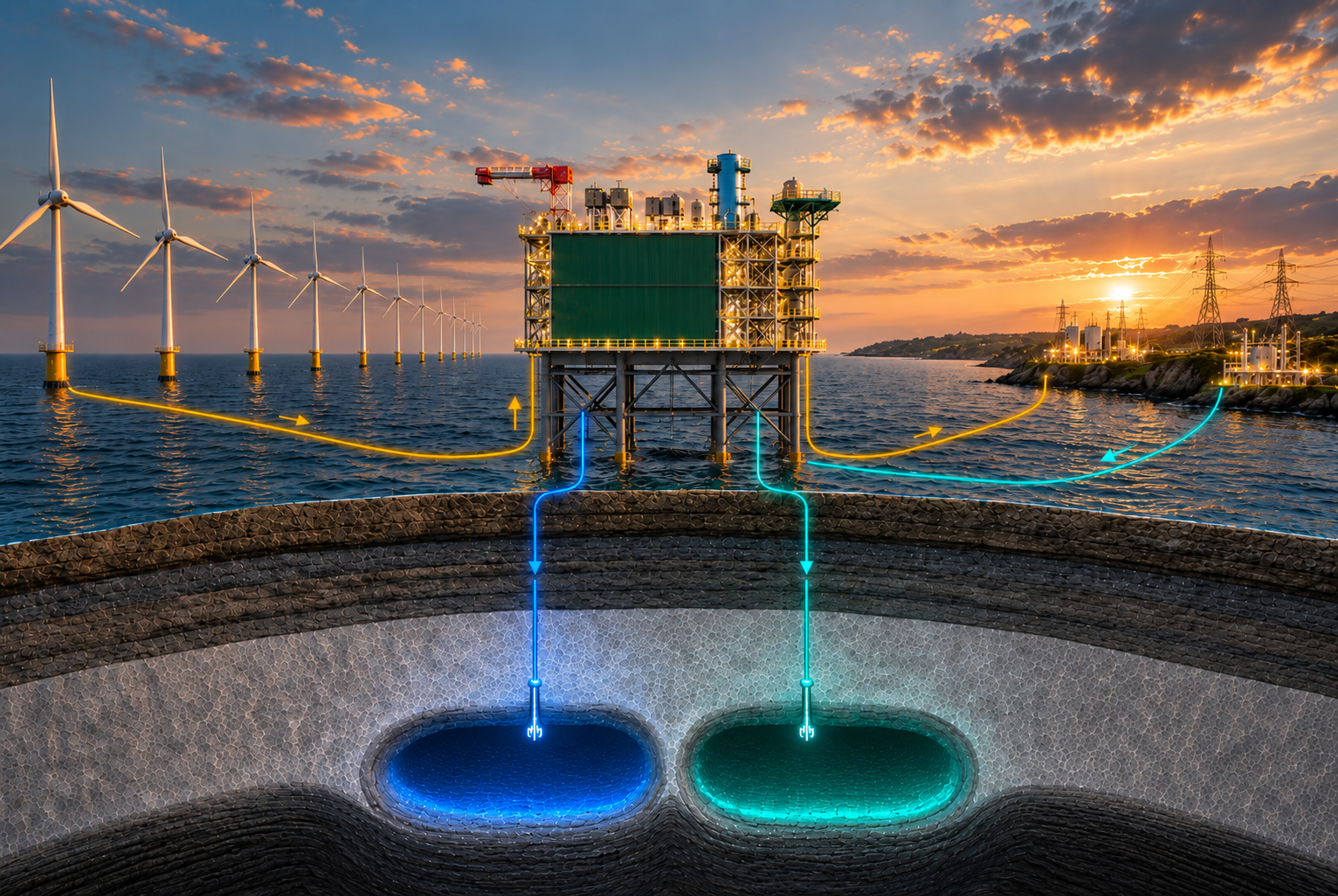
EnergyPathways, which is listed on London’s AIM market, is developing the Marram Energy Storage Hub (MESH) in salt caverns beneath the East Irish Sea, about 18 km off Lancashire, England, with onshore facilities at the Port of Barrow.
The first phase is a 300 MW/55.2 GWh CAES plant, more than seven days at full power, alongside planned gas and hydrogen storage and hydrogen and graphite production. It is currently the largest CAES project under development in the United Kingdom.
The pre-revenue company, which announced a proposed fundraise on Sept. 28, is targeting a final investment decision in 2028 and operations by the end of 2031, subject to consents and Ofgem cap-and-floor support. It did not apply to the scheme’s first window, in which Ofgem provisionally selected 16 projects totaling 7.6 GW and 136.9 GWh in June. pv magazine asked CEO Ben Clube why the company sat out the first round and what MESH needs from UK policy.
ESS News: MESH isn’t among the projects in the first round of Ofgem’s cap-and-floor scheme. What happened, and what are you hearing about round two?
Ben Clube: We didn’t apply for the first round. We were invited to, but we chose not to, so it wasn’t a matter of being picked or not. We’ve already been invited by Ofgem and Department for Energy Security and Net Zero (DESNZ) to participate in the second round of the cap and floor. We’re just awaiting the official launch, but the guidance from government is that the process will launch toward the end of this year.
If the second round slips beyond that, what does it mean for the project?
The cap-and-floor second round has already been pushed back by about six months from the government’s original plans, because of delays in closing the shortlisting for the first round. But it hasn’t stopped the MESH LDES project from proceeding. The project we submit will be much more mature, and we expect to put forward a very mature proposal with the issues and criteria well addressed. The cap-and-floor process is evolutionary: projects mature over the one-year evaluation period. In effect, we’re getting everything done before the process starts.
If cap-and-floor and gas storage support don’t come through in time, is there a version of MESH that still gets built? Which parts would survive: the storage, the hydrogen, the graphite?
MESH has already been recognized as a project of national significance. We’re in regular communication with the government about the project, and the support to see it proceed is very strong. So we don’t see it as a matter of if, but when the government is able to launch the second round.
The first-round cap-and-floor projects barely scratch the surface of the challenge ahead. The first round is about 130 GWh of storage capacity with an average duration of about 18 hours. Compare that to the scale of the challenge, where surpluses each year could be as much as 70 TWh, adding system costs in the multibillions. And because the system is wind-dominated, surplus events are typically well in excess of 12 hours, and often days. The first round isn’t delivering the amount of storage, or the right type of storage, that the UK desperately needs to bring down electricity bills.
What makes the salt formation suitable for caverns?
The salt is a very thick sequence, 500 to 600 meters of vertical relief, and it’s virtually pure halite. That combination of purity, thickness and depth makes it ideal for constructing salt caverns for compressed air storage.
What drives the low-cost proposition of MESH is the large scale of the caverns we can construct. Each cavern will be 700,000 cubic meters, the equivalent of four St. Paul’s cathedrals. There are limited places where this potential exists. The first MESH project requires four of these caverns, but we think the entire license area has potential for up to 60. So the scalability of MESH is immense, and it represents a significant strategic storage asset that can harness a considerable amount of the surplus wind the UK will generate in future.
Is MESH purely a compressed air project, or is there a hydrogen storage element as well?
It’s an integrated storage system. The compressed air captures surplus wind generation, but we combine that with gas and hydrogen storage to provide a strategic long-term storage reserve for the UK grid.
The UK grid currently depends on dispatchable gas-fired generation to back up renewables, which are mainly wind. About 50% of the gas supply comes from UK North Sea production, but as production declines, the UK will be importing up to 90% of its gas needs during peak winter demand periods. So security of gas supply becomes critical for the UK’s energy security. The UK currently has very little gas storage, less than six days of national supply. The EU has around 80 days, and other big importers like China have 40-plus days. Our gas storage offers seasonal capability, and hydrogen storage is the decarbonization pathway for that gas storage.
The system is rapid response, so we can dispatch power from a cold start within a couple of minutes, and with the strategic reserve from gas and hydrogen storage, we can provide flexibility across any time frame. A battery has a response time of milliseconds to seconds, but its duration capability is about an hour and a half. Pumped hydro operates within the hour mark. We cover both of those markets, plus the strategic reserve.
When is final investment decision (FID) and when would the first cavern be operating?
The FID target is 2028 for the LDES compressed air project, and that hangs off the cap-and-floor process, which provides the sovereign guarantee on the revenue stream for project financing. We’re looking at first operations at the end of 2031 or early 2032. Compare that to alternative clean energy solutions such as pumped hydro or nuclear, which have far longer development timescales.
What concerns you most on the road to FID? What needs to be locked down in the next year or two?
We can only move as fast as policy and regulatory frameworks are rolled out. Mobilizing investment needs those government signals to build investor confidence in inward investment into the UK, so timely rollout is key.
There are two main areas of policy. One is gas security of supply. A consultation was launched at the end of last year, and we put our gas storage project forward. With 90% import dependency, the UK is highly exposed to import disruption, and the government needs to move fast to get projects such as ours up and running to shore up the country’s energy security. We expect that to be addressed in the Energy Independence Bill in the autumn.
The second is the government’s position on hydrogen. The hydrogen strategy is a long-awaited piece of government direction that will drive the next round of hydrogen investment. Our approach to hydrogen production is commercially attractive, notably because of the high-value graphite by-product of our process, but we still need the framework rolled out so investment can be mobilized.
Your last accounts carried a going-concern warning from your auditor. What needs to happen for that to go away, and how much cash do you have?
We’re a small-cap company, with a market cap of just over GBP 20 million ($26.6 million), and we’re pre-revenue, so going-concern disclosures are typical for companies like ours. Our going-concern status is a matter of securing financing for the development work we plan to do, and that’s a continual exercise. So there’s nothing particularly abnormal about it.
Is there anything else you’d like to add?
As renewables in the UK expand and wind generates surpluses, the role for batteries is very limited relative to the challenge, because of their technical limitations on duration. In a solar-dominated world, batteries have a more natural role to play. So the move to other storage technologies is absolutely critical for the UK’s energy future. It won’t be done by batteries, and storage solutions like MESH are critical to bringing down electricity bills by stopping the waste.
Source link