

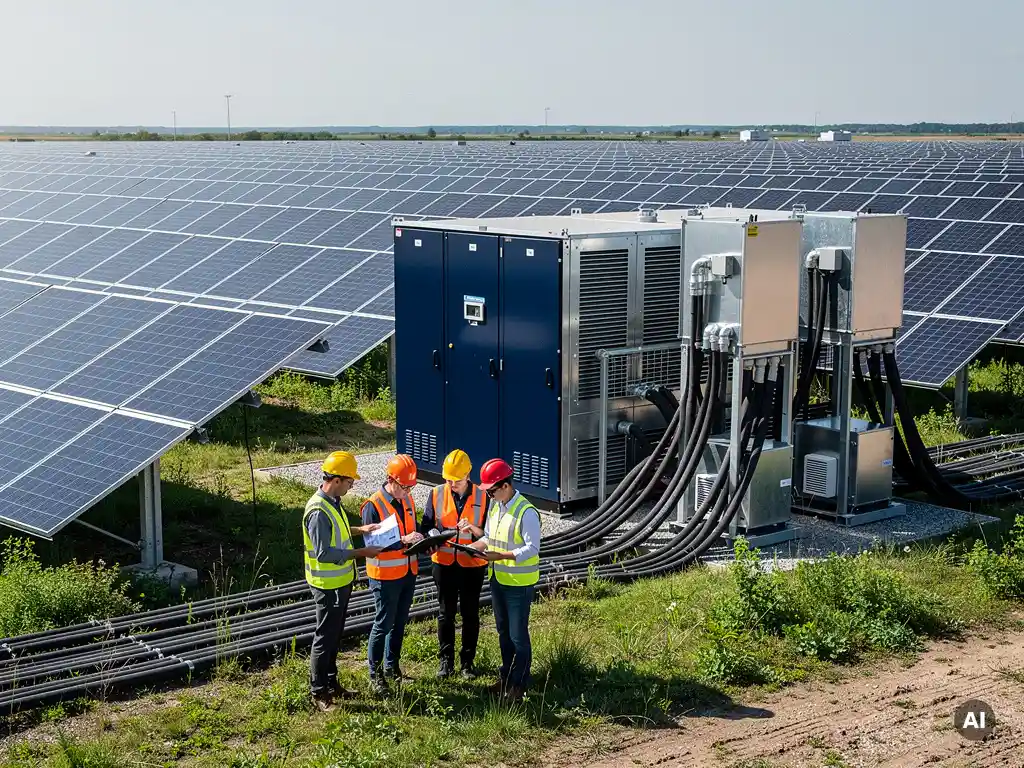
Grid-connected battery storage is a system that stores electrical energy and remains linked to the public utility grid, allowing it to charge from the grid, discharge to support loads, and export surplus energy back to the grid. Unlike standalone systems, grid-tied battery storage works in coordination with grid power, providing flexibility that off-grid systems simply cannot match. This article unpacks how these systems work, what they are made of, and what engineers need to consider when designing them.
How does grid-connected battery storage work?
A grid-connected battery storage system charges from either a solar PV array, the utility grid, or both, then discharges stored energy to supply loads or export power back to the grid. The system continuously monitors grid conditions and responds in real time, shifting energy between sources based on price signals, demand levels, or grid stability requirements set by the operator or control software.
At the heart of the operation is a battery management system (BMS) paired with an inverter or power conversion system (PCS). The BMS monitors cell voltage, temperature, and state of charge to protect the battery and maximize its lifespan. The inverter converts DC energy stored in the battery into AC power compatible with the grid and connected loads.
Control logic determines when the system charges and when it discharges. In a solar-plus-storage configuration, the battery typically charges during peak solar production hours and discharges during evening demand peaks or when grid electricity prices are highest. Grid operators can also send signals to the battery system, instructing it to provide frequency regulation or voltage support services, turning the battery into an active participant in grid balancing rather than a passive storage unit.
What are the main components of a grid-tied battery system?
A grid-tied battery system consists of four core components: the battery modules themselves, a battery management system (BMS), a power conversion system or inverter, and an energy management system (EMS). Together, these components handle energy storage, safety monitoring, AC/DC conversion, and intelligent dispatch decisions.
Here is a breakdown of each component and its role:
- Battery modules: Lithium iron phosphate (LFP) chemistry dominates utility-scale and commercial applications in 2026 due to its thermal stability, cycle life, and cost trajectory. Modules are grouped into racks and then into battery energy storage system (BESS) enclosures.
- Battery management system (BMS): Monitors individual cell parameters, balances charge across cells, enforces safety limits, and communicates state-of-charge data to the EMS and inverter.
- Power conversion system (PCS) or inverter: Converts DC power from the battery to AC power for the grid and loads, and reverses the flow during charging. Bidirectional inverters are standard in grid-tied applications.
- Energy management system (EMS): The intelligence layer that decides when to charge, when to discharge, and how to respond to grid signals or price incentives. The EMS integrates with SCADA systems, utility APIs, and forecasting tools.
- Grid interconnection equipment: Includes protection relays, meters, and switchgear required to safely connect the system to the utility network and comply with grid codes.
What is grid-connected battery storage used for?
Grid-connected battery storage systems serve multiple purposes simultaneously, including peak shaving, energy arbitrage, frequency regulation, voltage support, backup power, and solar self-consumption optimization. The specific use case mix depends on the project type, market structure, and the revenue streams available in a given grid region.
The most common applications include:
- Peak demand shaving: Discharging the battery during periods of high demand to reduce a facility’s peak demand charge on its electricity bill, which is one of the most financially compelling use cases for commercial and industrial customers.
- Energy arbitrage: Charging when electricity prices are low (often midday with high solar generation) and discharging when prices are high, capturing the price spread as revenue.
- Frequency regulation: Responding within milliseconds to grid frequency deviations, providing a fast-response ancillary service that grid operators value highly and compensate accordingly.
- Voltage support: Injecting or absorbing reactive power to maintain voltage stability on distribution networks, particularly in areas with high renewable penetration.
- Solar self-consumption: Storing excess solar generation that would otherwise be exported at low feed-in tariff rates and using it later when the sun is not producing, increasing the economic return of a PV installation.
- Backup power and resilience: Providing emergency power during grid outages, though this requires specific inverter configurations that allow islanding operation.
What is the difference between grid-connected and off-grid battery storage?
The fundamental difference between grid-connected and off-grid battery storage is whether the system maintains a physical and electrical connection to the utility grid. Grid-connected systems use the grid as a backup supply and an export channel, while off-grid systems operate in complete isolation and must be sized to meet 100% of load demand without any grid fallback.
This distinction has major engineering implications. An off-grid system must account for worst-case scenarios: extended periods of low solar irradiance, seasonal demand variation, and load growth over the system’s lifetime. Battery capacity and generator backup must cover every possible gap in solar production. This typically results in significantly oversized systems compared to grid-tied equivalents serving the same load.
Grid-connected systems, by contrast, can be sized more aggressively for specific use cases like peak shaving or arbitrage, because the grid absorbs any shortfall. This makes grid-tied battery storage more cost-effective per unit of delivered value in most commercial and utility contexts. Off-grid storage remains the right choice for remote locations where grid connection is technically impossible or economically prohibitive.
A third category worth noting is the hybrid or grid-interactive system, which operates grid-connected under normal conditions but can island and operate independently during outages. This configuration is increasingly common in critical facilities and microgrids.
What should engineers consider when sizing a grid-connected battery system?
When sizing a grid-connected battery system, engineers must evaluate energy capacity requirements, power output requirements, round-trip efficiency, depth of discharge limits, cycle life, degradation rates, and the specific use cases the system needs to serve. Getting the sizing wrong in either direction creates real financial and technical problems, so a structured approach is essential.
Key considerations include:
- Use case definition: The target application drives everything. A system optimized for peak shaving needs high energy capacity relative to power output. A frequency regulation system needs high power output and fast response but may need less total energy capacity. Defining the primary and secondary use cases before sizing is non-negotiable.
- Load profile analysis: Reviewing at least 12 months of interval meter data (typically 15-minute intervals) reveals demand peaks, load patterns, and the energy volumes involved. This data directly informs the required energy capacity in kilowatt-hours.
- Depth of discharge (DoD): Most lithium battery systems are rated at 80-90% usable DoD, but operating consistently at maximum DoD accelerates degradation. Engineers should factor in a conservative DoD assumption to preserve cycle life over the project’s intended lifespan.
- Degradation and end-of-life capacity: Battery capacity degrades over time. A system sized to meet requirements at year one may fall short by year ten. Sizing should account for end-of-life capacity, typically modeled at 70-80% of nameplate, depending on the manufacturer’s warranty terms.
- Round-trip efficiency: Energy is lost in every charge and discharge cycle. A system with 90% round-trip efficiency loses 10% of every kilowatt-hour cycled. This loss must be factored into both economic modeling and operational dispatch strategies.
- Grid interconnection limits: The utility’s interconnection agreement may cap the maximum export power or impose ramp rate limits, which constrain how the battery can operate and must be reflected in the system design.
- Regulatory and safety requirements: Grid codes, fire codes, and local building regulations impose requirements on battery chemistry, enclosure design, fire suppression, and protection systems that affect both sizing and cost.
For engineers working on solar-plus-storage projects, integrating battery sizing into the broader PV system design early in the process avoids costly redesigns later. Tools that handle PV layout, yield simulation, and electrical design within a single workflow make this coordination significantly more manageable. If you are working on a project that combines PV and battery storage and want to explore how software can streamline that process, get in touch with our team to discuss your specific project requirements.
Frequently Asked Questions
Can a grid-connected battery system operate during a grid outage?
Not automatically — standard grid-tied battery systems are required by safety regulations to shut down during a grid outage to protect utility workers. However, systems configured with islanding-capable inverters and the appropriate transfer switching equipment can disconnect from the grid and continue supplying critical loads independently. This hybrid or grid-interactive configuration requires additional hardware and must be explicitly designed for islanding from the outset, as it cannot typically be retrofitted without significant cost.
What is the typical lifespan of a grid-connected battery storage system, and how does degradation affect performance over time?
Most lithium iron phosphate (LFP) battery systems used in commercial and utility applications are warranted for 10–15 years or a specified number of cycles, whichever comes first, with end-of-life capacity typically defined at 70–80% of nameplate. In practice, degradation rate depends heavily on operating conditions — systems that regularly cycle to maximum depth of discharge, operate in high-temperature environments, or provide high-frequency regulation services will degrade faster than those with more conservative dispatch profiles. Engineers should model degradation curves from the manufacturer’s data and build augmentation or replacement costs into the project’s financial model from day one.
How do I choose between an AC-coupled and DC-coupled battery storage configuration for a solar-plus-storage project?
In a DC-coupled system, the battery and solar array share a single inverter, which is more efficient because solar energy charges the battery without an extra AC/DC conversion step — making it the preferred choice for new-build projects where both systems are installed simultaneously. AC-coupled systems connect the battery inverter independently on the AC side, making them easier to retrofit onto an existing PV installation without replacing the original solar inverter. The right choice depends on whether you are designing a new system or adding storage to an existing one, the available space for additional inverter hardware, and the round-trip efficiency targets set for the project.
What grid codes and standards should engineers be aware of when designing a grid-connected battery storage system?
The applicable standards vary by country and utility, but key references include IEEE 1547 (for interconnection of distributed energy resources in North America), IEC 62933 (for electrical energy storage systems), and UL 9540 (for battery energy storage system safety). In addition, most utilities have their own interconnection technical requirements covering protection relay settings, anti-islanding, power quality, and metering that must be satisfied before the system can be energized. Engaging with the utility’s interconnection team early in the design process is strongly recommended, as requirements can significantly influence system architecture and add lead time to the project schedule.
What are the most common mistakes engineers make when designing grid-connected battery storage systems?
One of the most frequent mistakes is sizing the system based on a single use case without accounting for how the dispatch strategy may evolve over the project’s lifetime — a system optimized purely for peak shaving may miss out on significant ancillary service revenue. Another common error is underestimating degradation, leading to a system that fails to meet contractual performance guarantees in later years. Engineers also frequently overlook the thermal management requirements of battery enclosures, which can lead to accelerated degradation or safety issues in climates with extreme temperatures. Finally, starting the interconnection application process too late is a recurring project delay that can be avoided with early utility engagement.
How does round-trip efficiency affect the economics of a grid-connected battery storage project?
Round-trip efficiency (RTE) directly determines how much energy is lost every time the battery completes a charge-discharge cycle — a system with 85% RTE loses 15% of every kilowatt-hour cycled, which compounds significantly over thousands of cycles per year. For energy arbitrage applications, the price spread between charging and discharging periods must exceed the cost of those efficiency losses for the project to be profitable, meaning a lower RTE raises the minimum price spread required to break even. When building a financial model, engineers should use the manufacturer’s measured RTE under realistic operating conditions rather than peak-rated values, and account for the fact that RTE can decline slightly as the battery ages.
At what project scale does grid-connected battery storage typically become financially viable without subsidies?
Financial viability without incentives depends heavily on the local electricity market structure, but commercial and industrial projects with high peak demand charges — typically above $15–20/kW per month — can often justify battery storage on peak shaving economics alone at capacities starting from around 100 kWh. Utility-scale projects (1 MW and above) benefit from lower per-unit hardware costs and access to wholesale ancillary service markets, which can stack multiple revenue streams and improve project returns. In markets with time-of-use tariffs, dynamic pricing, or well-developed capacity markets, the economics improve substantially, while markets with flat retail rates and no demand charges remain challenging without policy support.
Related Articles
This content was generated with the help of AI — it may contain mistakes
Source link