

The solar PV and battery storage sectors supported 982,000 full-time equivalent (FTE) jobs in the European Union in 2025, according to SolarPower Europe’s new EU Solar Jobs Report 2026. Solar accounted for 874,000 jobs, while battery energy storage systems (BESS) – included in the association’s study for the first time – accounted for another 108,000.
Employment was driven by deployment growth. The EU added 69 GW of solar capacity in 2025, while battery installations reached 27 GWh. Of all solar and storage jobs, 44% were direct positions and 56% were indirect jobs linked to supply chains and related activities.
Solar employment rose 1% year on year to 874,000 FTEs. Installation and deployment accounted for 742,000 jobs, or 85% of the total. Operations and maintenance reached a record 78,000 jobs, while manufacturing accounted for around 37,000, or just 4% of solar employment, with inverter production representing 90% of manufacturing jobs.
Germany was the EU’s largest solar employment market, with approximately 165,000 FTEs, followed closely by Spain. Italy ranked third, with around 85,000 jobs. Together, the three countries accounted for nearly half of EU solar employment.
The report also points to a shift in market structure. For the first time since the report series began in 2021, utility-scale PV slightly overtook rooftop solar in employment, accounting for 50.2% of jobs.
A similar shift toward larger projects occurred in storage. Utility-scale systems accounted for more than half of new battery capacity installed in 2025 and generated nearly half of deployment-related jobs.
Fewer installation jobs, more in O&M and recycling
SolarPower Europe expects EU solar employment to fall to 766,000 FTEs by 2030, from 874,000 in 2025. The decline will be concentrated in deployment, where employment is projected to fall 22% as annual installations stabilize and productivity improves.
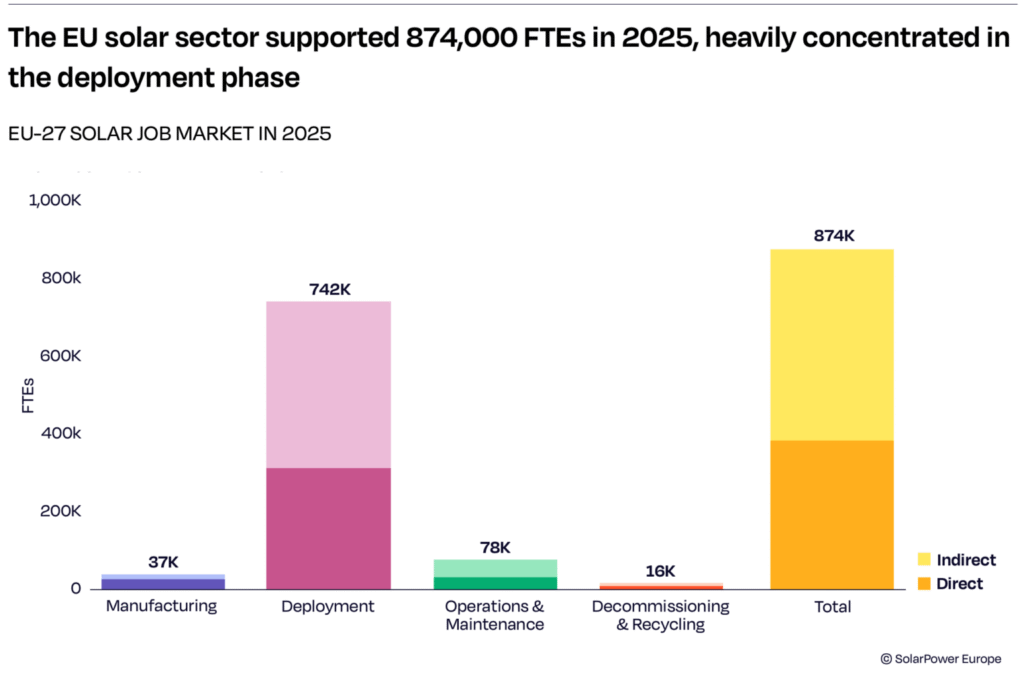
The projected decline in employment will come despite continued growth in the EU solar fleet. SolarPower Europe expects installed capacity to rise from 411 GW in 2025 to 739 GW in 2030. As a result, operations and maintenance employment is projected to increase from 78,000 to 109,000 FTEs.
Manufacturing employment could also increase, reaching 49,000 jobs if announced industrial projects are realized. Jobs in decommissioning and recycling are projected to nearly double, from 16,000 to 30,000 FTEs.
Deployment’s share of solar employment is therefore expected to fall from 85% in 2025 to 76% in 2030. Manufacturing, operations and maintenance, and decommissioning and recycling would collectively account for nearly one-quarter of solar jobs.
The report identifies several priorities for 2026, including maintaining solar skills within industrial and labor policies, improving SME access to training funding, updating training programs to include digital and technical skills, and implementing the training and installation requirements of the revised Renewable Energy Directive (RED III).
SolarPower Europe also calls for greater coordination between European training programs and for skills development spanning solar, storage, grids, heat pumps and e-mobility. It recommends expanding apprenticeships, career guidance and pathways for workers transitioning into the sector.
Source link