

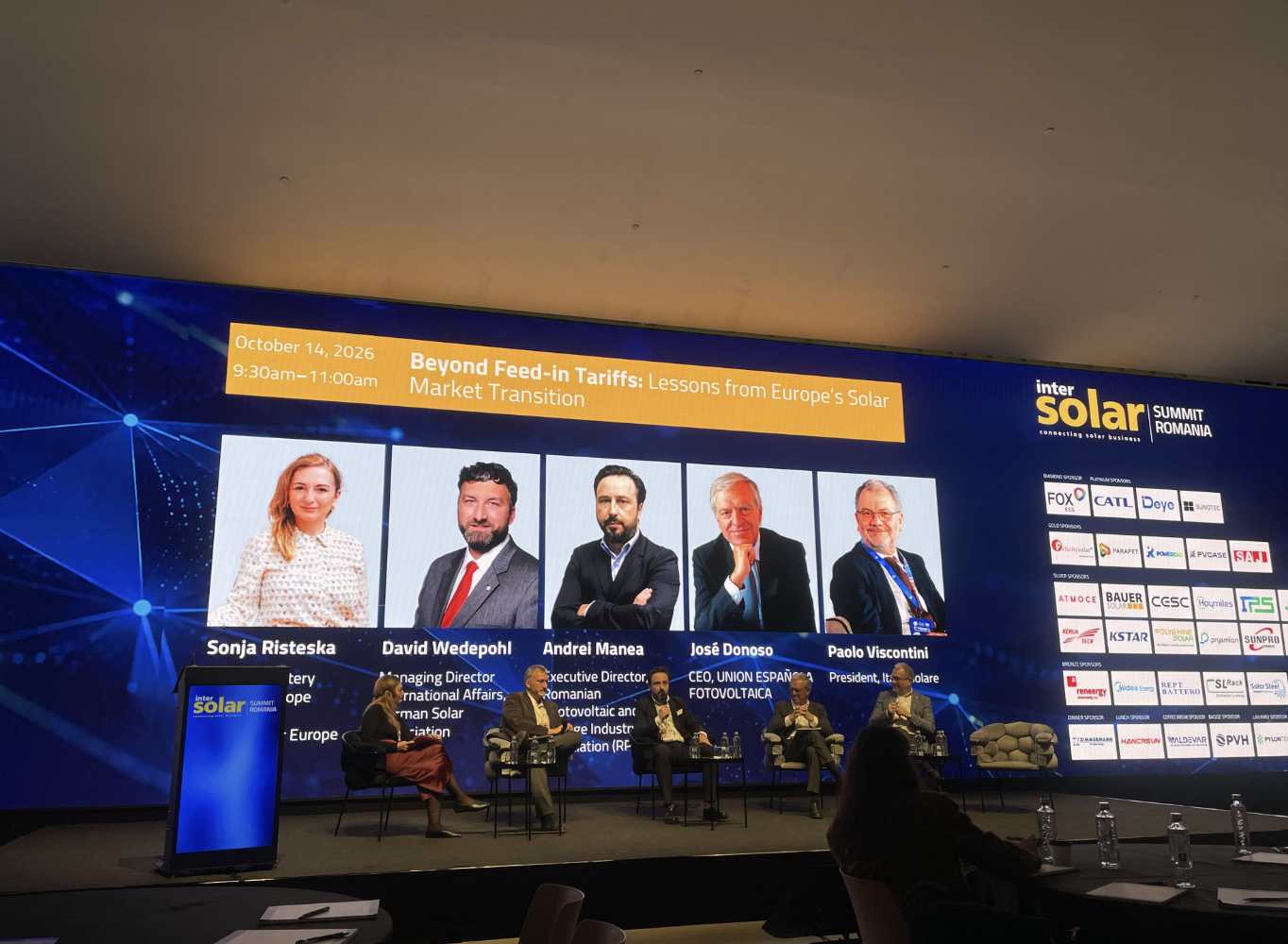
In the opening speech of the inaugural Intersolar Summit Romania, Florian Wessendorf, managing director of Solar Promotion International, referred to Romania as “the new renewables champion of Europe.” The country certainly has a strong claim to the title, largely thanks to its rapidly growing solar market. After installing around 2.2 GW of solar last year, Romania is set to deploy even more this year. Cumulative solar capacity exceeded 8.5 GW by mid-2026 and if current pace holds, the country is likely to reach its 2030 target of 10 GW before the end of next year. The country’s sizable project pipeline, including the largest planned project in the EU, suggests growth is set to continue.
In the opening panel of the event, Irene Mihai, policy director of the Romanian Photovoltaic Industry Association (RPIA) and Mihaela Nyerges, managing partner at Nyerges & Partners, told attendees how Romania has transformed into one of Europe’s most dynamic solar markets. They cited strong market fundamentals and a regulatory framework that includes some of, if not the, quickest permitting times for new solar projects in the European Union as key growth enablers. Mihai rounded out the first session of the event with a call for Romania’s future energy system to be “boring”, led by the predictability and stability required for players to continue investing.
As Romania’s solar market continues to grow, new challenges are entering the frame. Among them are grid access and expansion constraints. The country is currently undergoing the start of an auction-based mechanism for grid connections. The new rules are intended to curb speculative grid connection applications, but Nyerges said the process may need further refinement to give investors the certainty they need to participate. With the first round only just underway, initial results may not emerge until spring 2027.
Storage and flexibility emerged as recurring themes, reflecting the changing economics of solar projects and the emergence of negative electricity prices in Romania. Several discussions gave particular attention to flexibility solutions, including hybrid assets, co-location strategies and evolving revenue models. Panellists advised developers of hybrid projects to think from a system perspective and to look at where storage creates the greatest value. RPIA executive director Andrei Manea explained Romania is working to hybridize its existing assets. Manea said Romania had faced challenges this year, such as high electricity costs and drought, which left water levels on the Danube exceptionally low and disrupted power generation. He argued that higher electricity production and greater system flexibility will improve the outlook in the medium- to long-term.
Romania’s storage market is also picking up pace, having surpassed 1 GW of utility-scale battery storage capacity earlier this year, while solar prosumers are leading the growth of the smaller-scale storage market. If Romania wants to learn from a leading storage market, it needs to look no further than its southern border to find one of Europe’s leaders, in Bulgaria, where storage capacity reached 5.7 GW last month. Mariyana Yaneva, chief operating officer of IPS, explained this rapid storage buildout has contributed to Bulgaria registering no negative price hours since June, an impressive feat when considering Bulgaria is another of Europe’s gigawatt-sized solar markets.
The second day of the summit also explored innovations in solar power plant design and operation, the growing impact of artificial intelligence, data centres and energy resilience in Eastern Europe. Few countries know the importance of energy resilience as much as Romania’s northern neighbour, Ukraine. Chairman of the Board of the Solar Energy Association of Ukraine, Vladyslav Sokolovskyi, shared with attendees the latest on Ukraine’s work to rebuild its energy system amid ongoing attacks from Russia, which centres around a focus on deploying small-scale, distributed solar-plus-storage systems. This closing discussion also covered grid-forming storage, power grids, cross-border interconnectivity and cybersecurity, underscoring the importance of resilient and secure energy systems across Romania and the wider region.
Source link