

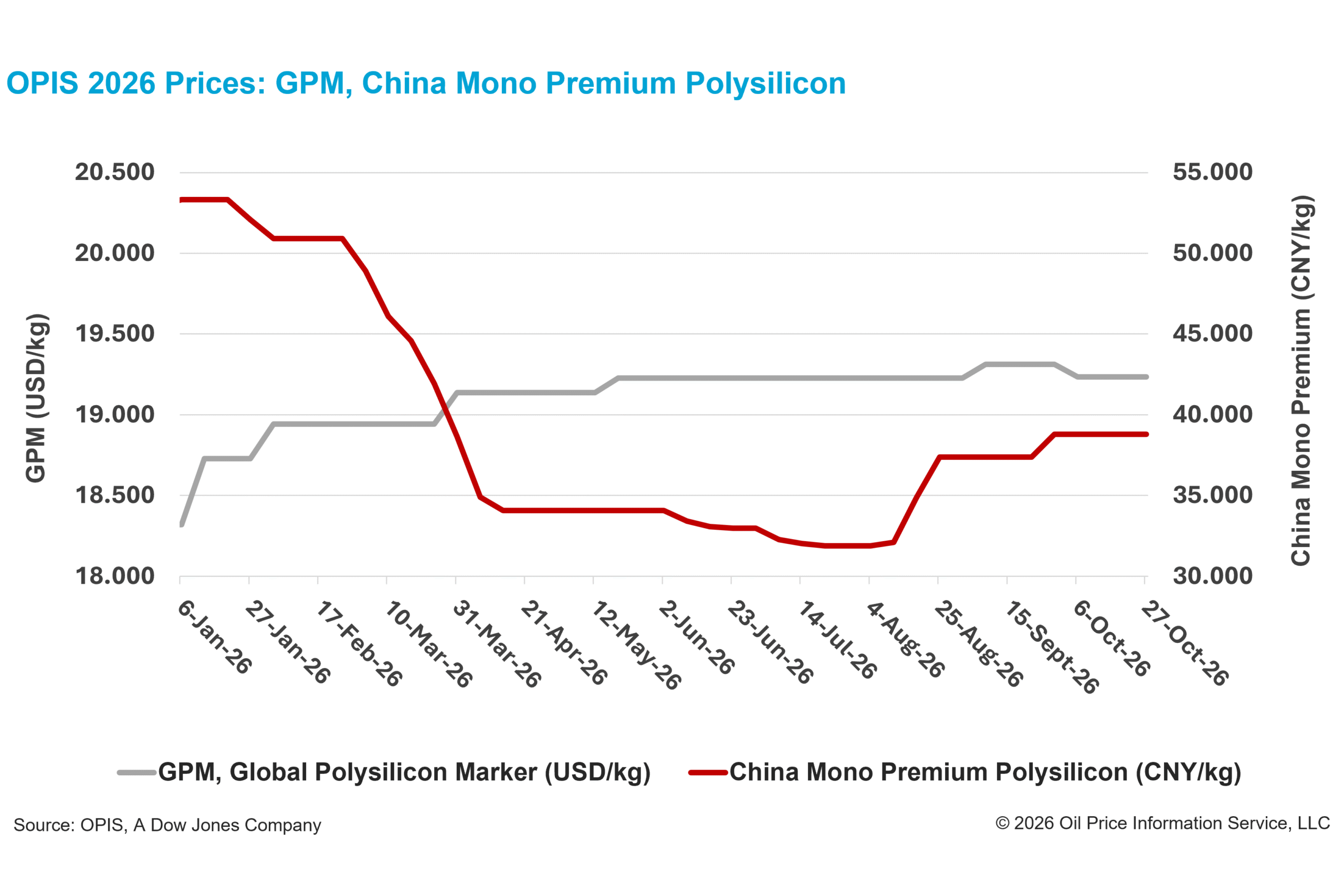
The China Mono Premium, the OPIS assessment for mono-grade polysilicon used in n-type ingot production, was unchanged at CNY 38.786 ($5.82)/kg, or CNY 0.081/W, according to the OPIS Global Solar Markets Report released on Oct. 27.
According to market participants, the fundamentals of the Chinese polysilicon market remain unchanged, with the market continuing to be characterized by manufacturers holding firm to full-cost-based offers while downstream buyers show limited willingness to accept current prices. This has kept prices largely at a standstill, with inventory levels exceeding 500,000 metric tons (MT) further prolonging the impasse.
Industry participants widely noted that futures prices, which remain significantly below mainstream spot prices, have provided a degree of balance to the ongoing standoff between upstream suppliers and downstream buyers. According to data from the Guangzhou Futures Exchange on Oct. 26, settlement prices for polysilicon futures contracts for delivery between November 2026 and October 2027 ranged from a low of CNY 33.620/kg to a high of CNY 37.180/kg, with even the highest about 4.14% below the latest spot assessment.
Market participants explained that actual spot transactions continue to be concluded at higher prices than futures contracts, partly because customers with long-term purchase agreements still need to procure some material in the spot market. To offset the higher procurement costs, these buyers also source relatively lower-priced polysilicon from futures traders, helping to balance their overall purchasing costs.
One trade participant said that futures traders had been gradually selling off previously accumulated stocks of low-priced polysilicon into the spot market. However, the availability of this lower-priced material is expected to diminish over time. The participant added that manufacturers adhering to the industry self-discipline agreement appear determined not to sell polysilicon at prices below CNY 40/kg during the fourth quarter. As low-priced supplies dwindle and manufacturers maintain their price stance, futures prices are expected to gradually rise, allowing actual spot transaction prices to find a new balance between futures prices and prevailing spot offers.
Separately, an industry source said the China Photovoltaic Industry Association would organize monitoring activities to oversee the implementation of polysilicon production cuts planned for the fourth quarter, adding that this gives the market a degree of confidence and expectation that prices will remain stable. However, no official confirmation or disclosure regarding these activities was available at the time of reporting.
Looking ahead, an upstream participant expected mainstream polysilicon offers to remain unchanged until the Lunar New Year in early February 2027. Meanwhile, prices offered by manufacturers that have not signed the pricing self-discipline agreement, along with polysilicon futures prices, are expected to remain below mainstream spot offers.
The Global Polysilicon Marker (GPM), the benchmark for polysilicon produced outside China, was assessed at $19.234/kg, or $0.040/W, unchanged from the previous week.
Both manufacturers and buyers in the global polysilicon market continued to face mounting pressure. One trade participant noted that some suppliers had reduced their China-based polysilicon sales teams to just a handful of people, underscoring the increasingly weak demand environment.
On the demand side, a source at an integrated manufacturer said that certain long-term contract holders with cell manufacturing facilities in the U.S. could still absorb around 300 MT of global polysilicon per month. While this volume provides some support for demand, the contribution remains relatively small and limited in scope.
Certain long-term contract holders, despite being in poor financial condition, reportedly continue to purchase global polysilicon at a loss due to their contractual obligations. However, the pricing mechanisms embedded in long-term contracts negotiated several years ago have given buyers some room to negotiate, potentially allowing these agreements to remain in effect despite challenging market conditions.
In the near term, industry participants generally expect the main sources of global polysilicon supply to remain U.S.-produced material and lower-priced polysilicon from other origins. In addition, the framework established under the Section 232 outcome has enabled limited volumes of compliant Chinese polysilicon to continue flowing into Southeast Asia.
OPIS, a Dow Jones company, provides energy prices, news, data, and analysis on gasoline, diesel, jet fuel, LPG/NGL, coal, metals, and chemicals, as well as renewable fuels and environmental commodities. It acquired pricing data assets from Singapore Solar Exchange in 2022 and now publishes the OPIS APAC Solar Weekly Report.
Source link