

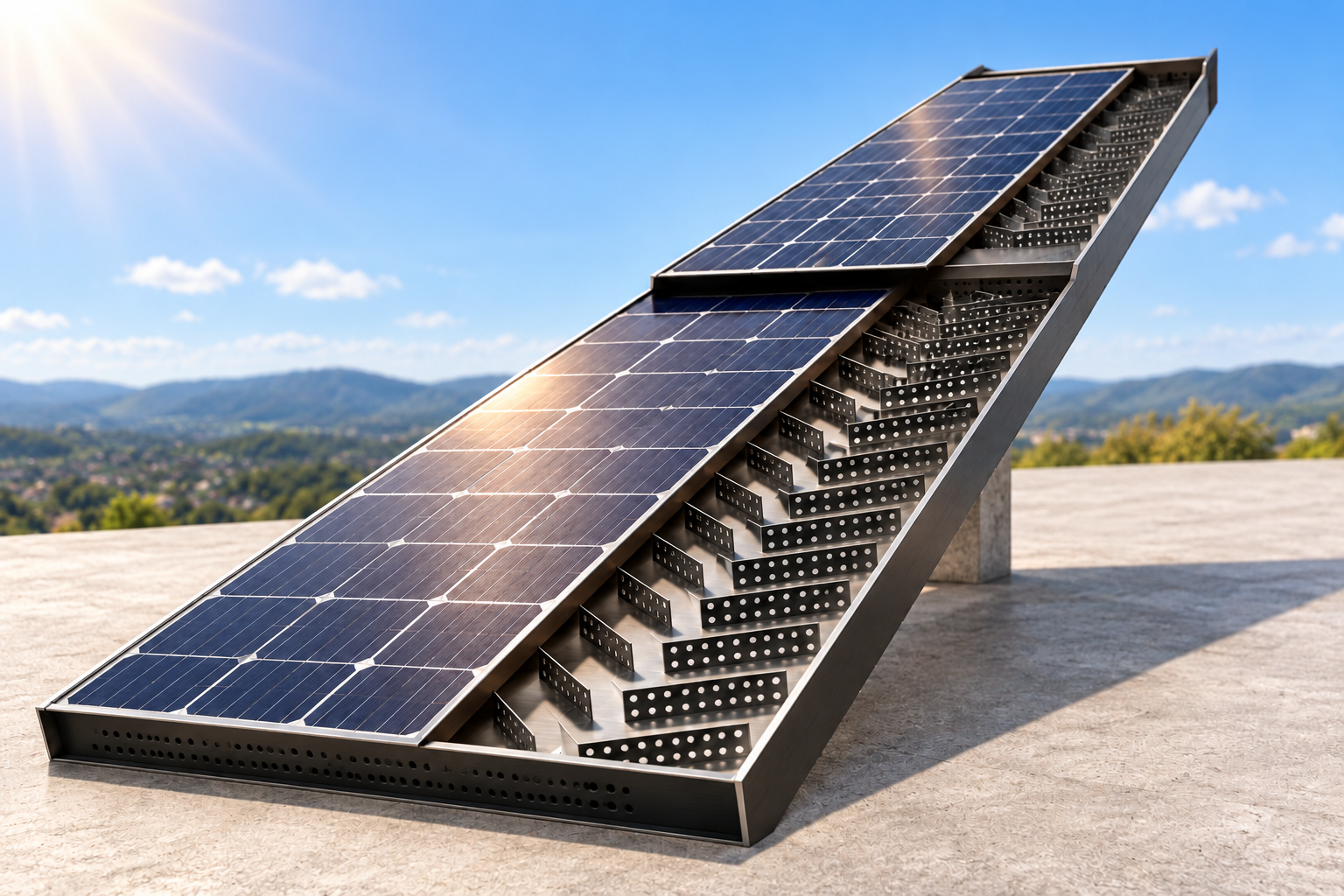
Researchers from Saudi Arabia and Algeria proposed a novel passive cooling system for PV–thermal (PVT) systems that combines a stepped air channel with perforated fins behind a solar panel. The staircase-shaped air channel is intended to disrupt the insulating air layer that develops along a heated surface. In contrast, the perforated V-shaped fins are intended to increase the heat-transfer area and promote air mixing.
“The system operates entirely under passive, naturally ventilated conditions, with airflow driven by buoyancy forces without auxiliary fans, pumps, or any external energy input for air circulation,” the academics said. “This passive design eliminates parasitic energy consumption and ensures maintenance-free operation, making it particularly suitable for deployment in arid, high-irradiance regions.”
The researchers used ANSYS Fluent to simulate a staircase-configured PVT air collector measuring 2.4 m × 0.54 m and tilted at 32 degrees. It featured a stepped air channel behind the PV module, two air inlets, one outlet, and staggered V-shaped aluminum fins with 5 mm-diameter perforations. Each fin measured 0.17 m long, 0.02 m high, and 0.0045 m thick. A CFD model simulated airflow and heat transfer.
The team applied solar irradiance and ambient temperature data for a clear summer day in Ghardaïa, Algeria, with irradiance peaking at 995 W/m² and temperatures ranging from 306 K to 318 K. After testing five computational meshes, it selected one with approximately 5.51 million elements. The researchers calculated thermal output from the airflow rate and inlet–outlet temperature difference and estimated electrical output using a temperature-dependent PV model. They compared the design with a reference PVT system.
“The system had a maximum thermal efficiency of 31% (vs. 29.4% for the reference) and electrical efficiency of 14.8% (vs. 14.6%), with peak outputs of 400 W thermal and 180 W electrical, driven by enhanced heat dissipation and turbulence,” the results showed. “It achieved a 9 K reduction in PV surface temperature through passive, naturally ventilated cooling.”
The findings show a 5.8-year payback period under clear-sky conditions and 7.2 years under cloudy conditions. It mitigates 3.2 tons of CO2 per 10-panel system annually, totaling 80 tons over 25 years, with an energy payback time of 0.86 years.
The article “A computational investigation of a staircase-configured PVT air system with perforated V-shaped fins for passive cooling” was presented in Ain Shams Engineering Journal. Researchers from Saudi Arabia’s Islamic University of Madinah, Algeria’s El Oued University, and the Renewable Energy Development Center have contributed to the study.
Source link