

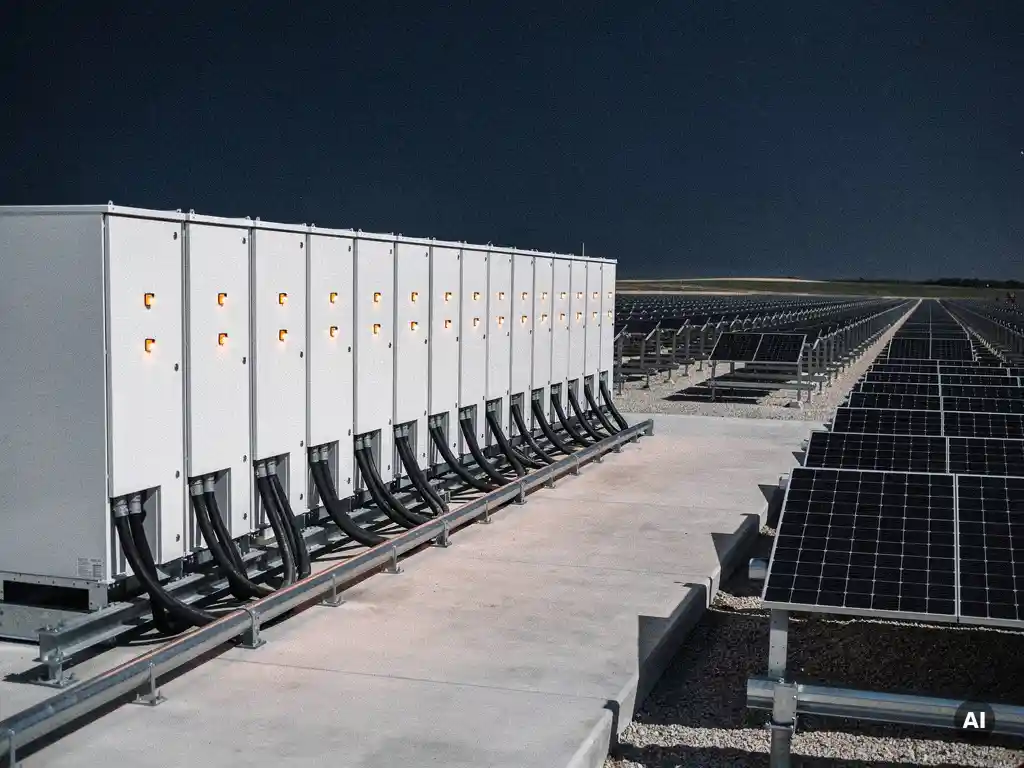
A battery energy storage system (BESS) stores electrical energy in chemical form and releases it on demand. It works by charging during periods of surplus power, such as peak solar generation, and discharging that stored energy when generation drops or demand rises. BESS technology is central to modern solar projects, enabling grid stability, self-consumption optimization, and energy independence. The sections below break down exactly how a BESS works, from its core components to sizing considerations for PV integration.
What components make up a battery energy storage system?
A battery energy storage system is made up of several interconnected components: battery cells grouped into modules and racks, a battery management system (BMS), a power conversion system (PCS), a thermal management system, and a supervisory energy management system (EMS). Each component plays a distinct role in making the BESS safe, efficient, and responsive.
The battery cells are the core of the system. Individual cells are grouped into modules, and modules are stacked into racks or cabinets that form the total storage capacity. The chemistry of those cells, lithium iron phosphate, NMC, or others, determines the energy density, cycle life, and safety profile of the entire system.
The battery management system (BMS) is the intelligence layer sitting directly on the battery hardware. It monitors cell voltage, temperature, and state of charge in real time, protecting the cells from overcharging, deep discharge, and thermal runaway. Without a well-designed BMS, even high-quality cells degrade rapidly or become unsafe.
The power conversion system (PCS) handles the conversion between DC power stored in the batteries and AC power used by the grid or loads. In most utility-scale and commercial BESS installations, the PCS is a bidirectional inverter that can both charge the battery from AC sources and discharge back to AC.
The energy management system (EMS) sits above all of this, coordinating charge and discharge cycles based on grid signals, tariff schedules, solar generation forecasts, and load profiles. It is the decision-making layer that determines when the BESS charges, when it discharges, and at what rate.
Finally, the thermal management system, typically active liquid cooling or HVAC-based air cooling, keeps battery cells within their optimal operating temperature range, directly affecting both performance and long-term degradation rates.
How does a BESS charge and discharge energy?
A BESS charges by converting incoming electrical energy into chemical energy stored within the battery cells, and discharges by reversing that process, converting stored chemical energy back into electrical energy. The bidirectional power conversion system manages both directions, responding to commands from the EMS based on grid conditions, generation output, or operator settings.
During charging, the PCS draws power from an available source, a solar array, the grid, or both, and delivers DC current to the battery cells at a controlled rate. The BMS governs this process, ensuring no cell is pushed beyond its safe voltage or temperature threshold. Charging speed is expressed as a C-rate: a 1C rate charges the full capacity in one hour, while a 0.5C rate takes two hours.
During discharging, the process reverses. The battery releases stored DC energy, the PCS converts it to AC, and that power flows to the load or the grid. The BMS again monitors cell behavior throughout, preventing deep discharge that would permanently damage cell chemistry.
The state of charge (SoC) is the key operational parameter, analogous to a fuel gauge. Most BESS systems operate within a defined SoC window, typically between 10% and 90%, to protect long-term cycle life. Operating at the extremes of SoC accelerates degradation, so the EMS is programmed to keep the system within safe bounds while still delivering the required energy.
Round-trip efficiency, the ratio of energy out to energy in, is a critical performance metric. Modern lithium-based BESS systems typically achieve round-trip efficiencies in the range of 85% to 95%, meaning some energy is lost as heat during each charge-discharge cycle. This loss must be factored into any energy yield calculation for a solar-plus-storage project.
How does a BESS connect to a solar PV system?
A BESS connects to a solar PV system either on the DC side before the inverter or on the AC side after it. The connection point determines the system architecture, the equipment required, and how efficiently solar energy flows into storage. Both approaches are widely used, and the right choice depends on project scale, existing infrastructure, and design priorities.
In a DC-coupled configuration, the battery is connected directly to the solar array’s DC output, typically through a charge controller or a hybrid inverter that manages both the PV input and the battery simultaneously. Energy generated by the panels flows directly into the battery without first being converted to AC, which reduces conversion losses.
In an AC-coupled configuration, the solar inverter converts PV output to AC first, and a separate bidirectional inverter then converts that AC power back to DC for storage. This adds a conversion step but offers greater flexibility, particularly when retrofitting storage onto an existing solar installation.
Regardless of coupling type, the EMS coordinates the interaction between the PV system and the BESS. It monitors solar generation in real time and decides whether surplus power should charge the battery, be exported to the grid, or both. This coordination is what enables strategies like peak shaving, self-consumption maximization, and grid services.
What is the difference between AC-coupled and DC-coupled BESS?
The key difference between AC-coupled and DC-coupled BESS is where the battery connects in the energy flow. In a DC-coupled system, the battery connects before the main inverter on the DC side, sharing the same inversion stage as the solar array. In an AC-coupled system, the battery connects after the inverter on the AC side, using its own dedicated bidirectional inverter. Each approach has distinct trade-offs in efficiency, flexibility, and cost.
DC-coupled BESS
DC coupling is generally more efficient because solar energy charges the battery without an intermediate AC conversion step. This makes it well-suited for new-build projects where the entire system, PV array, battery, and inverter, is designed together from the start. Hybrid inverters that handle both PV and battery on the DC bus are a common solution at commercial scale. The trade-off is less flexibility: the battery capacity and inverter must be closely matched, and retrofitting DC-coupled storage onto an existing system is more complex.
AC-coupled BESS
AC coupling is the preferred approach for retrofitting storage onto an existing solar installation because the original solar inverter does not need to be replaced or modified. The battery system operates independently with its own inverter, making it modular and easier to scale. The downside is slightly lower efficiency due to the additional AC-to-DC conversion when charging from solar. However, AC-coupled systems can also charge from the grid, giving them greater operational flexibility for grid services and arbitrage strategies.
For utility-scale projects being designed from scratch, DC coupling often wins on efficiency grounds. For commercial retrofits or projects requiring grid-charging capability, AC coupling is frequently the more practical choice.
What are the main battery chemistries used in BESS?
The dominant battery chemistry in utility-scale and commercial BESS today is lithium iron phosphate (LFP), valued for its safety, long cycle life, and thermal stability. Other chemistries, including nickel manganese cobalt (NMC), lead-acid, and flow batteries, are also used, each with different trade-offs in energy density, cost, cycle life, and application suitability.
- Lithium Iron Phosphate (LFP): The current industry standard for stationary storage. LFP offers excellent cycle life (often exceeding 4,000 cycles), strong thermal stability, and no cobalt content, which reduces supply chain risk. Its lower energy density compared to NMC is less of a concern in ground-mounted or containerized applications where space is not severely constrained.
- Nickel Manganese Cobalt (NMC): Higher energy density than LFP, making it useful where space is at a premium. However, NMC cells are more sensitive to thermal stress and have a shorter cycle life in stationary applications. NMC is more common in electric vehicle batteries than in grid-scale BESS.
- Lead-Acid: A mature, low-cost technology still used in smaller off-grid and backup power applications. Lead-acid batteries have a much shorter cycle life, lower depth of discharge, and higher maintenance requirements than lithium chemistries, making them less competitive for large-scale solar-plus-storage projects.
- Flow Batteries (Vanadium Redox): Store energy in liquid electrolyte tanks rather than solid cells. Flow batteries offer near-unlimited cycle life and the ability to independently scale power and energy capacity, but their lower energy density and higher upfront cost currently limit them to niche long-duration storage applications.
For most commercial and utility-scale solar projects in 2026, LFP is the default chemistry of choice, and for good reason. Its combination of safety, longevity, and falling costs makes it the most practical option for the majority of BESS deployments alongside PV systems.
What factors affect BESS sizing for a solar project?
BESS sizing for a solar project depends on several interrelated factors: the project’s energy objectives, the solar array’s generation profile, the load demand pattern, grid connection constraints, and the desired duration of storage. There is no universal formula, sizing is always a project-specific calculation that balances technical requirements against cost.
The first question is what the BESS is designed to do. A system optimized for self-consumption maximization needs to be sized around daily surplus solar generation and evening load demand. A system designed for peak shaving needs to be sized around the magnitude and duration of demand peaks. A system providing grid frequency response services has different power-to-energy ratio requirements entirely. Defining the use case is the prerequisite for any sizing calculation.
The solar generation profile directly shapes how much energy is available to charge the battery. A larger PV array with significant midday surplus justifies a larger BESS capacity. The DC/AC ratio of the solar system also matters, an oversized array relative to the inverter will clip energy that could otherwise be captured by a battery.
The load profile determines how much stored energy is actually needed and when. Detailed interval data, ideally at 15-minute or 30-minute resolution, is essential for accurate sizing. Without it, engineers risk either undersizing the battery (leaving demand peaks unshaved) or oversizing it (paying for capacity that never gets used).
The desired storage duration, typically expressed in hours, sets the relationship between power capacity (kW) and energy capacity (kWh). A 1 MW / 2 MWh system provides two hours of storage at full power. Longer durations require proportionally more battery capacity, which drives cost.
Finally, degradation and warranty terms must be factored in. Battery capacity declines over time, so a system must be sized to meet its performance requirements not just at commissioning but at the end of its warranted life, often 10 to 15 years out. Oversizing at the outset to account for degradation is standard practice in professional BESS design.
If you are working on a solar project that involves BESS integration and want to explore how design software can support your engineering workflow, get in touch with our team to discuss your project requirements.
Frequently Asked Questions
How do I know if my solar project actually needs a BESS, or is it overkill for smaller installations?
A BESS makes the most sense when there is a clear economic or operational driver: significant solar curtailment, high demand charges, time-of-use tariffs with large peak/off-peak price spreads, or a need for backup power. For smaller installations, a simple payback analysis comparing the cost of storage against the value of avoided grid imports, demand charge reductions, or export revenue will quickly reveal whether the investment is justified. If your site has a flat load profile and a favorable net metering policy, storage may add limited value at this stage.
What are the most common mistakes made when sizing a BESS for a solar-plus-storage project?
The most frequent mistakes are sizing the battery based on peak solar output alone without accounting for the actual load profile, and failing to factor in end-of-life degradation. Both errors lead to a system that either underperforms within a few years or never fully utilizes its installed capacity. Another common oversight is ignoring the DC/AC ratio of the PV array — if the inverter is already clipping significant energy, a battery can recover that otherwise wasted generation, which changes the sizing calculation considerably.
How long does a typical BESS last, and what happens to battery capacity over time?
Most commercial and utility-scale LFP-based BESS systems are warranted for 10 to 15 years, with capacity guarantees typically set at 70–80% of original nameplate capacity at end of warranty. Degradation is driven by the number of charge-discharge cycles, operating temperature, and how aggressively the system is used relative to its SoC limits. This is why professional BESS designs always oversize initial capacity to ensure the system still meets its performance targets at year 10 or 15, not just at commissioning.
Can a BESS operate during a grid outage to power critical loads?
Yes, but only if the system is specifically designed and configured for islanding or backup power operation — this capability is not automatic in all BESS installations. Grid-tied systems without islanding functionality will shut down during an outage for safety reasons, just like a standard solar inverter. If backup power is a project requirement, the system must include an islanding-capable inverter, appropriate transfer switching equipment, and an EMS configured to manage the battery and any connected solar generation independently from the grid.
What safety risks are associated with BESS installations, and how are they managed?
The primary safety concern with lithium-based BESS is thermal runaway — a self-sustaining exothermic reaction within a cell that can propagate to adjacent cells and, in severe cases, lead to fire. This risk is managed through multiple layers: robust BMS monitoring that detects early warning signs such as voltage deviation and temperature rise, active thermal management systems that keep cells within safe operating ranges, and fire suppression systems integrated into the battery enclosure. LFP chemistry is significantly more thermally stable than NMC, which is one of the key reasons it has become the dominant choice for stationary storage applications.
What grid services can a BESS provide, and how does that affect the business case?
A BESS can provide a range of grid services including frequency regulation, voltage support, spinning reserve, and demand response, depending on the market rules and grid operator requirements in your region. Stacking multiple revenue streams — for example, combining self-consumption optimization with frequency regulation participation — is often what makes the business case for a BESS financially compelling. However, each additional use case adds complexity to the EMS configuration and may impose additional cycling on the battery, so the impact on degradation must be modeled carefully before committing to a multi-service strategy.
What software tools or data inputs do engineers typically need to properly model and design a BESS for a solar project?
Accurate BESS design requires at minimum: high-resolution load interval data (15- or 30-minute intervals for at least 12 months), solar generation profiles either from measured data or simulation tools, local tariff structures including time-of-use rates and demand charges, and grid connection constraints such as export limits. Specialized solar-plus-storage design software can simulate dispatch strategies, model degradation over the project lifetime, and optimize the power-to-energy ratio for a specific use case — significantly reducing the risk of costly under- or over-sizing decisions.
Related Articles
This content was generated with the help of AI — it may contain mistakes
Source link