

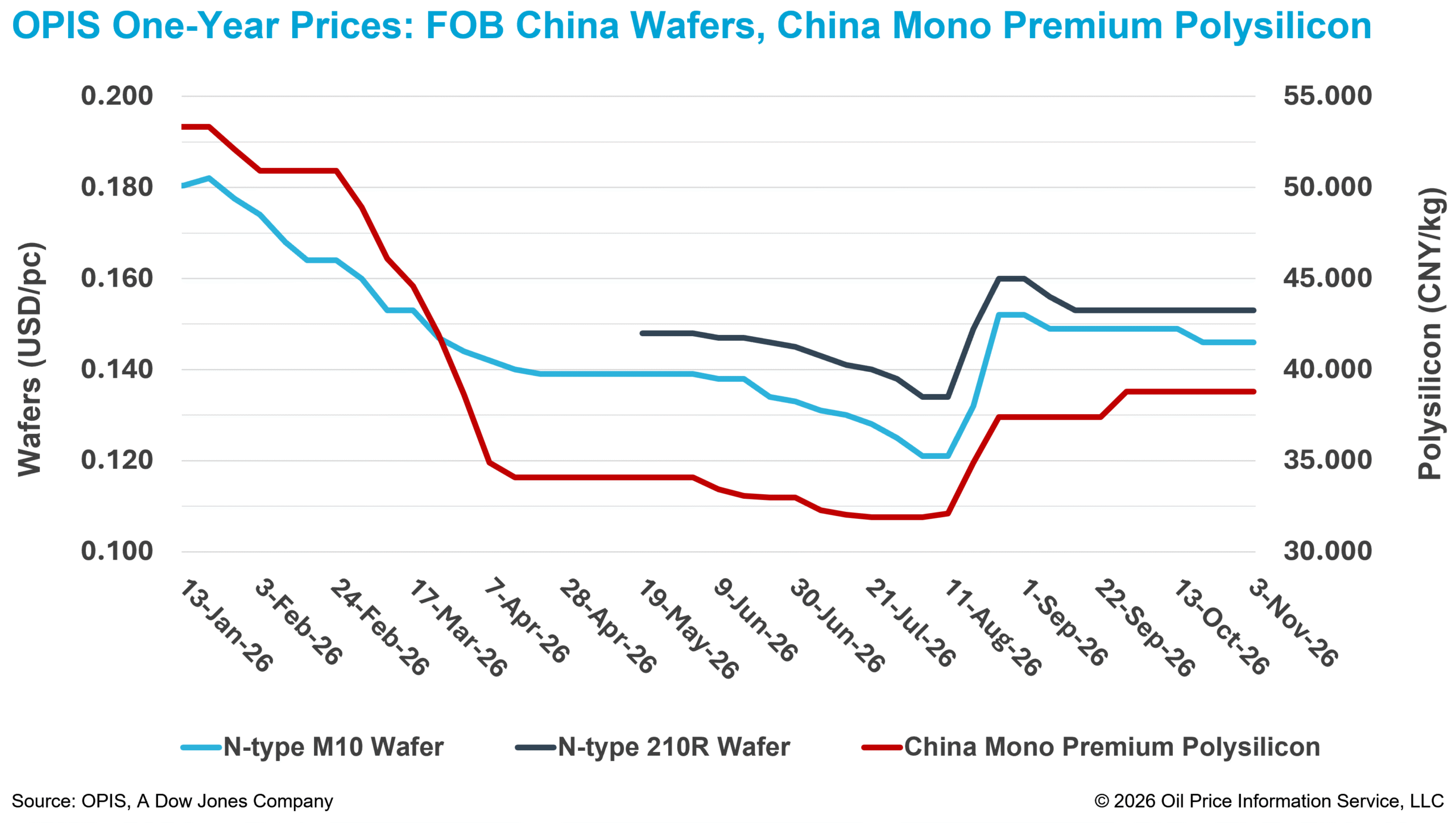
Free-On-Board (FOB) China prices for n-type M10 and 210R wafers remained stable week on week at $0.146/pc and $0.153/pc, respectively, according to the OPIS Global Solar Markets Report released on Nov. 3.
According to market participants, wafer price stability has been supported primarily by firm polysilicon prices. In addition, improving supply-demand dynamics in the solar cell segment, underpinned by overseas demand and domestic end-market installation activity, have provided further support for wafer prices.
Industry sources said that major wafer manufacturers have largely maintained the reduced operating rates implemented in October, with little change since the beginning of November. Leading wafer producers continue to operate at approximately 45%-50% capacity, while specialized manufacturers are maintaining operating rates above 60%.
However, these production adjustments have yet to translate into a meaningful improvement in overall market fundamentals, with oversupply and elevated inventory levels continuing to weigh on the wafer market. Market participants estimated that wafer inventories currently stand at the upper end of the 20-30 GW range. With these structural imbalances yet to ease, sources said the price outlook remains subdued, particularly if downstream demand weakens further.
Another industry source shared a similar assessment, describing the wafer market as fundamentally weak and noting that its pricing outlook remains highly dependent on supply-demand dynamics and price trends across both upstream and downstream segments. The source added that once polysilicon prices come under downward pressure, wafer prices are unlikely to remain insulated from the impact.
A major wafer manufacturer said that transaction volumes remain relatively modest, with customers continuing to adopt a cautious procurement approach. Buyers are closely monitoring potential downstream price declines in December, particularly amid expectations of a seasonal slowdown in demand. Nevertheless, the manufacturer said it currently has little incentive to lower prices, as further price reductions alone are unlikely to stimulate additional purchasing beyond customers’ immediate procurement needs.
Meanwhile, another trade participant noted that demand for large-format n-type G12 wafers is also expected to gradually soften as November progresses, after strong demand from China’s ground-mounted solar projects supported upward price momentum over the previous two months. The source said wafer prices may decline in stages across different sizes, with smaller-format wafers likely to come under downward pressure first, followed gradually by larger-format products.
Upstream, the China Mono Premium, the OPIS assessment for mono-grade polysilicon used in n-type ingot production, was unchanged week on week at CNY 38.786 ($5.81)/kg.
According to market sources, the underlying fundamentals of the Chinese polysilicon market remain weak. Inventory levels exceeding 500,000 metric tons, monthly production continuing to outpace demand, and sluggish downstream consumption continue to weigh on market sentiment.
Nevertheless, one encouraging development is the anticipated impact of production cuts initiated by polysilicon manufacturers in October, with the resulting reduction in supply likely to become more evident from November onwards.
Despite the anticipated improvement in supply-demand dynamics, some trade participants have observed signs of further price declines during ongoing negotiations between buyers and sellers, largely attributed to mounting financial pressure on suppliers and the approaching seasonal slowdown in end-user demand.
One trade participant said the apparent stability in polysilicon prices is somewhat misleading, as it is being maintained largely through an industry self-discipline agreement that currently carries no penalties for non-compliance. For companies facing financial difficulties, breaking ranks by resuming production or offering lower prices ahead of others may therefore appear to be the most viable way out, the participant added.
Taking a longer view, an upstream industry source said the agreement alone is insufficient to establish a sustainable price floor, cautioning that a meaningful recovery in the PV sector remains a long way off. Such a recovery will require time and progress across several fronts, including the gradual reduction of polysilicon inventories, sustained production rationalization, improved corporate profitability, technological upgrades and production-line optimization, and further consolidation through mergers and acquisitions, the source added.
OPIS, a Dow Jones company, provides energy prices, news, data, and analysis on gasoline, diesel, jet fuel, LPG/NGL, coal, metals, and chemicals, as well as renewable fuels and environmental commodities. It acquired pricing data assets from Singapore Solar Exchange in 2022 and now publishes the OPIS APAC Solar Weekly Report.
Source link