

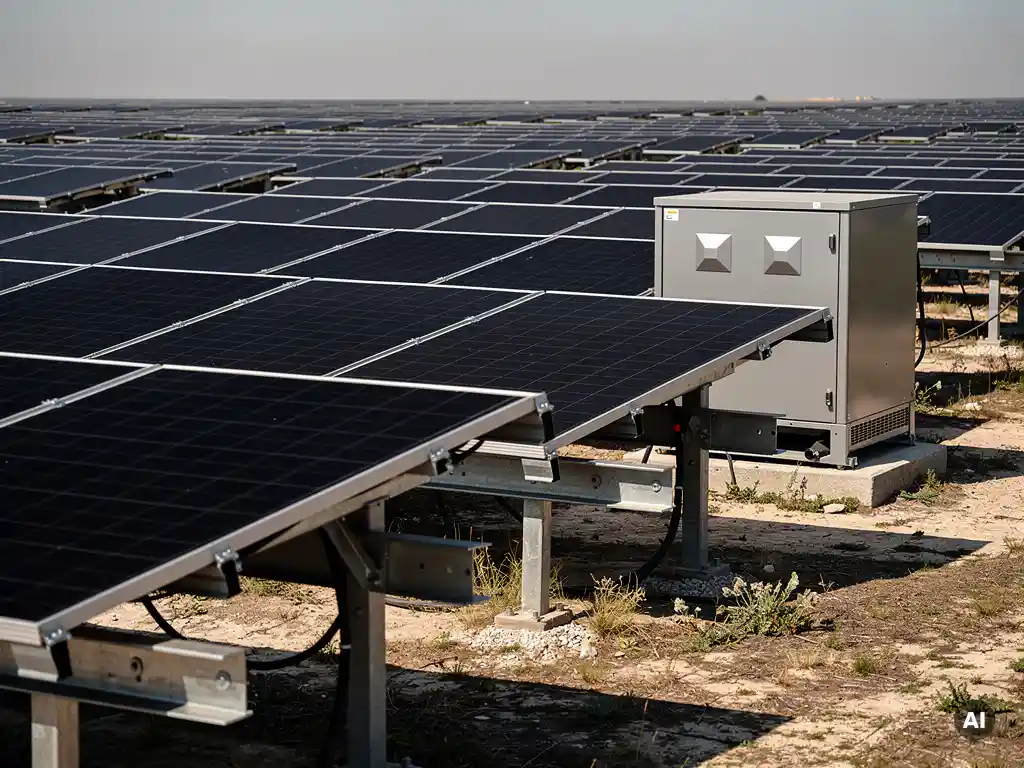
A Battery Energy Storage System (BESS) and a solar battery storage system are not the same thing, though they are closely related. A solar battery storage system is a specific type of energy storage designed to capture and store electricity generated by solar panels. A BESS is a broader category of energy storage technology that can work with solar, wind, the grid, or any other power source. In short, all solar battery storage is a form of BESS, but not all BESS systems are tied to solar. The sections below break down the key differences, components, and use cases so you can make sense of both terms with confidence.
What does BESS stand for in the solar industry?
BESS stands for Battery Energy Storage System. In the solar industry, a BESS refers to an integrated system that stores electrical energy in batteries so it can be discharged later when generation is low or demand is high. It combines battery cells, a battery management system, power conversion equipment, and control software into a single coordinated unit.
The term BESS became widely adopted as solar and wind installations scaled up and grid operators needed a standardized way to describe large-scale storage assets. Unlike a simple battery pack, a BESS is engineered to interact with the grid, respond to control signals, and manage charge and discharge cycles automatically. In utility-scale solar projects, a BESS is typically co-located with a photovoltaic array and sized to store several hours of the plant’s output.
The term is used consistently across engineering documentation, grid codes, and procurement contracts, which is why solar professionals encounter it so frequently. When a project specification refers to a BESS, it signals a complete, grid-ready storage solution rather than a standalone battery product.
How does a BESS differ from a solar battery storage system?
The key difference is scope and source independence. A solar battery storage system is purpose-built to store energy from solar panels and is typically sized and configured around a specific PV array. A BESS is a more general term for any battery-based storage system that can accept energy from multiple sources, including solar, wind, diesel generators, or the utility grid itself.
In practical terms, a residential solar battery like a home energy storage unit is often marketed as a solar battery storage system because it is sold as part of a solar package and charged primarily from rooftop panels. A BESS, by contrast, is more commonly associated with commercial, industrial, and utility-scale projects where the storage asset must interact with multiple energy inputs and respond to grid signals such as frequency regulation or peak-shaving commands.
Another meaningful difference is control sophistication. A solar battery storage system typically follows a straightforward charge-from-solar, discharge-at-night logic. A BESS includes advanced energy management software that can optimize dispatch based on electricity prices, grid conditions, contractual obligations, and forecast data. This makes BESS the preferred term in engineering and procurement contexts where the storage system must perform multiple functions simultaneously.
Can a BESS work without solar panels?
Yes, a BESS can operate completely independently of solar panels. Because a BESS can charge from any available power source, it can be connected directly to the utility grid, a wind farm, a gas generator, or any combination of these. Solar panels are not a requirement for a BESS to function.
Standalone BESS installations are common in grid-scale applications where the primary purpose is frequency regulation, voltage support, or peak demand reduction rather than solar self-consumption. Grid operators and utilities deploy large BESS assets specifically to stabilize the network, and these systems may never be connected to a single solar panel.
That said, the combination of solar PV and BESS is one of the most commercially compelling configurations available today. Solar generates electricity at predictable times, and a co-located BESS captures the surplus for use during evening hours or cloudy periods. This pairing improves project economics, reduces curtailment, and allows developers to offer firm power delivery, which commands better offtake agreements. The solar-plus-storage model is now a standard design approach for commercial and utility-scale projects in 2026.
What are the main components of a BESS compared to a solar battery?
A BESS and a solar battery share some core elements, but a BESS includes significantly more engineering layers. Understanding these components helps clarify why the two terms are not interchangeable.
Core components of a BESS
- Battery modules: The electrochemical cells that store energy, most commonly lithium iron phosphate (LFP) chemistry at utility scale due to its thermal stability and cycle life.
- Battery Management System (BMS): Electronics that monitor cell voltage, temperature, and state of charge to protect the battery and maximize lifespan.
- Power Conversion System (PCS): Inverters and converters that translate DC energy stored in the batteries into AC power suitable for grid export or on-site use.
- Energy Management System (EMS): The software layer that controls charge and discharge scheduling, responds to grid signals, and optimizes dispatch based on price or operational targets.
- Thermal management system: Active or passive cooling to keep battery cells within safe operating temperature ranges.
- Protection and switchgear: Circuit breakers, fuses, and disconnects that isolate the system safely during faults or maintenance.
What a solar battery typically includes
- Battery cells and BMS: Similar to a BESS, but usually packaged as a single consumer or commercial unit.
- Integrated inverter or hybrid inverter connection: Many solar batteries are designed to connect directly to a solar inverter rather than including a standalone PCS.
- Basic charge controller logic: Simpler software that prioritizes solar charging and manages self-consumption without advanced grid interaction features.
The practical takeaway is that a solar battery is a component or subsystem, while a BESS is a complete, engineered system. When a solar project grows beyond a certain scale or requires grid services, the engineering team moves from specifying a solar battery to specifying a full BESS with all the associated control and protection infrastructure.
When should a solar project use BESS instead of standard battery storage?
A solar project should use a BESS instead of standard battery storage when the project requires grid interaction, multi-source charging, advanced dispatch control, or regulatory compliance with grid codes. For commercial and utility-scale projects, a BESS is almost always the appropriate choice. Standard solar battery storage is better suited to straightforward residential or small commercial self-consumption applications.
Specific scenarios where a BESS is the right engineering decision include:
- Utility-scale solar farms where the storage asset must provide ancillary services such as frequency response or spinning reserve to the grid operator.
- Projects with peak shaving or demand charge reduction requirements at the commercial or industrial level, where the EMS must respond dynamically to consumption patterns.
- Solar-plus-storage projects with power purchase agreements that require firm, dispatchable power delivery at contracted times regardless of solar generation.
- Hybrid renewable plants combining solar with wind or other generation sources, where the storage system must manage multiple inputs simultaneously.
- Projects in markets with time-of-use tariffs or energy arbitrage opportunities, where optimized charge and discharge scheduling drives significant revenue.
For engineering teams working on large-scale PV projects, getting the storage specification right from the start is critical. Errors in battery sizing, DC/AC ratio planning, or cable sizing between the PV array and the BESS can cascade into costly rework during construction. Tools like Virto Solar’s design software help engineering teams automate these calculations and produce construction-ready designs that account for storage integration from the outset, reducing the risk of late-stage design changes.
If you are evaluating whether your next solar project needs a full BESS or a simpler battery solution, the decision ultimately comes down to the project’s grid obligations, dispatch requirements, and scale. When in doubt, speaking with a solar engineering specialist early in the design phase will save significant time and cost downstream.
Frequently Asked Questions
What is the typical lifespan of a BESS compared to a standard solar battery?
A utility-scale BESS using lithium iron phosphate (LFP) chemistry is typically rated for 4,000–6,000 charge cycles, which translates to roughly 15–20 years of operational life under normal conditions. Standard residential solar batteries tend to have shorter warranties, often 10 years or around 3,000–4,000 cycles, partly because they are not always engineered with the same thermal management and BMS sophistication as a full BESS. Proper sizing, temperature control, and avoiding deep discharges are the most effective ways to maximize lifespan in either system.
How do I know what size BESS my solar project actually needs?
BESS sizing depends on three core variables: the amount of energy you need to store (measured in kilowatt-hours), the power output required during discharge (measured in kilowatts), and the duration you need the system to sustain that output. For utility-scale projects, sizing is also shaped by grid code requirements, contracted dispatch obligations, and the DC/AC ratio of the associated PV array. Using purpose-built solar design software that integrates storage calculations from the start — rather than adding storage as an afterthought — significantly reduces the risk of undersizing or oversizing the system.
Can an existing solar installation be retrofitted with a BESS, or does it need to be designed in from the start?
Retrofitting a BESS onto an existing solar installation is technically possible but comes with real engineering challenges, including inverter compatibility, available grid connection capacity, protection coordination, and potential cable resizing. At the residential level, many modern hybrid inverters are designed to accommodate battery additions after initial installation. At commercial and utility scale, however, retrofitting a full BESS often requires a detailed engineering review and may trigger grid interconnection amendments, which can be time-consuming and costly. Designing storage integration in from the outset is almost always more efficient and economical.
What chemistry is most commonly used in utility-scale BESS installations, and why?
Lithium iron phosphate (LFP) has become the dominant chemistry for utility-scale BESS deployments due to its strong thermal stability, long cycle life, and relatively low risk of thermal runaway compared to other lithium-ion chemistries. While nickel manganese cobalt (NMC) batteries offer higher energy density, LFP’s safety profile and durability make it the preferred choice when systems are operating continuously in demanding grid environments. As of 2026, the vast majority of new large-scale BESS procurement contracts specify LFP chemistry as the baseline.
What common mistakes should engineering teams avoid when specifying a BESS for a solar project?
The most frequent mistakes include undersizing the energy capacity relative to the project’s dispatch obligations, miscalculating the DC/AC ratio between the PV array and the BESS inverter, and neglecting to account for round-trip efficiency losses in the energy yield model. Teams also sometimes underestimate the importance of the EMS configuration — a BESS with poorly programmed dispatch logic will underperform regardless of how well the hardware is specified. Engaging storage specialists early in the design phase and using integrated design tools that model PV and storage together helps catch these issues before they become expensive construction-phase problems.
Does a BESS qualify for solar incentives or tax credits?
In many markets, a BESS co-located with a solar installation can qualify for the same incentives as the PV system itself, provided it meets specific criteria — most commonly that the battery is charged predominantly from the co-located renewable source. In the United States, for example, the Investment Tax Credit (ITC) under the Inflation Reduction Act covers standalone storage systems as of 2023, regardless of whether they are paired with solar. Incentive rules vary significantly by country and jurisdiction, so it is important to verify eligibility requirements with a tax advisor or energy finance specialist familiar with your specific market.
How does an Energy Management System (EMS) decide when to charge and discharge a BESS?
An EMS uses a combination of real-time data inputs and pre-programmed dispatch strategies to determine optimal charge and discharge timing. Inputs typically include current solar generation, grid electricity prices, on-site load demand, weather and irradiance forecasts, and any contractual dispatch obligations. Based on these inputs, the EMS can prioritize self-consumption, maximize revenue through energy arbitrage, provide frequency response services to the grid, or follow a fixed schedule — often running multiple strategies simultaneously. The sophistication of the EMS is one of the key factors that distinguishes a full BESS from a simpler solar battery system.
Related Articles
This content was generated with the help of AI — it may contain mistakes
Source link