

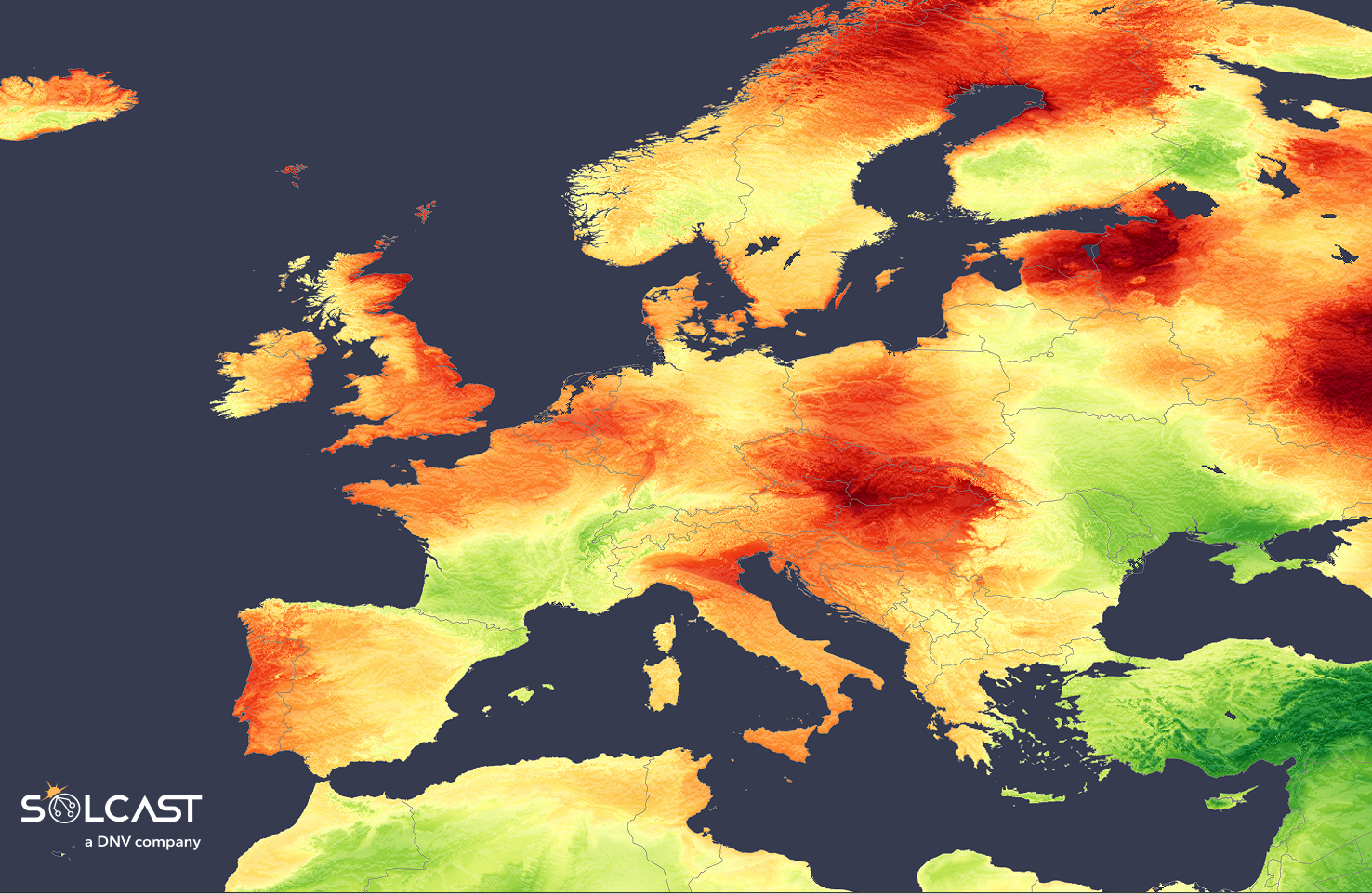
Irradiance was above average across much of Europe in October 2026, as extended periods of high pressure produced clearer skies and offset several cloudy and unsettled intervals. Conditions were particularly favourable across central Europe and the Baltic States. However, low-pressure systems reduced irradiance in southern France and around the Black Sea, while several damaging autumn storms crossed western Europe, according
to analysis using the Solcast API.

Monthly irradiance was around 10% above the October average across large parts of the continent. The strongest positive anomalies occurred in Czechia, Slovakia and Hungary, where irradiance reached as much as 25% above average. Similarly large percentage increases were recorded in the Baltic States, although shorter daylight hours at these northern latitudes limited average daily irradiance to around 1.3 kWh/m².

Recurring high-pressure systems suppressed cloud formation and produced more settled, sunnier conditions across much of Europe. This pattern was consistent with a positive phase of the North Atlantic Oscillation during September and October, which strengthens the Azores high over the Atlantic, with increased high pressure ridging across Western Europe.
Not all regions fared so well. Irradiance across the southern half of France finished around 5% below average. Ukraine and Moldova were as much as 10% below average. Repeated low-pressure systems and weather fronts brought greater cloud cover and rainfall to the Black Sea area, limiting the amount of sunlight reaching the surface.
Southern France’s irradiance deficit was the result of an accumulation of several factors. Storm Adam in mid-October produced intense rainfall and flash flooding across parts of France, Spain and Corsica. Southern France was also subject to additional “épisode cévenol” thunderstorm events occurred during the month. These are a regional phenomenon which develops when warm, moisture-laden Mediterranean air encounters colder air near the elevated terrain of southern France, generating deep cloud and heavy rainfall that can sharply reduce irradiance.

Lower GHI across southern France and surrounding areas reflects the extensive cloud associated with the storm.
Two further named storms affected western Europe during the second half of October. Storm Austin crossed southern England and France, bringing wind and rain, while Storm Boelo later struck Scotland and Northern Ireland with severe gusts of over 130 km/h. The associated cloud and rainfall disrupted otherwise favourable irradiance conditions, while the strong winds damaged electricity transmission and distribution infrastructure. Power outages affected nearly 300,000 customers in France during Storm Austin, while cuts affecting 800,000 people were reported following Storm Boelo.
The Severe Weather Index uses Numerical Weather Prediction data to represent winds associated with larger weather systems and thunderstorms, with higher values indicating more severe conditions.

Elevated values extended from the Atlantic across the United Kingdom and into the North Sea. When forecast in advance, such conditions may prompt operators to prepare for potential grid interruptions, with actions such as pre-emptive charging of batteries.
Solcast produces these figures by tracking clouds and aerosols at 1-2km resolution globally, using satellite data and proprietary AI/ML algorithms. This data is used to drive irradiance models, enabling Solcast to calculate irradiance at high resolution, with typical bias of less than 2%, and also cloud-tracking forecasts. This data is used by more than 350 companies managing over 350 GW of solar assets globally.
Source link