

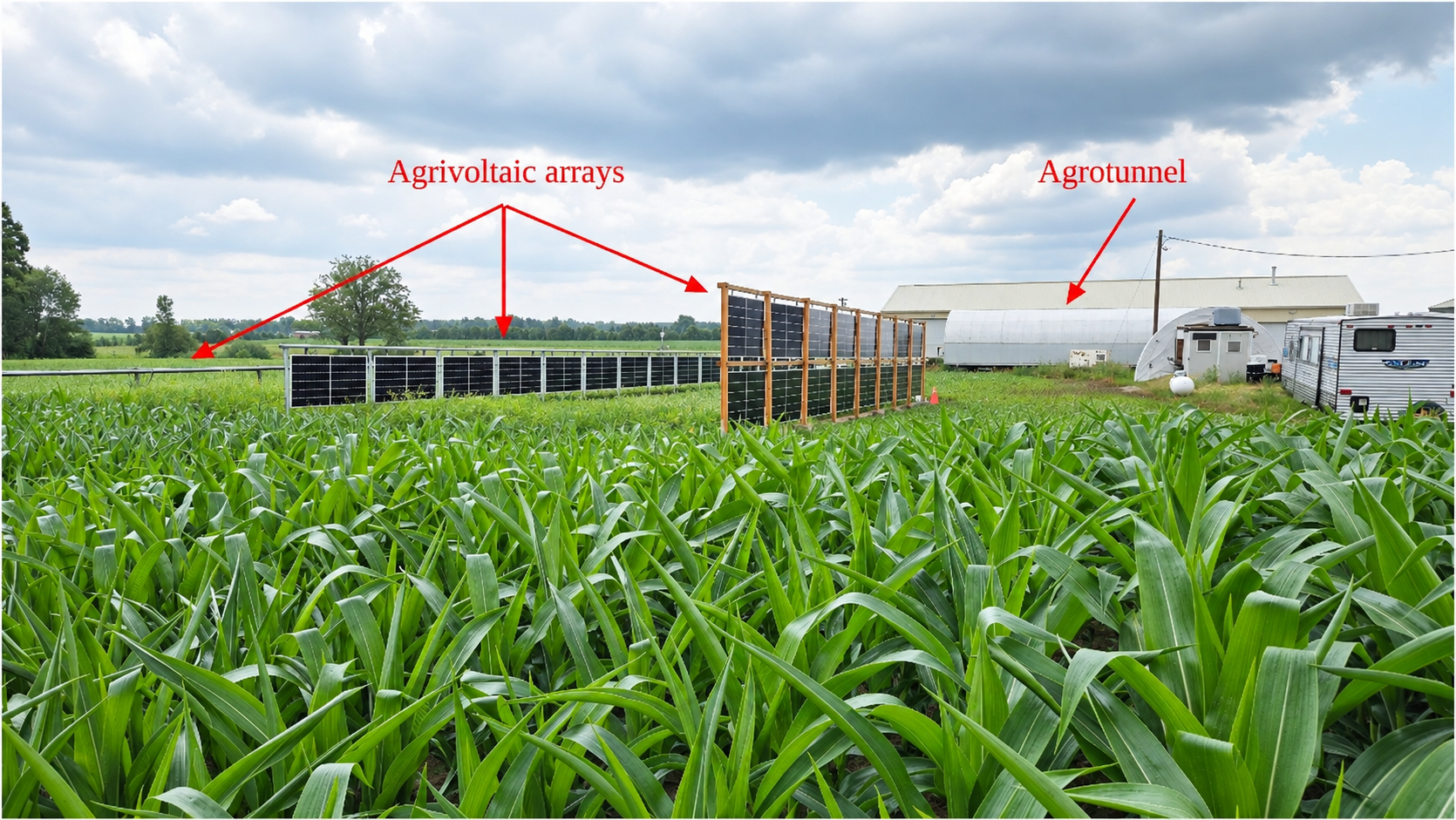
Researchers at Canada’s Western University have demonstrated that agrivoltaic installations can improve the profitability of indoor farming (IF) agrotunnels by reducing electricity costs.
These facilities are enclosed, tunnel-shaped structures that combine conventional agricultural polytunnels with indoor farming technologies. They provide controlled or semi-controlled growing environments, protecting crops from adverse weather, pests and diseases while potentially improving yields.
“We have known for a long time that there are a lot of environmental benefits of indoor farming. Sadly, many indoor farms go bankrupt because of high energy costs,” corresponding author Joshua Pearce told pv magazine. “This is where solar comes in, as it can provide known low-cost power that makes the economics of indoor farming much more attractive.”
The researchers conducted experiments in Ilderton, Ontario, focusing on Genovese basil grown at different planting densities and under different lighting conditions. They subsequently scaled the experimental findings to a commercial agrotunnel featuring 12,816 growing ports integrated into vertical cultivation walls. Their energy analysis accounted for electricity consumption by LED lighting, heat pumps, ventilation fans, dehumidifiers and irrigation pumps.
The team optimized a grid-connected, battery-free PV system to minimize electricity costs. It also assessed different lighting schedules and PV configurations using computational optimization techniques to identify the most cost-effective operating strategies.
The researchers developed a comprehensive economic model covering capital investment, operating and maintenance expenses, electricity costs and crop revenues. They evaluated the system across six North American locations – London, Montreal and Edmonton in Canada, and Boston, Santa Fe and San Francisco in the United States – to account for differences in solar resources, climate and operating costs.
The analysis assumed a 25-year system lifespan and compared cultivation strategies involving one to three basil plants per pot, with lighting periods of either 18 or 24 hours per day.
The scientists found that the most profitable configuration involved three basil plants per pot under continuous 24-hour lighting, resulting in an annual yield of 3,573 kg. Integrating grid-connected PV systems substantially reduced electricity costs and enabled near-zero net electricity consumption in most of the locations analyzed.
Total capital investments ranged from approximately $567,000 to $745,000, while annual operating expenses varied between $60,000 and $119,000. Basil production costs ranged from $12.10/kg to $22.70/kg.
The researchers calculated returns on investment of approximately 317% to 499%, with discounted payback periods ranging from 1.6 to 2.2 years. The Canadian locations generally achieved higher net present values than their US counterparts, although profitability depended on local market conditions and electricity tariffs.
The analysis also showed that electricity export compensation policies in Santa Fe and San Francisco limited the ability of PV systems to offset grid electricity costs. Nevertheless, solar generation remained more cost-effective than relying exclusively on grid electricity in those locations.
A sensitivity analysis identified basil market prices as the most influential factor affecting profitability, followed by the initial investment cost of the agrotunnel. The findings suggest that PV-powered agrotunnels could offer an economically viable approach to commercial indoor farming, particularly for high-value crops such as basil.
“Across all six locations, the basil production resulted in substantial profit margins of 517-829% and average payback periods around 2 years. Solar integration cut the levelized cost of energy and made the economics even tastier,” Pearce said. “Overall, solar-based mitigation of energy related risk substantially improves the indoor farming economics, making cleaner indoor basil highly profitable.”
The findings are presented in the study “Technoeconomic Analysis of Indoor Basil Cultivation in Agrivoltaic Agrotunnels with Optimized Near-Zero Energy Systems,” published in Cleaner Energy Systems.
Western University has previously investigated the effects of different PV technologies on agricultural productivity. In a study on lettuce cultivation under extreme heat, researchers tested 13 types of PV modules during an unusually hot Canadian summer and found that some agrivoltaic configurations increased lettuce yields by more than 400% compared with unshaded control plants. Another study on agrivoltaic turnip cultivation showed that semitransparent cadmium telluride modules and low-transparency crystalline silicon panels could improve crop growth by optimizing light distribution and reducing heat stress.
The university’s researchers have also examined the integration of PV systems into protected cultivation environments. In a study on greenhouse electrification, they found that semitransparent crystalline silicon modules could improve tomato yields while heat pumps eliminated the need for fossil fuel heating. A separate investigation of agrivoltaic cold frames showed that neutral semitransparent PV modules increased lettuce yields by 300% compared with open-air cultivation, highlighting the potential of combining solar generation with controlled-environment agriculture.
Source link