

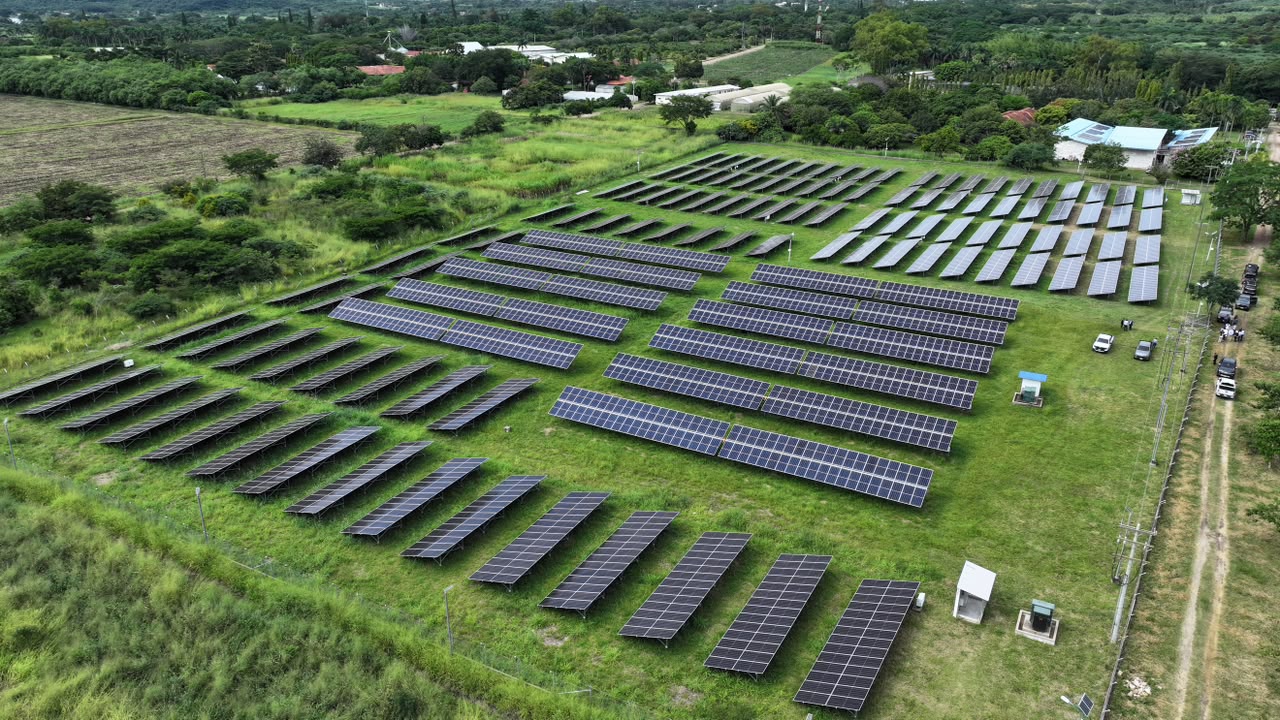
Empresa Nacional de Energía Eléctrica (ENEE), Honduras’s state-owned electric utility, said that Zamorano University is the country’s first self-generating electricity customer to receive financial compensation for surplus renewable power supplied to the grid. The university has a 1,954.84 kWp solar installation comprising 4,832 modules, with an authorized maximum AC output of 1,600 kW.
Located in the municipality of San Antonio de Oriente, in the department of Francisco Morazán, the system will use a bidirectional meter to record electricity drawn from the grid separately from surplus power exported to it. The exported electricity will be compensated through monthly bill credits, based on tariffs approved by the Electricity Regulatory Commission (CREE).
Resolution CREE-89-2026, published in the official gazette La Gaceta on Oct. 1, sets compensation rates of $111.27/MWh for customers connected to medium-voltage networks and $92.50/MWh for those connected to low-voltage networks.
Honduras approved regulations that year allowing renewable self-consumption customers to receive compensation for surplus electricity exported to the grid. In 2025, the regulator expanded the rules to include commercial customers connected at medium voltage with installations larger than 1 MW, and provided for the use of energy storage systems.
Zamorano University has operated solar installations since 2015, when Enertiva completed the first phase of its solar park, with 926.4 kWp of capacity and 2,940 polycrystalline modules. In March 2021, the university inaugurated a second phase with 402 kWp of capacity, comprising 864 465 W modules installed on solar trackers.
In May 2025, the university also signed a memorandum of understanding with ENEE to develop the 14.5 MWp Energy for Education solar project, which will include lithium-ion battery storage. Revenue from electricity sales is intended to fund scholarships for Honduran students from low-income families.
From pv magazine LatAm
Source link